
You have an interview coming up, and you want to do well. You have prepared your CV, researched the company, and rehearsed your elevator pitch. Yet competency based interview questions catch even the most qualified candidates off guard, not because they lack the experience, but because no one has shown them how to talk about it effectively.
That gap between being capable and being able to demonstrate capability in the moment is where interviews are won or lost. Hiring managers are not just assessing what you have done; they are assessing how clearly you can reflect on it, what you learned, and how you would perform in their organisation. Getting that wrong, even once, can cost you a role you were perfectly suited for.
In the UK, the majority of employers now use competency-based questions as a core part of their selection process, from graduate schemes and public sector roles to senior leadership positions. That means knowing how to answer them is not optional; it is essential.
This guide covers everything you need: expert-backed techniques, real-world examples, and the frameworks that turn good candidates into stand-out ones.
Key Takeaways for Competency Based Interview Questions
- Competency based interview questions ask you to give real-life examples of your past behaviour, not hypothetical answers.
- The STAR method (Situation, Task, Action, Result) is the most effective structure for answering these questions.
- Employers use competency interviews to assess key skills like leadership, teamwork, problem-solving, and communication.
- Prepare at least 6 to 8 STAR examples before your interview; you can adapt them to multiple competency questions.
- These interviews are common in the NHS, Civil Service, graduate schemes, finance, and large private-sector employers.
What Is a Competency Based Interview?
A competency-based interview, also known as a structured, behavioural, or situational interview, is designed to assess one or more specific skills or competencies required for a role.
Instead of focusing solely on industry knowledge or general qualifications, these interviews aim to understand how an applicant has handled particular scenarios in the past, thus predicting how they might approach future ones.
Interviewers use a set of predetermined questions, often requiring real-life examples, and evaluate answers against specific criteria to ensure objectivity and fairness in the hiring process.
For instance, competency-based interview questions and answers are commonly asked in the public sector, graduate schemes, and professional services such as finance, law, consulting, and automotive/manufacturing industries. If you are asked these questions, consider it a good sign.
How to Know an Employer Uses Competency Based Questions?
Not every interview will be flagged as competency-based, but there are clear signs to look out for:
- The job description lists specific competencies such as communication, leadership, or commercial awareness
- You are invited to an assessment centre or a structured group exercise
- The interview invite mentions a structured or panel interview format
- Questions begin with phrases like ‘Tell me about a time…’ or ‘Give me an example of…’
- If you spot any of these, prepare your STAR examples in advance.
What Are Competency Based Interview Questions?
Competency based interview questions are structured questions that ask you to demonstrate specific skills through real examples. They are different from general interview questions because they follow a consistent format and are marked against predefined criteria. It is for skill-based hiring. Common competency based questions look like this:
- Tell me about a time you worked under pressure. What did you do?
- Tell me about a time you showed leadership at work?
- Describe a situation where you had to adapt to a significant change.
- Give an example of a time you resolved a conflict at work?
- Tell me about a time you improved a process or solved a problem.
Each question targets a specific competency the employer wants to assess. Your job is to give a clear, structured example that shows you have that skill.
How to Answer Competency Based Questions: The STAR Method
The STAR method is the most widely recommended technique for answering competency based interview questions. It gives your answer a clear structure that is easy for the interviewer to follow and score. You need professional career services to implement this:
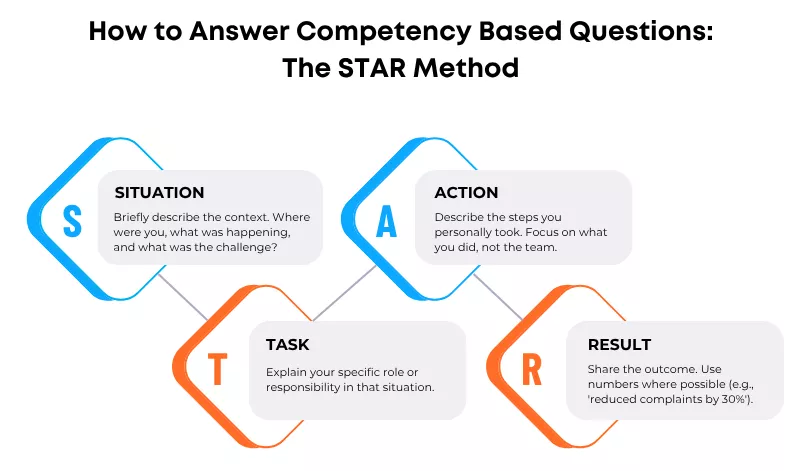
A good STAR answer takes around two to three minutes to deliver. Practice it out loud so it sounds natural rather than scripted.
Why Is the STAR Method Effective?
This method keeps your answer focused, evidence-based, and easy for the interviewer to evaluate. This is not an informal interview. It also demonstrates that you think clearly under pressure, which is itself a competency.
Competency vs Behavioural vs Situational Interviews: What Is the Difference?
When you ask how to prepare for an interview first know these differences. These three interview types are closely related, but they are not identical.
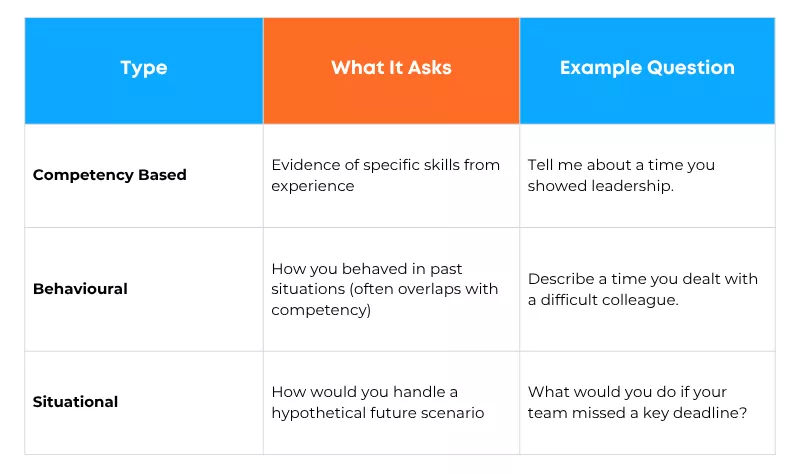
In practice, most interviews blend all three. But competency based interview questions always focus on real, past examples, not hypotheticals. You must check strength based interview questions as well for better preparation.
Most Common Competency Based Interview Questions and STAR Method Sample Answers
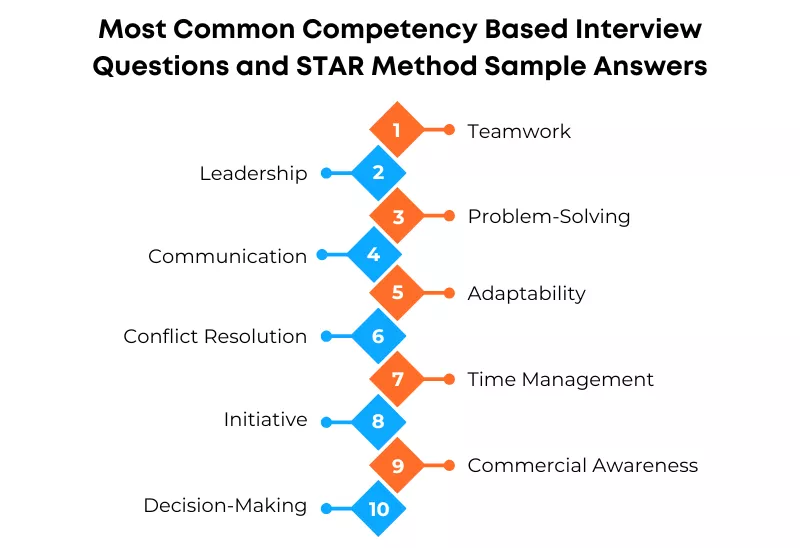
Here are the most common competency based interview questions and answers, each with a sample care assistant interview question and answer:
1. Teamwork
Question: Tell me about a time you worked effectively as part of a team.
Sample Answer: In my previous role, our team was given two weeks to deliver a client report that typically took a month. I coordinated daily check-ins, divided tasks based on each person’s strengths, and stepped in to help a colleague who was struggling with data analysis. We delivered the report two days early, and the client extended their contract.
2. Leadership
Question: Give an example of when you demonstrated leadership at work.
Sample Answer: When our team leader left unexpectedly, I volunteered to manage the project handover. I mapped out all outstanding tasks, reassigned responsibilities, and updated senior management weekly. The project was completed on schedule with no disruption to the client.
3. Problem-Solving
Question: Tell me about a time you improved a process or solved a problem?
Sample Answer: A key supplier pulled out two weeks before a major product launch. I identified three alternative suppliers within 48 hours, negotiated emergency rates, and restructured the delivery timeline. The launch went ahead without delay, and we stayed within budget.
4. Communication
Question: Describe a time you had to explain a complex idea to someone with no technical background.
Sample Answer: I had to present a data migration plan to a non-technical board of directors. I replaced technical jargon with plain-English analogies, used a simple flowchart, and focused on business impact rather than process. The board approved the plan unanimously.
5. Adaptability
Question: Give an example of a time you had to adapt to change at work?
Sample Answer: When our company moved to a new CRM system mid-project, I quickly completed the training, created a quick-reference guide for my team, and reconfigured our reporting templates. We were fully operational within a week, ahead of the company-wide deadline.
6. Conflict Resolution
Question: Can you give me an example of when you had to deal with conflict at work?
Sample Answer: Two team members disagreed on how to prioritise client requests, which was slowing down delivery. I arranged a structured conversation, listened to both perspectives, and proposed a prioritisation matrix based on client impact and effort. Both colleagues agreed, and the tension was resolved within a day.
7. Time Management
Question: Describe a situation where you had to meet a tight deadline?
Sample Answer: During an especially busy quarter, I was managing three concurrent projects with overlapping deadlines. I created a priority matrix, communicated realistic timelines to stakeholders early, and delegated lower-priority tasks. All three projects were delivered on time.
8. Initiative
Question: Tell me about a time you took initiative without being asked.
Sample Answer: I noticed our onboarding process for new clients was inconsistent and confusing. Without being asked, I drafted a standardised onboarding checklist, tested it with two new clients, and presented the results to my manager. It was adopted team-wide and reduced client queries by 40%.
9. Commercial Awareness
Question: Give an example of how you demonstrated commercial awareness in a previous role.
Sample Answer: I identified that a product line was generating high revenue but thin margins due to supplier costs. I presented a cost analysis to the procurement team, recommended renegotiating contracts, and the resulting savings improved the product margin by 12%.
10. Decision-Making
Question: Tell me about a time you had to make a difficult decision with limited information.
Sample Answer: During a product crisis, I had to decide whether to delay launch or proceed with a known minor flaw. I quickly consulted stakeholders, assessed the risk to customer experience, and decided to launch with a transparent communication plan. Customer response was positive, and the flaw was patched within two weeks.
Common Competencies Employers Look for When Hiring
Different employers prioritise different skills, but these are the competencies that come up most often in UK interviews across all sectors:
- Teamwork and collaboration
- Leadership and people management
- Problem-solving and analytical skills
- Communication, written and verbal
- Adaptability and flexibility
- Time management and prioritisation
- Initiative and self-motivation
- Commercial awareness
- Decision-making under pressure
- Conflict resolution
- Customer focus and stakeholder management
- Planning and organisation
When you prepare for competency based interview questions and answers for graduates or scenario based interview questions, match your STAR examples to the specific competencies listed in the job description. Employers will score your answers against those exact criteria.
Competency Based Interview Questions by Industry
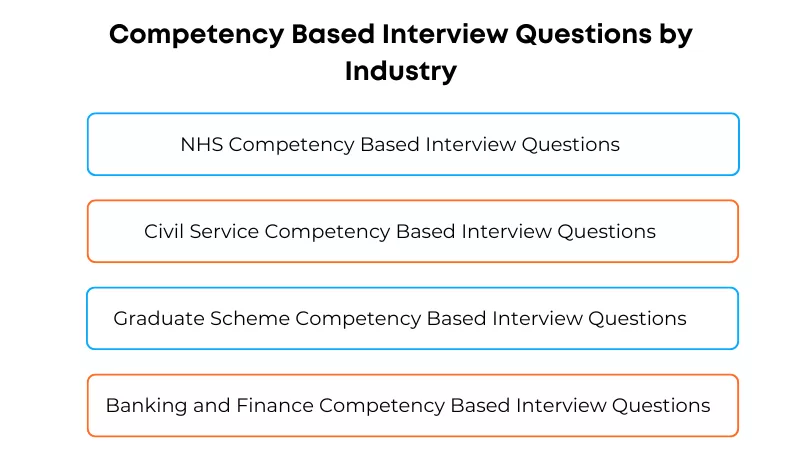
Different sectors use competency based questions in different ways. Here are examples tailored to the most common industries.
NHS Competency Based Interview Questions
The NHS values compassion, communication, and patient-centred care alongside technical skills. Common NHS competency based interview questions examples are:
Tell me about a time you provided excellent patient care under pressure.
S: Our ward was short-staffed by two nurses during a busy evening shift with four high-dependency patients needing close monitoring. T: I needed to ensure every patient received safe, timely care despite the reduced team. A: I prioritised the most critical patients myself, delegated routine observations to the healthcare assistant, and escalated the staffing issue to the senior nurse immediately. R: All patients received timely care, no incidents were recorded, and the approach was praised in the shift handover notes.
Give an example of when you had to communicate difficult news to a patient or family.
S: A patient’s test results confirmed a serious diagnosis when no senior doctor was immediately available on the ward. T: I needed to inform the family sensitively without overstepping my clinical boundaries. A: I took them to a private room, spoke calmly, acknowledged their emotions, and arranged an urgent doctor follow-up within the hour. R: The family thanked the ward for the compassionate handling, and the doctor noted they arrived at the follow-up feeling supported rather than distressed.
Describe a time you worked as part of a multidisciplinary team.
S: A patient with complex needs required a coordinated discharge involving nursing, physiotherapy, social care, and the GP within a tight timeframe. T: My role was to align all parties and ensure no element of the care plan was missed. A: I organised a joint handover, created a shared sign-off checklist, and kept the patient informed after each stage. R: The patient was discharged safely on schedule with a complete care package, which was highlighted positively in the ward review.
Civil Service Competency Based Interview Questions
The Civil Service uses a structured framework called the Success Profiles. Key behaviours assessed include making effective decisions, using CAR technique in interviews, (Context, Action, Result): briefly set the scene, describe exactly what you did, then quantify the outcome.
Tell me about a time you managed a project with competing priorities.
S: Two high-priority policy submissions were due in the same week, requested by different senior leads who were unaware of the conflict. T: I needed to deliver both to a high standard without creating tension between the stakeholders. A: I mapped the workload, negotiated a 24-hour extension on one submission with a clear rationale, and focused my deepest work time on the more complex piece first. R: Both were delivered on time, both leads gave positive feedback, and I proposed a shared forward-planning calendar to prevent similar clashes.
Give an example of when you challenged an existing process to improve outcomes.
S: My team was tracking policy correspondence manually through spreadsheets, causing an average three-day delay in response times. T: I wanted to address the inefficiency without disrupting the team’s ongoing workload during the transition. A: I mapped the bottlenecks, piloted a case management tool with two colleagues, proved its effectiveness, and then led a two-week training rollout for the wider team. R: Response times dropped to under 24 hours, and the new process was adopted department-wide within a quarter.
Describe a time you built relationships with a diverse group of stakeholders.
S: A cross-departmental project brought together five teams with different working styles and competing priorities, who had little experience collaborating with one another. T: I needed to build enough trust across all five groups to move toward a shared outcome effectively. A: I started with individual conversations to understand each team’s concerns, identified common ground, and then facilitated a joint planning session built around shared goals. R: The project was delivered on time, all five teams endorsed the final output, and two leads requested to work with me again on a follow-up initiative.
Graduate Scheme Competency Based Interview Questions
If you are applying for a graduate programme, you may not have extensive work experience, but that is fine. Employers understand this. You can use examples from university projects, part-time jobs, volunteering, or societies.
Tell me about yourself when you demonstrated leadership during your studies.
S: Two of the four members in our final year dissertation group became disengaged, putting our key milestones at risk. T: I needed to re-energise the team and get the project back on track without any formal authority. A: I called a reset meeting, restructured tasks around each person’s strengths, and introduced brief weekly check-ins to maintain momentum. R: We submitted on time and scored 71%, with the tutor specifically noting the strong sense of shared ownership in the final piece.
Give an example of when you worked on a team project with a tight deadline.
S: In a university business competition, my team of three had just 72 hours to research, analyse, and present a full strategic recommendation to industry judges. T: We needed to establish a productive dynamic quickly and deliver genuinely strong work under serious time pressure. A: We divided responsibilities by strength within the first hour, collaborated through shared documents in real time, and held a group review the evening before to stress-test our argument. R: We placed second out of fourteen teams, with judges specifically commending the clarity and structure of our recommendation.
Describe a situation where you had to learn a new skill quickly.
S: I was assigned a data analysis module requiring Python with no prior experience and a group presentation due in three weeks. T: I needed to reach a functional level fast enough to contribute meaningfully and explain the methodology during the presentation. A: I completed two focused online tutorials in the first week, applied the skills directly to our dataset, and ran a quick session with teammates who were equally unfamiliar with the tool. R: Our group scored 72%, and the marker’s feedback specifically praised the quality of the data visualisation.
Tip: Frame your examples around the competency required, not the environment. A well-structured STAR answer from a university group project can be just as strong as a workplace example.
Banking and Finance Competency Based Interview Questions
Finance employers focus on commercial awareness, analytical thinking, and integrity.
Give an example of when you identified a financial risk and what you did about it.
S: During a routine portfolio review, I noticed a client account had been consistently underperforming against its benchmark for several quarters without being formally investigated. T: I needed to identify the root cause, assess the risk, and present a clear recommendation before the situation worsened. A: I analysed 18 months of transaction data, identified over-concentration in one underperforming sector, modelled two rebalancing scenarios, and presented both to the client with a clear recommendation. R: The client approved the rebalance, the portfolio recovered to benchmark within two quarters, and they subsequently renewed their contract.
Tell me about a time you had to deliver accurate work under a tight deadline.
S: A colleague fell ill at quarter-end, leaving me to complete a detailed financial reconciliation report in one day instead of the usual three. T: The report needed to be completely accurate as it was feeding directly into a client presentation the following morning. A: I broke the reconciliation into sections, applied a dual-check approach to each one as I went, and flagged a minor data discrepancy to my manager immediately so it could be resolved without slowing progress. R: The report was completed on time, passed the senior review without corrections, and my manager acknowledged the quality of the work at my next one-to-one.
Describe a situation where you had to use data to support a business decision.
S: Our team was divided over whether to continue investing in a product line showing inconsistent performance, with no evidence to guide the decision. T: I volunteered to lead the analysis so the team could make an informed, data-led recommendation. A: I reviewed 24 months of sales, margin, and retention data, identified that the product performed strongly in two specific segments, and presented two strategic options to leadership with a clear recommendation. R: Leadership adopted the approach, refocused the product line on the stronger segments, and profitability improved by 18% within six months.
How to Prepare for a Competency Based Interview?
Preparation is the difference between a generic answer and a strong one. Here are interview preparation tips UK effectively:
- Read the job description carefully and identify the key competencies the employer is looking for
- Prepare 6 to 8 STAR examples that can be adapted across multiple competency questions
- Use real examples, volunteering, part-time work, and university projects all count if you are a graduate
- Practice your answers out loud with a friend or record yourself. This helps remove filler words
- Research the organisation’s values and align your examples to them
- Prepare a professional self-introduction that includes your key strengths and a headline example
One common mistake candidates make is preparing answers that are too vague and not hiring CV writing services too. The interviewer needs to understand exactly what you did, not what the team did, not what you tried to do, but what you actually did and what happened as a result.
Common Mistakes Candidates Make When Answering Competency Based Questions
- Being too vague- ‘We improved the process’ instead of ‘I redesigned the workflow, which reduced processing time by 25%.’
- Telling a team story instead of a personal one, always use ‘I’, not ‘we.’
- Forgetting the result- Every STAR answer needs a clear outcome
- Memorising answers word for word- They sound robotic and fall apart when probed
- Using examples that are too old or irrelevant to the role
- Rambling- Aim for two to three minutes per answer, not five
Final Thoughts
Competency based interview questions are not something you can wing. But they are absolutely something you can prepare for, and prepare for well.
The key is to go into your interview with a bank of real, specific STAR examples that show employers exactly what you bring to the table. Match those examples to the competencies in the job description, and you will stand out from most other candidates.
If you want to make an equally strong first impression on paper, our expert CV writers can help you articulate your skills and experience in a way that gets you into the interview room in the first place.
Frequently Asked Questions
What is a competency based interview?
A competency based interview is a structured interview questions where candidates are asked to give real examples of how they have demonstrated specific skills in the past. The interviewer scores each answer against predefined criteria.
How to answer competency based interview questions?
Use the STAR method: describe the Situation, the Task you were responsible for, the Action you took, and the Result. Keep your answer focused on what you personally did and what the outcome was. Aim for two to three minutes per answer.
What is the STAR method for competency based interviews?
STAR stands for Situation, Task, Action, Result. It is a structured framework that helps you give clear, evidence-based answers to competency questions. Each part of your answer should be concise and relevant to the competency being assessed.
What are the most common competency based interview questions?
The most common questions cover teamwork, leadership, problem-solving, communication, adaptability, time management, conflict resolution, initiative, commercial awareness, and decision-making. We have covered all ten in this guide with sample STAR answers.
How do you pass a competency based interview?
Prepare specific STAR method answers for competency based interviews for each key competency in the job description, practice delivering them out loud, and focus on concrete results. Avoid vague answers; the more specific and measurable your example, the better.
Should I memorise STAR method answers?
Do not memorise STAR method interview answers word for word; they sound scripted and fall apart when the interviewer probes deeper. Instead, memorise the key points of each example and practice delivering them naturally.
What is the difference between a competency based interview and a behavioural interview?
They are closely related. Competency based interviews assess specific, pre-defined skills from the job description. Behavioural interviews questions focus on past behaviour as a predictor of future performance. In practice, most UK employers use a blend of both.
How to prepare for competency based interview questions?
Identify the key competencies from the job description, prepare 6 to 8 STAR examples, research the company’s values, and practice your answers. If you are a graduate, use examples from university, volunteering, or part-time work.
Can you give an example of working under pressure in an interview?
‘Tell me about a time you worked under pressure. What did you do and what was the outcome?’ This is a classic competency question targeting resilience and time management.
What competencies do employers look for in an interview?
UK employers most commonly look for teamwork, leadership, problem-solving, communication, adaptability, commercial awareness, initiative, and decision-making. These competencies are listed in the job description; always align your examples to them.
How long should a competency based interview answer be?
Aim for two to three minutes per answer. Long enough to cover the full STAR structure with specific detail, but short enough to stay focused. If the interviewer wants more, they will ask follow-up questions.
What happens if I do not have work experience for competency based questions?
Use examples from university projects, part-time jobs, volunteering, sports teams, or student societies. Employers assessing graduates understand you may not have extensive work experience. What matters is the quality of the example and the skill you demonstrate.
Are competency based interviews used in the NHS and Civil Service?
Yes. The NHS and Civil Service are among the most frequent users of competency based interviews in the UK. The Civil Service uses its Success Profiles framework, while the NHS assesses values and behaviours alongside technical competencies.
What is the difference between competency based and strength based interviews?
Competency based interviews assess whether you can do the job by asking for examples of past behaviour. Strength based interviews assess what you enjoy doing and where you naturally excel. Some employers, particularly graduate recruiters, now blend both approaches.
How many STAR examples should I prepare for a competency based interview?
Prepare at least 6 to 8 examples covering different competencies. Choose versatile examples that can be adapted to multiple questions; for instance, a strong leadership example can also demonstrate communication, problem-solving, and decision-making.
How useful was this post?
Click on a star to rate it!
Average rating / 5. Vote count:
No votes so far! Be the first to rate this post.
We are sorry that this post was not useful for you!
Let us improve this post!
Tell us how we can improve this post?

Want To See My Profile — Click Here Jessica
- Part time Jobs in UK for Students: 15 Best Options with Pay Rates - June 4, 2026
- Competency Based Interview Questions: STAR Method Examples - May 11, 2026
- Best Font for CV in the UK: 10 Professional Fonts in 2026 - April 25, 2026

