

Analytical Skills for CV can be defined as the ability to collect, process, and evaluate information to identify patterns, solve problems, and make logical, data-driven decisions, involving critical thinking, research, and interpreting complex data to understand situations thoroughly and form reasoned conclusions.
With 69% of employers in the UK citing analytical skills as a core requirement for their workforce, the need to know, understand, and use them in a job application is crucial for all candidates.
Here, we will take you through the meaning of these skills, why they are important, how you can include them in your CV, and a few examples.
What Are Analytical Skills? A Clear Definition for Professionals
The analytical skills meaning is your ability to make decisions and find solutions to problems. From a professional perspective, a person possessing these skills can help solve problems by breaking down information and going through the available data to find patterns, trends, and outliers.
Analytical thinking is not only about solving a problem by analysing data and patterns. Instead, it is a combination of logic and creativity to solve problems. Apparently, the skill might seem specific to technical persons, but it is not.
This is one of the most important skills for CV you need to add, irrespective of the job you are applying to. The following section will take you through the importance of including analytical abilities in your CV.

A refreshed CV makes your story clear
Career change, gap or restart — the editor structures your CV section by section so it reads clean. Free to build — download from £3.99.
What Is the Importance of Analytical Skills in a Job Application?
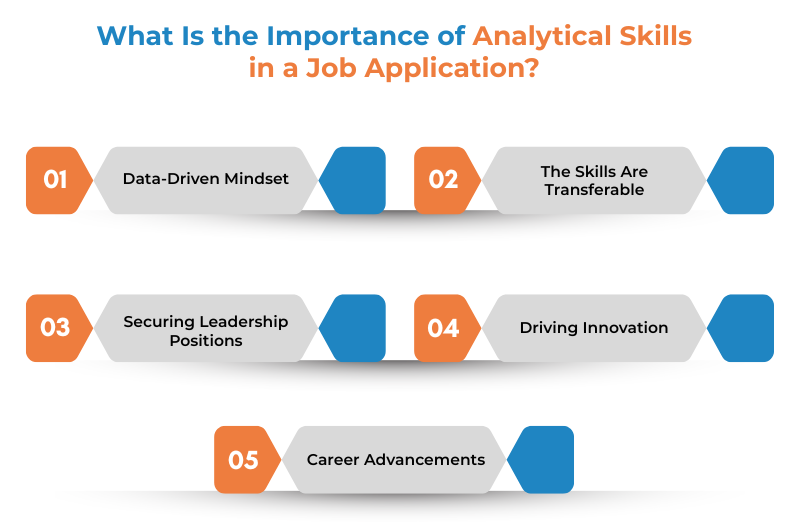
Analytical skills reflect a candidate’s ability to handle complex problems, make good decisions, and solve real business problems. Recruiters in every industry now look for candidates with demonstrable analytical skill based hiring. Here’s why:
A. Data-Driven Mindset
The growing use of data in almost every industry prioritises the need for candidates with analytical abilities. In fact, if you go through an HR analyst CV example, you will see how the CV carries data-driven analytics to fit into the job requirements.
B. The Skills Are Transferable
Analytical skills are not restricted to any particular field. A person with strong analytical skills can apply them to any scenario. This is one of the major reasons hiring managers look for candidates with analytical skills.
C. Securing Leadership Positions
Showcasing analytical skills in your job application can get you closer to securing a leadership position. A CV carrying instances of application of analytical skills can get you closer to getting called for a job interview for a leadership position.
D. Driving Innovation
An analytical thinker can drive innovation and contribute to the success of a company. If you have a proven ability to bring new ideas and support them with a logical approach, you will be preferred by recruiters and hiring managers.
E. Career Advancements
Analytical skills will not only get you a job but will also help you advance in your career. Employers who look for senior managers often search for candidates who can analyse data confidently, possess logical thinking skills, and have the ability to make informed decisions to help organisations reach their goals.
So, how do you demonstrate analytical skills? You can hire an expert from the best CV writing company to get it done correctly.
Moving on, we will take you through a few examples of analytical skills to help you better understand them.
Key Analytical Skills Examples to Highlight on Your CV
Analytical skills help professionals to think critically to solve problems. Let’s take you through a few important analytical skills UK CV examples:
1. Analytical and Research Skills
Research is one of the most important analytical skills for professionals. It tops the Analytical skills list as it helps them find the necessary data to form opinions and make informed decisions. Both qualitative research and quantitative research help in creating business strategies.
2. Forecasting
Professionals with forecasting skills can make accurate predictions related to a business decision or the progress of a certain topic. This skill is important for applicants applying to project management roles or in industries like investing, weather forecasting, and other sciences.
3. Brainstorming
This is a skill that allows professionals to create and contemplate ideas. The skill is very helpful in group projects and in the problem-solving process. Brainstorming skills allow professionals to browse through different ideas.
4. Critical and Analytical Thinking Skills
Critical thinking is one of the important analytical skills. It allows professionals to analyse facts and find an appropriate solution. In fact, if you go through competency based interview questions, you will come across questions that analyse a professional’s critical thinking skills.
5. Creativity
There are job roles that need you to be creative, and this is why creativity is an important one of the analytical skill set. Hiring managers look for candidates who can think out of the box to find solutions to problems. You can showcase your creativity in your LinkedIn headline as well to grab the attention of recruiters.
6. Data Analysis

Do not mistake data analysis with the role of data analysts only. There’s more to it. Candidates who can understand and interpret data to make informed decisions are considered to have proper data analysis skills, and this is also an important component of the analytical skill set.
7. Communication Skills
Communication is an important skill in the workplace. Be it written or non-verbal communication, candidates must show how they use it to convey any message. This is a crucial skill for any role you are applying to. Show off your analytical skills by writing a good CV personal statement.
8. Logical Thinking
Logical thinking skills are defined as analysing a problem and creating a logical solution. You need to use reasoning skills to evaluate a situation objectively. Candidates who say they possess this skill must show their ability to review facts and concrete data for better decision-making.
9. Observation
Candidates who talk about having observation skills mean that they can notice details and carefully consider them when working. This analytical skill is very important for professionals, especially in the medical field, because it helps in making a diagnosis and treating medical conditions.
10. Active Listening
Active listening is very important for professionals. It shows how they listen to what someone is saying. It helps in gathering valuable information. While this skill is important for all, professionals in management positions need this more.
11. Strategic Planning

Candidates who possess strategic planning skills can map out steps and methods to help complete different tasks. Project managers, marketers, and medical professionals are expected to possess such skills.
12. Inductive Reasoning
This analytical skill allows professionals to make general conclusions on the basis of specific information. You need to show your experience in using previous experience as a data point to make independent decisions.
13. Assessment Skills
Assessment skills allow candidates to review resources and information to draw conclusions about them. Professionals generally use this skill to understand the value of a data set and interpret information.
14. Collaboration
This can also be considered as one of the soft skills. Collaboration reflects a professional’s ability to work with others. It is a part of the analytical skill set because it involves assessing other professionals’ ideas and comparing them to your own.
15. Problem Identification
The analytical skill allows professionals to identify a problem and find the source. It allows professionals to handle workplace issues by applying other analytical skills to the problem. Numerous employers look for this ability in a candidate.
Adding on to these, there are a few more analytical skills examples for cv that you must know about:
16. Troubleshooting
17. Organisation
18. Interpretation
19. Decision-making
20. Financial management
21. Optimisation
22. Reporting
23. Problem sensitivity
24. Correlation
25. Prioritisation
26. Judgement
27. SWOT analysis
28. Investigation
29. Fact checking
30. Argumentation
31. Comparison
32. Reformation
So, if you are wondering, ‘Do I have analytical skills?,’ go through the analytical skills list here to get an answer to the question.
Now that you know what are analytical skills, let’s help you understand how to include them in your CV.
How to Showcase Analytical Skills Effectively on Your CV?
You can demonstrate your analytical skills in three places on your CV:
- Personal statement
- The section talking about key skills and competencies
- Employment history
However, you need to remember a few things before including them in your CV:
- Incorporate keywords – You must check if the job description has any keywords related to analytical skills. It is crucial that you show your analytical skills using the right keywords.
- Use synonyms – You need to keep your eyes open for the different terms related to analytical skills. Since communication, data analytics are part of the skill set, use them in your CV wherever relevant.
- Customise your CV – It is highly recommended that your CV aligns with the requirements in the job description. Don’t use a generic CV template; include examples that directly answer the questions employers ask.
Adding on to that, you also need to understand the ways to use analytical skills in a job interview. Since analytical skills are important in the entire recruitment process, you need to showcase your skills in both. Let’s take you through the ways you can use these skills in an interview. You can also hire a professional to learn how to build analytical skills and be prepared for the interview.
How to Demonstrate Analytical Skills in an Interview?
Hiring managers might use behavioural questions to understand your analytical skills. Therefore, when you are attending an interview, you must explain analytical skills by providing detailed responses to show how you used your skills in the past and how they helped improve a situation or solve problems.
Here’s an example to help you understand this better:
“In my role as a content specialist at an annotation platform, client feedback scores dropped 20% after a new tool rollout. I gathered data from user logs, surveys, and session recordings, spotting that 70% of drop-offs occurred during the labeling interface transition due to unclear instructions.
I hypothesized better onboarding would help, so I prototyped a simplified tutorial with step-by-step visuals, tested it with a small user group, and iterated based on their input—reducing confusion points by 40%. After full rollout, feedback scores rose 25% within a month, proving the value of targeted analysis over assumptions.”
This would help you demonstrate yourself as an analytical person and prove your strong analytical skills.
Put these examples straight into a CV
Copy your favourite line into the editor and have a finished, ATS-friendly CV today. Free to build — download from £3.99.
Final Thoughts,
Analytical qualities help you stay ahead in the competition. It helps you demonstrate how you use analytical thinking, demonstrate your data skills, as well as your decision-making skills. It is crucial to understand what does analytical skills mean and use them correctly in your CV as well as in an interview.
You can hire a professional to write your CV showing the skills correctly. Also, consult with the experts at iCover to understand the correct ways to explain analytical skills in a job interview. These will help you get a call for an interview and get you a step closer to getting a job.
Frequently Asked Questions
How to improve analytical skills?
To improve these skills, you can:
- Use analytical thinking skills daily
- Engage in data science exercises
- Solve puzzles to improve your skills
- Demonstrate your skills via creative solutions
- Seek feedback for approaching a problem differently
What jobs require analytical skills?
Analytical roles like data science, finance, and consulting need hard skills, data skills, and decision-making skills. These job roles value analytical people who can understand numerical data and data visualization.
How to assess analytical skills?
The skills can be assessed by self-reflection, where you take time to assess your approach to a problem and evaluate outcomes. It is recommended that you use quizzes or scenarios to evaluate your ability to use analytical thinking to make a decision based on evidence.
How do you develop analytical skills for work?
It is recommended for job aspirants to enrol in training courses for data skills and practice problem-solving methods like STAR during projects. You must also build an analytical mindset by considering opposing viewpoints, brainstorming solutions, and applying data visualisation tools.
How do employers test these skills?
Employers test these skills through assessment centres, interviews with questions on these skills, and tasks requiring numerical reasoning or data analysis. They observe how candidates approach a problem, weigh the pros and cons of different ideas, and demonstrate decision-making skills under pressure.
How to describe analytical skills in a personal statement?
You can use the STAR method to describe analytical skills in a personal statement. You can tell a brief story focusing on how you used analytical skills in the workplace. Focus on showing, instead of just telling.
How useful was this post?
Click on a star to rate it!
Average rating / 5. Vote count:
No votes so far! Be the first to rate this post.
We are sorry that this post was not useful for you!
Let us improve this post!
Tell us how we can improve this post?

Want To See My Profile — Click Here Sarah
- 30+ Analytical Skills Explained: Meaning, Importance, and Examples - December 13, 2025
- Resignation Letter Example Due to Family Illness- A Complete Guide! - November 13, 2025
- Thinking of Resigning with Immediate Effect? Handle it Professionally! - April 22, 2025
