
![How to Write a Self-Employed CV [Tips, Examples, and Templates Inside]](https://www.icover.org.uk/wp-content/uploads/2026/01/How-to-Write-a-Self-Employed-CV-Tips-Examples-and-Templates-Inside.webp)
Transitioning from self-employment to full-time employment is one of the most challenging career moves professionals face. In the UK alone, over 140,000 individuals shifted from self-employment to employment in a single quarter, highlighting a growing trend, but not an easy one.
The real challenge lies in presenting your self-employed experience in a way recruiters understand and value. From translating projects into measurable achievements to positioning your learnings as in-demand skills, your CV needs to do more than list responsibilities; it must tell a compelling story.
That’s where many candidates struggle.
In this guide, we’ll share proven tips and practical strategies to help you create a high-impact self-employed CV that speaks the recruiter’s language, highlights your strengths, and significantly improves your chances of landing interviews.
Key Takeaways: A Guide to Add Self-Employed Experience on Your CV
- You need to structure your CV well and not show yourself as the CEO of the company.
- Always apply for roles that are similar to your current employment; this will help you highlight your skills better.
- Use keywords from the job description to make your CV ATS-friendly and quantify your achievements.
What Is a Self-Employed CV?
A CV for self employed basically lists your work experience, skills, and achievements from business, freelancing, and contractual jobs. Just as any other CV, a self employed CV showcases and highlights relevant responsibilities and achievements of the professional. The significant and primary goal of writing a CV for a self-employed professional is to convey the skills and capabilities in a way that shows how valuable an asset they can become to the hiring company.
How to Write a Self-Employed CV: A Step-by-Step Guide
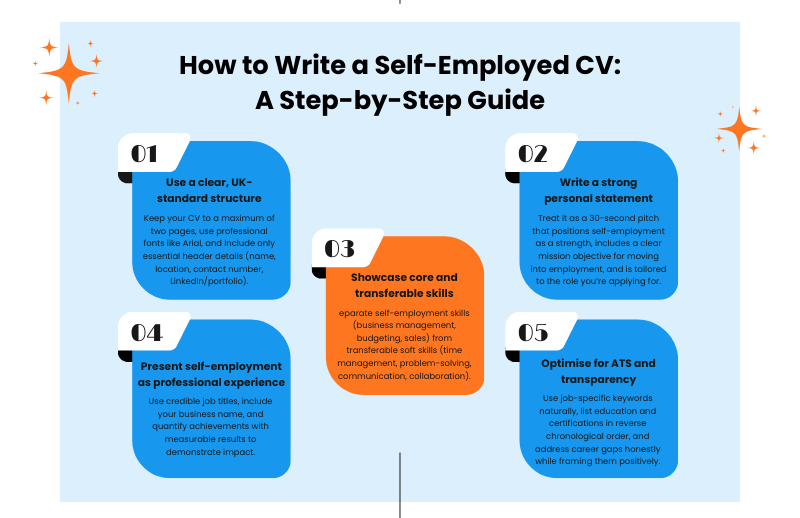
As a Professional Career Services provider, we advise our clients to follow a strong structure to showcase and highlight their qualifications, skills, duties, and achievements to impress the hiring manager:
Structure and Header
When writing a career change CV, you must use a clean, neat structure that is easy for recruiters to navigate.
- Your header will only have your name, address, contact number, and LinkedIn profile or professional portfolio.
- Always use fonts like Arial, which is one of the Best Fonts for a CV in the UK. Furthermore, make sure your CV is not more than 2 pages long.
Craft a Captivating Personal Statement
When creating your CV, do remember it’s your only chance to prove your credibility; this is your 30-second pitch.
- Frame your independence as a strength: To enhance your credibility, highlight your versatility and key achievements.
- Include a “Mission Objective”: Briefly explain your decision to move into a traditional role, focusing on what you can bring to the new company rather than what you are leaving behind. This will make your Self-Employed but Working for One Company UK CV better!
- Tailor it: Emphasise how your self-employed journey makes you a perfect fit for the specific role you are applying for.
Pro Tip: To quickly get a job, always choose to transition to your own field of work. For instance, if you had a digital marketing agency, apply for a role in the digital marketing field. Your experience will add credibility to your CV.
Highlight Core and Transferable Skills
Create a dedicated skills section to showcase your skills and categorise them as per core skills and transferable skills:
- Self-Employed Specific Skills: Include business management, financial planning/budgeting, networking, and sales/negotiation.
- Transferable Soft Skills: Emphasise time management (working without supervision), problem-solving (handling challenges independently), and communication (building client relationships).
- Collaboration: When writing your CV, highlight your experience with remote collaboration tools (Slack, Asana, or Zoom) to show you can work effectively within a team.
Though please note that it is illegal in the UK to lie on your CV, so if you are not compatible with these tools, do not mention them at all.
Detail Your Self-Employment Experience
Treat your self-employment like any other professional role rather than a “side gig.”
- Job Titles: Use a title that reflects your niche, such as “Freelance Graphic Designer” or “SEO Consultant.”
- Company Name: Use your business name if you have one to add credibility and allow employers to research your work.
- Quantify Data: Always frame your experience of businesses, contractual, or freelance work as tangible, measurable results.
Education and Certifications
- Always list your employment history, educational qualifications, and certifications in reverse chronological order.
- Focus on relevant certifications and degrees, meaning add only those that are directly related to the job you are applying for.
Address Gaps and References
- Gaps: Here’s an expert tip for you: Be transparent about any pauses in your career. When writing your CV, frame them positively, such as taking time to launch a business or upskilling.
- Reference: Adding long-standing clients as a reference is the best. Even on LinkedIn, you can add Recommendations from clients about your self-employed work.
Optimise for Applicant Tracking Systems (ATS)
Most self-employed candidates fail to write an ATS-friendly CV. Use keywords from the job description and add them to your CV and cover letter. You must list key skills or your six years of experience in client delivery or budgeting naturally throughout your CV.
How to Translate Entrepreneurial Experience into Valuable Transferable Skills?
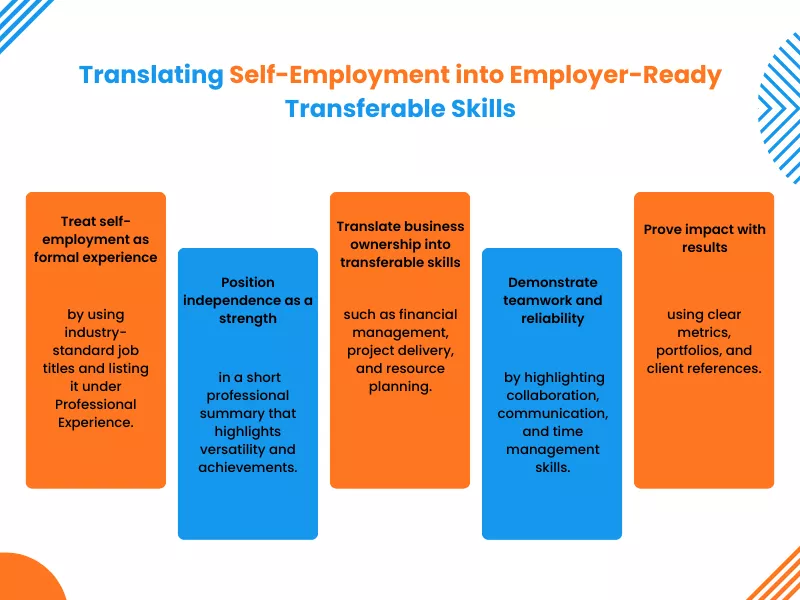
Strategic Framing of Job Titles and Roles
To ensure credibility, you should treat their independent work as a “proper” job under the “Professional Experience” section of their CV
Use Industry-Standard Titles:
Even though you were the CEO of your company, you can represent yourself as one in the CV. As evident from the CV for Self Employed Examples, you must avoid high-level titles like “CEO” or “Director” unless applying for executive positions.
Instead, use titles that reflect the niche, followed by Freelancer or Contractor. You can also use a consultant. (e.g., “SEO Consultant” or “Freelance Graphic Designer”).
Professional Summary:
The above self employed CV examples effectively show how you can use the personal statement to frame independence as a strength, highlighting versatility and key achievements in three to five sentences.
Identifying and Mapping Transferable Skills
Self-employment provides a “treasure trove” of skills that are highly attractive to hiring managers when presented as corporate assets:
Business and Financial Management:
Imagine you need to highlight your business acumen; you can share examples of how you successfully met objectives by managing finances, resources, and personnel. This includes financial planning, budgeting, and tax compliance.
Project and Time Management:
Since freelance writers or contractors often work without direct supervision, you must highlight your ability to provide a responsive and reliable service. You can talk about how you are comfortable using Slack, Asana, or Monday.com to maintain deadlines and manage time effectively. If you have additional certifications, make sure to list them under the micro-credentials CV section format.
Communication and Collaboration:
Self-employment significantly depends on persuasive copywriting and listening. When addressing common concerns about being “unmanageable,” you should emphasize your ability to integrate into established teams and collaborate via platforms like Zoom or Microsoft Teams. This is an important skill set for professional development.
Quantifying Impact and Credibility
Employers prioritize tangible results over vague descriptions of duties.
Use Metrics:
Recruiters do not read CVs; they skim through them only when you have an ATS-friendly CV. Therefore, use bullet points to highlight measurable achievements, such as increasing customer engagement by 30%, reducing project costs by 20%, or securing specific funding amounts (e.g., £500k).
Portfolio and References:
Including a link to a digital portfolio or professional presentation allows employers to assess tangible metrics like search engine rankings or marketing campaigns. While traditional manager references may be missing, you can use a CV References Example from trusted clients, business partners, or collaborators to attest to your character and ability.
How to Put Self Employed on CV in the UK?
To list self-employment in your UK CV effectively, you should show your extensive experience as an entrepreneur as your asset; you are not a freelancer, you are a brand! In the UK, where roughly 16% of the workforce is self-employed, when applying for traditional employment, you need to show what you bring to their organisation.
Unlike freelancers, you can highlight the value of your dedication and self-motivation skills. Here’s the best way to structure it for a job-winning CV:
- Outline: A brief description of the services provided and the industries served.
- Responsibilities: Use action verbs such as “managed,” “developed,” or “executed”.
- Achievements: Highlight tangible, results-driven, measurable results.
Self-Employed CV Examples


Self-Emplyment CV Template
Here is a Self-employed CV template to help you write a proper CV that highlights career goals and customer satisfaction:


Write a Strong Self Employment CV with iCover.org.uk
At iCover, we have a decade of experience in helping applicants get placed in their preferred and dream jobs. Our team of CV experts writes ATS-friendly CVs that showcase your skills in the best possible light. From maintaining the UK CV format to showing your failed business as a knowledge hub, our team will guide you so you can quickly get a job. Hire experts today!
Frequently Asked Questions
How to Write Self Employed on CV?
List yourself as Self-Employed or Founder, include business name, dates, key services, achievements, clients, metrics, and skills, emphasizing outcomes and relevance to the role.
Do I Need a CV If I’m Self Employed?
Yes, a CV helps when applying for contracts, roles, or funding, summarizing experience, credibility, and results, and translating entrepreneurial work into employer-friendly language.
How to List Self Employment on CV?
Create a dedicated experience entry with your title, business name, dates, responsibilities, accomplishments, technologies, and quantified results, mirroring standard employment formatting.
Does Self Employment Look Bad on a CV?
No, it can look strong, showing initiative, versatility, and impact, especially when clearly explained with results, continuity, and relevance to the target role.
Can You Lie on Your CV about Being Self Employed?
No, lying risks credibility and termination; instead, present self-employment honestly, clarify scope and clients, and frame experiences to match job requirements.
How useful was this post?
Click on a star to rate it!
Average rating / 5. Vote count:
No votes so far! Be the first to rate this post.
We are sorry that this post was not useful for you!
Let us improve this post!
Tell us how we can improve this post?

Want To See My Profile — Click Here Ben
- How to Write a Self-Employed CV [Tips, Examples, and Templates Inside] - January 7, 2026
- How Do You Know If an Interview Has Gone Well or Badly: 30 Signs an Interview Went Well - January 2, 2026
- The Unwritten Rules of Job Offer Thank You Letter Example - March 10, 2025

