

In the competitive UK job market, many job seekers meticulously craft their CVs, only to be met with silence. The reason? Their CV may not be optimised for the modern recruitment landscape, which is dominated by Applicant Tracking Systems (ATS). The solution lies in understanding the importance of keywords in modern CVs. This article will discuss everything from how to find them to how to use them effectively to make your CV stand out.
What Does Keyword Mean on a Job Application?
In the context of a Job Application, keywords are specific words or phrases that are relevant to the role you are applying for. They act as a bridge between your qualifications and the employer’s requirements. They can also be skills, experiences, activities or even Hobbies and Interests for CV. Recruiters and hiring managers appreciate the presence of these key terms, which enable them to identify suitable candidates quickly.
What Are CV Keywords?
CV keywords are essentially the most important terms related to a specific job that candidates are supposed to include while writing a Curriculum Vitae. This helps in creating a ATS friendly CV.
What Are Keywords on a CV? Let’s Understand with Examples
CV Keywords can be broken down into several categories:
| Types | What Is It? | Examples |
| Job-Specific Keywords | These terms are directly related to the role and are typically found in the “job description” section. | For example, in the case of a “Digital Marketing Manager” role, these might be “SEO”, “PPC”, “content marketing”, and “social media campaigns”. |
| Skills Keywords | What are the skills keywords in a CV? These are more like key phrases for a CV that encompass both hard skills and soft skills. A strong CV will include a mix of both to show you can both perform the job and excel in the role. They highlight the benefits of hiring you. | Hard skills are teachable abilities, such as proficiency in a particular software (e.g., “Adobe Creative Suite”) or a technical skill (e.g., “data analysis”). Soft skills are interpersonal attributes like “communication”, “teamwork”, and “problem-solving” |
| Action Verbs | These are dynamic words that describe your accomplishments and responsibilities. | Using good verbs for CV like “managed”, “developed”, “implemented”, and “achieved” can make your CV more impactful. |
| Industry-Specific Jargon | Every industry has its own unique language. Using relevant jargon in CV Personal Statement Examples demonstrates your familiarity and expertise within your field. | For instance, mentioning terms like SaaS in tech, EBITDA in finance, or HIPAA in healthcare immediately signals you are a knowledgeable industry insider. |
To understand how the four keyword types work together, let’s deconstruct a single, powerful bullet point from a Marketing Manager’s CV.
Example CV Statement:
“Planned, led and executed a multi-channel digital marketing strategy, utilising SEO and PPC campaigns to increase MQLs by 40% in Q3.”
Here is how each keyword type functions within this one sentence:
1. Action Verb: Planned, Led, and Executed
Why does it work? These verbs immediately grab attention and frame you as a leader and an achiever, not just an employee who “was responsible for” tasks.)
2. Job-Specific Keywords: digital marketing strategy, SEO, PPC campaigns
Why does it work? These are the exact terms an ATS and a recruiter are scanning for to match your experience directly to the job’s core responsibilities.
3. Industry-Specific Jargon: MQLs (Marketing Qualified Leads)
Why does it work? Using this acronym signals that you are an industry insider who understands the profession’s unique language and metrics for success. It builds instant credibility.
4. Skills Keyword (Implied): Campaign Management & Data Analysis
Why does it work? While not stated explicitly as “my skill is…”, the entire statement powerfully demonstrates your high-level skills. The mention of increasing leads by 40% showcases your data analysis and strategic management abilities in a practical, undeniable way.
To understand how the four keyword types work together, let’s deconstruct a single, powerful bullet point from a Marketing Manager’s CV.
Example CV Statement:
“Planned, led and executed a multi-channel digital marketing strategy, utilising SEO and PPC campaigns to increase MQLs by 40% in Q3.”
Here is how each keyword type functions within this one sentence:
1. Action Verb: Planned, Led, and Executed
Why does it work? These verbs immediately grab attention and frame you as a leader and an achiever, not just an employee who “was responsible for” tasks.)
2. Job-Specific Keywords: digital marketing strategy, SEO, PPC campaigns
Why does it work? These are the exact terms an ATS and a recruiter are scanning for to match your experience directly to the job’s core responsibilities.
3. Industry-Specific Jargon: MQLs (Marketing Qualified Leads)
Why does it work? Using this acronym signals that you are an industry insider who understands the profession’s unique language and metrics for success. It builds instant credibility.
4. Skills Keyword (Implied): Campaign Management & Data Analysis
Why does it work? While not stated explicitly as “my skill is…”, the entire statement powerfully demonstrates your high-level skills. The mention of increasing leads by 40% showcases your data analysis and strategic management abilities in a practical, undeniable way.
To understand how the four keyword types work together, let’s deconstruct a single, powerful bullet point from a Marketing Manager’s CV.
Example CV Statement:
“Planned, led and executed a multi-channel digital marketing strategy, utilising SEO and PPC campaigns to increase MQLs by 40% in Q3.”
Here is how each keyword type functions within this one sentence:
1. Action Verb: Planned, Led, and Executed
Why does it work? These verbs immediately grab attention and frame you as a leader and an achiever, not just an employee who “was responsible for” tasks.)
2. Job-Specific Keywords: digital marketing strategy, SEO, PPC campaigns
Why does it work? These are the exact terms an ATS and a recruiter are scanning for to match your experience directly to the job’s core responsibilities.
3. Industry-Specific Jargon: MQLs (Marketing Qualified Leads)
Why does it work? Using this acronym signals that you are an industry insider who understands the profession’s unique language and metrics for success. It builds instant credibility.
4. Skills Keyword (Implied): Campaign Management & Data Analysis
Why does it work? While not stated explicitly as “my skill is…”, the entire statement powerfully demonstrates your high-level skills. The mention of increasing leads by 40% showcases your data analysis and strategic management abilities in a practical, undeniable way.
Are Keywords Important in a CV?
Absolutely. In today’s recruitment landscape, the increasing reliance on ATS (recruiters use to search talent for recruitment) makes the inclusion of the right keywords in CVs more critical than ever. It is crucial to contact the best CV writing service company in the UK to ensure that your CV has all the keywords to improve your chances.
What Is the Importance of Keywords on CVs? Explained
The importance of keywords on CVs, especially CV Example For 16 Year Olds, can be summarised in two main points: passing the automated talent filtering system and capturing the recruiter’s attention.
Beating the ATS:
The applicant tracking system is the first gatekeeper in the hiring process. The ATS software scans CVs for keywords that match the job description. It filters specific terms and ranks applications on visibility. Therefore, a well-written CV that lacks the right keywords will likely be overlooked by the system, ranked lower, and may never be seen by human eyes.
Impressing the Hiring Manager:
Beyond the initial automated screening, recruiters who are often inundated with applications will also scan CVs for specific keywords to assess a candidate’s suitability quickly. Each keyword in CV describes your skills and experience for the job. By including these keywords, you make it easier for the hiring manager to see that you are a good fit.
Therefore, keywords in your CV are the foundation of a successful job application in the digital age.
What Are ATS-Friendly Keywords?

ATS-friendly keywords are the specific terms an Applicant Tracking system is programmed to look for. These are typically the hard skills and job-specific keywords.
To optimise your CV with ATS keywords, you need to carry out strategic research to identify the terms.
Why Is It Important to Identify Keywords?
Identifying ATS keywords is a crucial step in tailoring your CV for each job application. This will not only improve your CV but also help you prepare for the interview. It shows you have taken the time to understand the role and are not just sending out a generic CV.
How to Find Keywords for CV?
Finding the right keywords for your CV requires research. Here’s a step-by-step guide:
- Analyse the Job Description: This is the most important source of keywords for CV. Carefully read the job description and highlight the skills, qualifications, and experience they are looking for.
- Look for Repeated Words and Phrases: Words and phrases that are repeated throughout the job posting are likely to be important keywords.
- Review the ‘Requirements’ or ‘Qualifications’ Section: This section is a goldmine. Make sure you address each of the requirements in your CV.
- Research the Company and Industry: Look at the company’s website and LinkedIn page. Research industry-specific jargon to further enhance your CV.
This process can be time-consuming, but it is what sets a winning CV apart. If you need expert help with targeted CV keywords and phrases, professional CV Writing Services can offer expert guidance.
How to Effectively Use Keywords in CV?
Effectively using keywords in a CV is about strategic placement:
- In your CV profile/summary
- In your work experience section
- In your skills section
Also, customise and update your CV for each job application by adding relevant keywords.
Should a CV Be Too Wordy?
No, a CV should not be overly wordy. Remember, the goal is to use keywords naturally, not to stuff your curriculum vitae with them.
Sample on How to Write Keywords in a CV
This is a sample “Skills” section for a marketing professional, demonstrating how to group and what different keywords to include in CV.
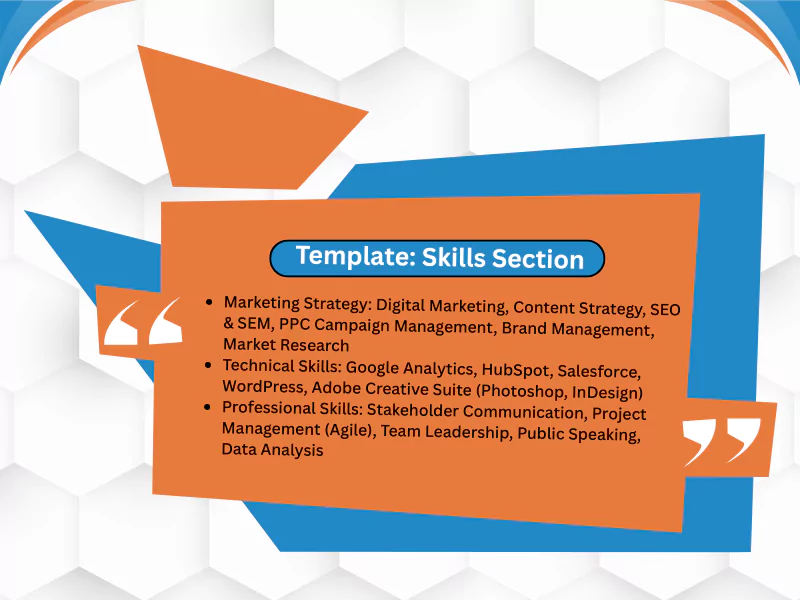
Also, CV should be concise and easy to read. Use bullet points to break up text and make your CV easy to scan.
Focus on your most relevant and impressive achievements, and quantify them with numbers wherever possible.
This format helps an ATS to parse the information easily while allowing a recruiter to quickly scan your capabilities.
For more guidance on structuring your CV, explore different Types of CV.
Should I Bold Keywords in My CV?
It is generally not recommended to bold keywords on your CV. It can be distracting and create an impression of “desperation” during manual review.
Instead of bolding, focus on integrating them naturally into your sentences. Let the power of keywords speak for themselves through their context and relevance
How to Tailor Keywords for Your Career Level: From Graduate to Executive

Your keyword strategy should evolve as your career progresses. The terms that showcase potential for an entry-level candidate are different from those that demonstrate leadership for a senior executive.
1. For the Recent Graduate/Entry-Level Candidate
In a graduate CV, your focus should be on potential and transferable skills.
Words to use in CV: Coursework in [relevant subject], Projects involving [skill], Internship experience, Proficient in [software/tool], Eager to learn, Developed, Assisted.
Strategy: Your keywords should highlight your academic achievements, relevant projects, and any practical experience from internships or volunteering. Use phrases that show you are a capable and quick learner.
2. For the Mid-Career Professional
Your focus is on demonstrated achievement and expertise.
Keywords to Emphasise: Managed, Led, Increased revenue by X%, Streamlined processes, Launched, Negotiated, Optimised, Technical proficiency in [specific industry tech].
How to put keywords in a CV? Use strong action verbs connected to quantifiable results. Your keywords should tell a story of growth, responsibility, and direct impact on your previous employers’ goals.
3. For the Senior/Executive Leader
Your focus is on strategic vision and large-scale impact.
Keywords to Use: Directed, Oversaw, Strategic planning, P&L management, Drove growth, Vision, Organisational change, Board-level communication, Stakeholder engagement.
Strategy: Your keywords need to reflect a high-level, strategic mindset. Focus on terms related to leadership, financial oversight, market strategy, and your ability to steer the entire organisation or department.
Are Buzzwords or Keywords the same?
While there can be some overlap, buzzwords and keywords are not exactly the same.
So, What Are Buzzwords in CVS?
While a keyword in CV is specifically a job-relevant term, Buzzwords are often trendy, fashionable, and overused corporate phrases intended to make you sound impressive and in tune with modern business culture.
How to Identify Buzzwords?
Common examples include:
- Synergy
- Go-getter
- Team player
- Results-driven
- Think outside the box
- Dynamic
- Proactive
- Self-starter
Since they are so common, they can sound like clichés and lack specific meaning if not supported by concrete evidence. ATS systems may ignore them, and human recruiters will be unimpressed.
Instead of stating a buzzword, prove it with a specific achievement. Vague buzzwords tell recruiters nothing, but a measurable accomplishment provides undeniable proof of your value.
Weak (The Buzzword): “I am a results-driven sales associate.”
Strong (The Proof): “I increased my personal sales revenue by 30% in Q4 by identifying and pursuing new market opportunities.”
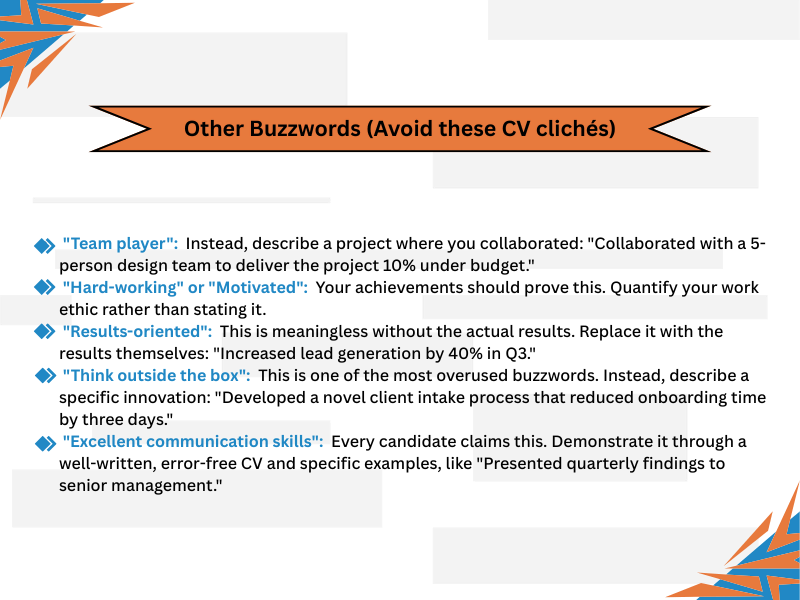
It’s generally better to focus on using specific, evidence-based keywords on a CV that demonstrate your value.
What Are Trigger Words on a CV?
Suppose standard keywords are the logical terms designed to get your CV past the computerised Applicant Tracking System (ATS). In that case, trigger words are high-impact terms designed to capture the attention and imagination of the human reader.
Their purpose is to evoke a positive emotional response from a recruiter or hiring manager. They are psychological shortcuts that signal you are an achiever, an innovator, or a leader, compelling them to stop scanning and start reading your CV seriously. Using them correctly can make a recruiter feel they’ve just found a top-tier candidate.
Here are examples of powerful trigger words, grouped by the impression they create:
1. Words That Signal Leadership & Initiative
These words show you don’t wait to be told what to do; you make things happen.
- Spearheaded
- Orchestrated
- Pioneered
- Directed
- Introduced
- Founded
2. Words That Signal Growth & Achievement
These terms immediately convey to the reader that you deliver positive and measurable results.
- Accelerated
- Generated
- Maximized
- Exceeded
- Amplified
- Capitalized on
3. Words That Signal Positive Change & Improvement
These demonstrate that you don’t just maintain the status quo; you actively seek ways to improve things, make them better, faster, or more efficient.
- Transformed
- Revitalized
- Standardized
- Re-engineered
- Streamlined
- Optimized
The Golden Rule for Using Trigger Words
A trigger word’s power is only unlocked when it is immediately followed by specific proof. Without evidence, it’s just another buzzword.
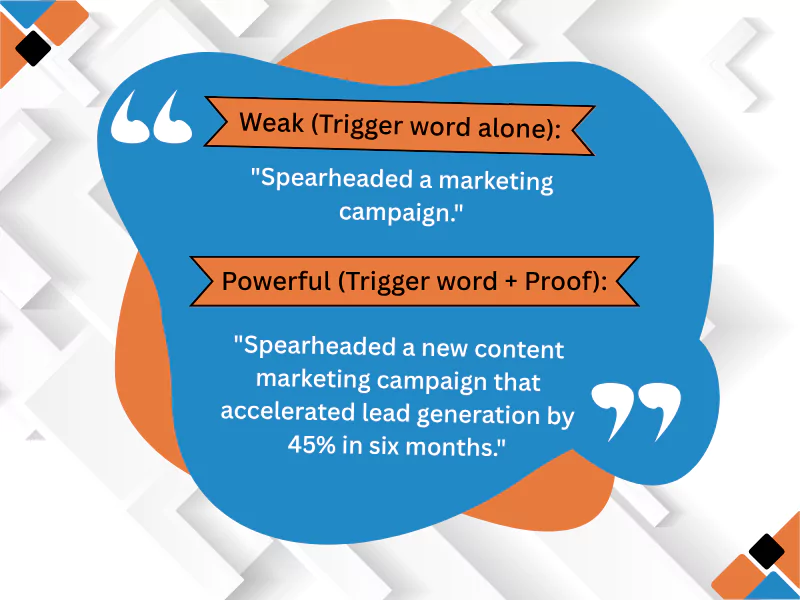
This combination of a powerful trigger word and a quantifiable result is what elevates your CV from a list of duties to a story of achievements.
Beyond ATS: The Future of CVS Keyword, AI, and Your Job Search
The technology for scanning CVs is evolving. While traditional Applicant Tracking Systems focus on keyword matching, newer AI-powered platforms are more sophisticated in their approach. They are beginning to analyse context and sentiment.
- Contextual Understanding: Future systems won’t just look for the keyword “managed.” They will understand the context around it, recognising that “led a team” or “spearheaded an initiative” are synonymous and indicate a similar skill level.
- Sentiment Analysis: AI can now gauge the tone of your CV. Using confident, positive, and action-oriented language will become even more crucial.
What this means for you: The core advice in this guide is to write a clear, achievement-focused CV using natural language and strong verbs. This is not just best practice for today; it’s the best way to future-proof your CV for the next generation of recruitment technology. The era of simply stuffing keywords is definitively over.
If you need help staying current, the iCover UK team is here to help.
Conclusion
The role of keywords in modern CVs is crucial. In the world of recruitment, it’s a strategic move to get your CV with relevant keywords past the initial screening. By understanding what keywords are, how to find them, and how to use keywords effectively, you can significantly increase your chances of landing your dream job. Remember to tailor your CV to the job, naturally incorporate relevant keywords, and focus on showcasing your key achievements. Don’t be afraid to seek professional help to create a CV that truly shines. Keywords are the key, and mastering this will give you a significant advantage in your job search.
Frequently Asked Questions
What Is the Most Important Part of a CV?
The work experience section is often considered the most crucial. This is where you can provide concrete evidence of your skills and experience.
How Many Keywords Should I Use in My CV?
There is no magic number. Focus on relevance and natural integration. Avoid keyword stuffing.
What Is the Best Way to Make My CV Stand Out?
The best way is to tailor it, use powerful action verbs, and quantify your achievements. Using the right keywords will ensure your tailored CV gets seen by the recruiter or hiring manager.
What Words Look Good on a Curriculum Vitae?
Words that look good on a curriculum vitae are powerful and action-oriented. Instead of saying “Responsible for social media”, say “Managed and grew social media presence across three platforms, resulting in a 40% increase in engagement”. Here are some words to use in a CV: Achieved, Improved, Managed, Created, Developed, Led, Increased, Reduced. Using these, you can craft a CV that showcases your accomplishments.
How useful was this post?
Click on a star to rate it!
Average rating / 5. Vote count:
No votes so far! Be the first to rate this post.
We are sorry that this post was not useful for you!
Let us improve this post!
Tell us how we can improve this post?

Want To See My Profile — Click Here Peter
- What is The Importance of Keywords in Modern CVs? Your Ultimate Guide - August 11, 2025
- Why Should I Update My CV? Update Your CV for Career Advancement - April 24, 2025
- The Wrong Types of CV Can Cost You Your Dream Job – Choose Wisely! - March 5, 2025

