

If you are wondering whether to include hobbies and interests on your CV or not, the answer is simple: totally go ahead! While your job history and academic qualifications speak to your achievements, skills, and experience, the hobbies and interests section allows employers to have a glimpse into your personality. This is no longer extraneous, but an important element valued by modern recruitment practices that provides a window into a candidate’s possession of transferable skills not evident from work history alone. Therefore, if you are wondering what to include in Hobbies and Interests for CV, this article is going to be your insightful guide. We discuss how to strategically design the CV hobbies and interests section to add value and what should be avoided. Keep on reading…
The Strategic Value of Including Hobbies and Interests Section on the CV
When you start to write a CV or develop a plan for professional growth, there’s no denying the fact that the primary focus is placed on professional experience and qualifications. However, a professional CV should paint a full picture. While some advice suggests you don’t include hobbies, the right interests in a CV can be a tie-breaker. Adding hobbies and interests outside of work can add significant value by humanising the applicant and providing a more holistic view of their capabilities.
Key Benefits of Hobbies and Interests CV section include:

- Demonstration of Skills: Activities outside of work are a powerful way to showcase both hard skills (e.g., coding, web development, video editing) and soft skills (e.g., teamwork, communication, leadership, resilience, time management) that may complement your CV Education Section.
- To Stand Out From Other Candidates: In fields where candidates possess similar qualifications, unique or relevant hobbies and interests can make a CV more memorable and distinctive, potentially becoming a deciding factor. For example, companies like Google appreciate quirkier aspects of a candidate’s personality that other, more traditional companies may not appreciate.
- Indication of Cultural Fit: Hobbies that align with a company’s values can signal that a candidate will integrate well into the team. For example, if someone lists volunteering as a hobby, it indicates that they’re more likely to be a good culture fit.
- Creation of Interview Talking Points: This hobbies section provides interviewers with natural conversation starters. This allows for a more personal connection and lets the candidate build rapport with hiring managers and elaborate on their passions, skills and interests.
What to Write for Hobbies and Interests on a CV?
While writing about good hobbies and interests for CV, you must ensure the section is effectively aligned with the strategic intent and relevant Keywords in CV. It simply starts with distinguishing Hobbies from Interests. While often used interchangeably, there is a subtle distinction between the two terms:
- Hobbies: Hobbies are activities that one actively and regularly engages in for enjoyment or skill development. Examples of hobbies include playing a sport, painting, or coding.
- Interests: These are topics or subjects that a person is passionate about or curious about but may not participate in regularly. For instance, following technology trends, reading about history, or having an interest in cinema.
Therefore, the core principle for inclusion is relevance.
What Are Good Hobbies and Interests for CV?
Here are some examples of good hobbies and associated skills for CV, based on different categories that signal distinct sets of desirable professional traits.
| Category | Good Hobbies and Interests for CV examples | Associated Skills and Traits |
| Sports & Fitness |
|
|
| Creative & Artistic |
|
|
| Technology & Digital |
|
|
| Writing |
|
|
| Intellectual & Strategic |
|
|
| Community & Volunteer |
|
|
| Outdoor Pursuits |
|
|
| Unique/Unusual |
|
|
Examples of Hobbies and Interests You Must Avoid Listing on CV
Certain hobbies can be detrimental to an application and should be omitted. These include:
- Generic or Passive Activities: Hobbies like “watching TV/Netflix,” “scrolling TikTok,” “sleeping,” “listening to music,” “shopping,” or “socialising with friends” add no value. While one source suggests reading is a valuable hobby, another warns against it, stating it can make one seem like a “loner” and is not a unique skill.
- Extreme or Dangerous Activities: Risky hobbies such as “street racing,” “free solo climbing,” “urban exploring” (trespassing), or “BASE jumping” could raise red flags for recruiters about a candidate’s judgment and insurance risk.
- Controversial or Divisive Topics: Activities related to “political campaigning,” “hunting,” “taxidermy,” or “religious preaching” should be avoided to prevent alienating potential employers who do not share those specific views.
- Potentially Unprofessional Activities: Hobbies that could be misinterpreted, signal antisocial behavior, or seem violent, such as “clubbing,” “online gambling,” “playing violent video games,” or “partying”, should never be included.
How to Select and Tailor Hobbies and Interests Ideas for CV?
The most critical step while making a ATS friendly CV is choosing the right hobbies and interests to put on the list. Here are the effective tips:
- Prioritise Relevance: The fundamental question to ask is, “Does this hobby or interest relevant to the job that I am applying for?”
- Research the Company: Analyse the company’s website, social media, and the job description to identify the culture and desired skills.
- Align with Required Skills: Select hobbies that demonstrate the skills mentioned in the job ad. For example, team sports show collaboration and team player capability, while endurance sports show dedication.
- Fill Skill Gaps: Tailor your CV with specific hobbies to compensate for a lack of professional experience in a certain area. For example, an aspiring illustrator can list photography or sketching to show an eye for design.
List of Hobbies and Interests for CV for Various Professions
Aligning hobbies and interests for a CV with a specific profession can powerfully reinforce a candidate’s suitability for a role, but remember that different types of CV may require different approaches to this section. To help you out, here are some profession-specific best hobbies and interests for CV:
For Accountants
Mentions activities like serving as a club treasurer, strategic investment clubs, or genealogy. These choices show you have a natural aptitude for tracking details, financial stewardship, and tracing complex histories, which helps you write a good CV that screams reliability.
Here’s an example of Accountant CV

For Estate Agents
Include participation in local historical societies, urban exploration, or hosting community meetups. These prove you have deep-rooted knowledge of the area and the social networking stamina to find buyers. When you use your hobbies and interests this way, you validate your market expertise.
Here’s an example of Estate Agent CV

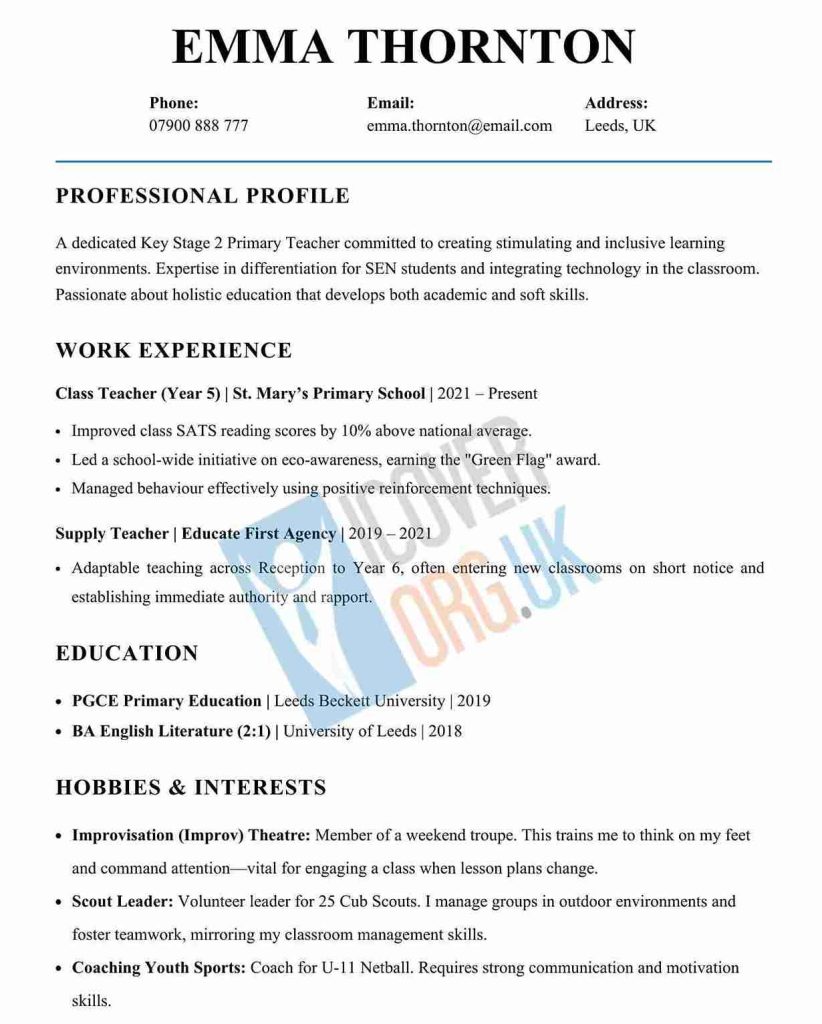
For Teachers
Highlight coaching youth sports, improvisation (improv) theatre, or scout leadership. Unlike solitary hobbies, these demonstrate your ability to manage groups, think on your feet, and command attention, traits that are essential to include on a CV for education roles.
Here’s an example of Teacher CV
For Engineers
Mention drone racing, 3D printing, or home automation projects. Such unique examples of hobbies and interests imply you are constantly tinkering with mechanics and systems even in your downtime.

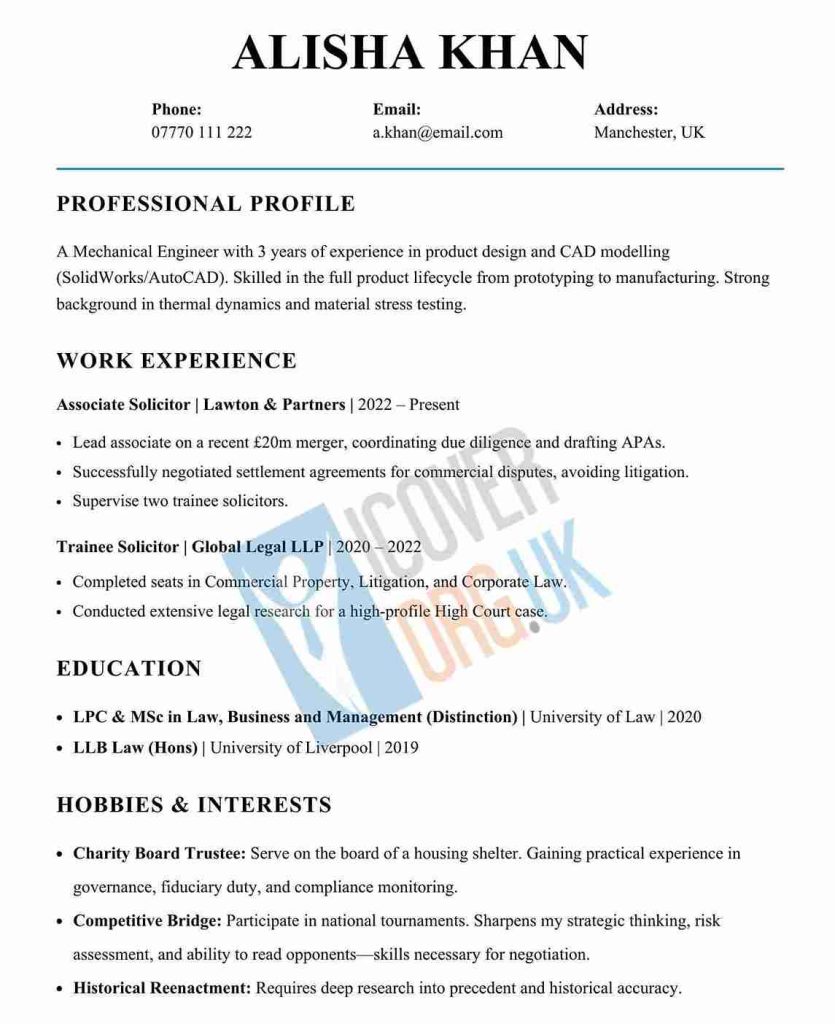
For Lawyers
Feature playing contract bridge or poker, serving on a charity board, or historical reenactment. These activities highlight risk assessment, an understanding of governance, and respect for precedent. Including these can answer recruiters’ silent questions about hobbies and interests regarding your strategic mind.
Here’s an example of Lawyer CV
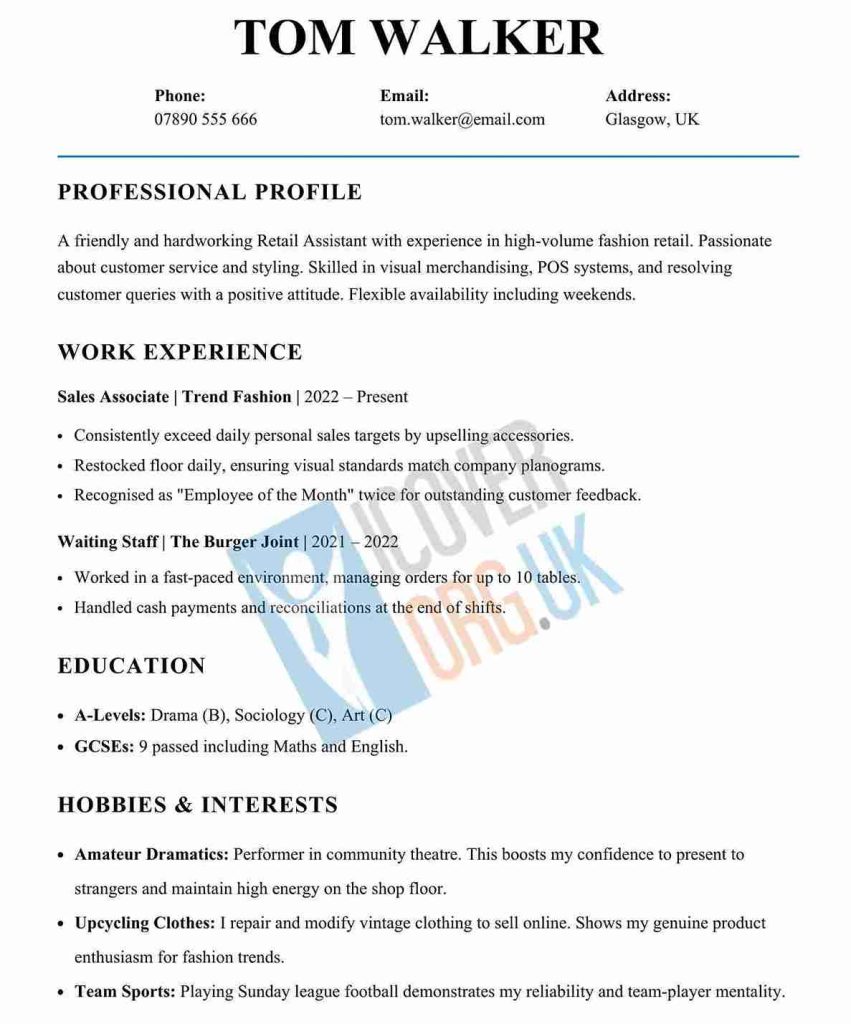
For Retail Assistants
Showcase upcycling clothes, amateur dramatics, or running a review vlog. These chosen hobbies highlight a flair for presentation, product enthusiasm, and the confidence to perform in front of strangers. It’s smart to include your hobbies that involve audience engagement here.
Here’s an example of Retail Assistant CV
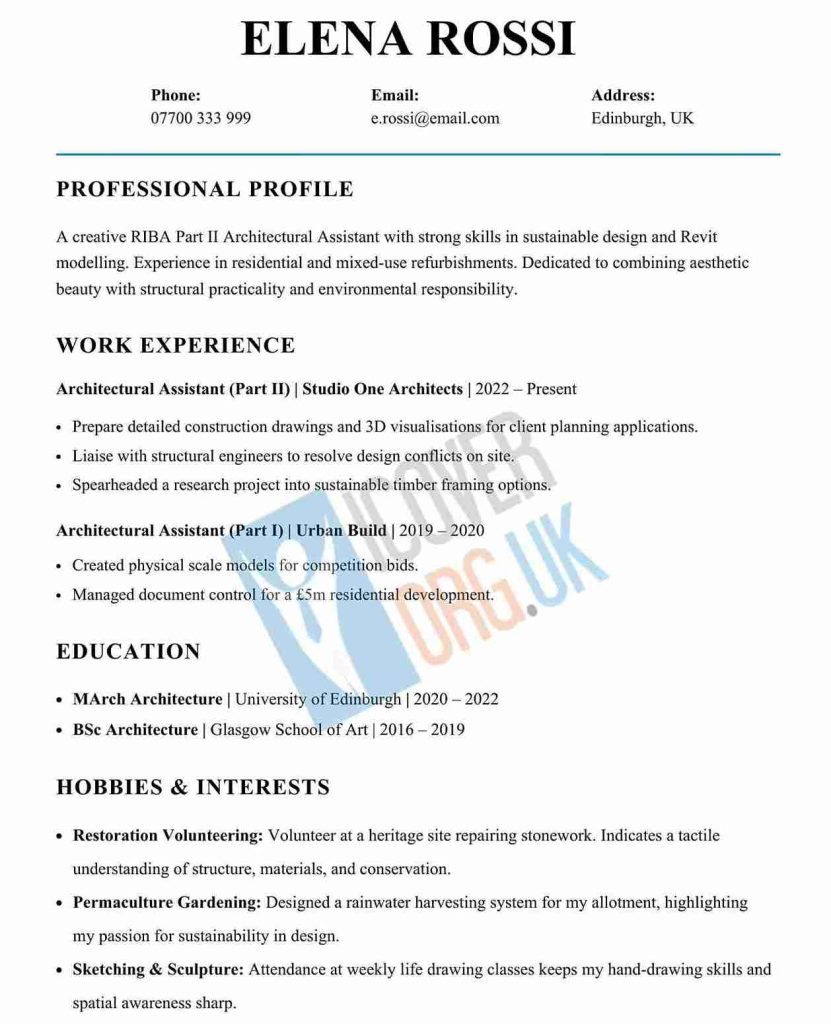
For Architects
Focus on sculpture, permaculture gardening, or restoration volunteering. These indicate you understand materials, sustainability, and how different elements fit into a 3D environment. These are unique interests to your CV that show a tactile understanding of structure.
Here’s an example of Architect CV
For Graphic Designers
Add screen printing, typography enthusiasts groups, or animation. A graphic designer CV must show that your aesthetic sense extends beyond 9-to-5. These passions prove you are visually versatile and keep up with trends without being asked.
Here’s an example of Graphic Designer CV

For Data Analysts
Add fantasy sports leagues, competitive gaming, or participating in puzzle hunts. These signals that you enjoy pattern recognition and making decisions based on statistics; excellent traits to put on your CV for analytics roles.
Here’s an example of Data Analyst CV

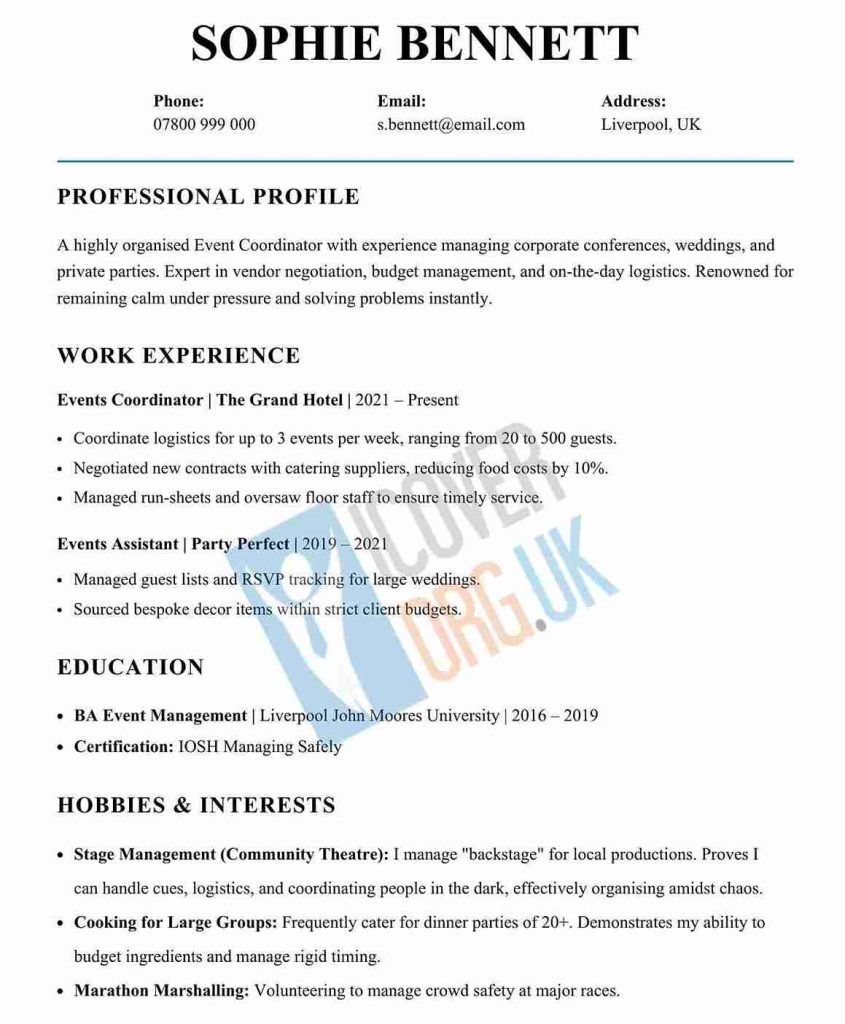
For Event Planners
Add cooking for large groups, marathon marshalling, or backstage stage management. These hobbies prove you can handle logistics, timing, and pressure. When considering what hobbies and interests to include, prioritise ones that show organisation amidst chaos.
Here’s an example of Event Planner CV
Also, check out our Voluenteer job cover letter example.
How to Write Interest and Hobbies for CV?
To make your hobbies work for you, apply this three-step formula: Specific Activity + Active Verb + Result/Context.
1. Be Specific, Not Generic: Avoid broad terms that tell the recruiter nothing.
| Weak Version | Strong Version |
| Reading | Reading historical non-fiction and contributing to industry book clubs. |
| Travel | Solo backpacking through Southeast Asia; planning routes and logistics. |
2. Start with Power Verbs: Replace passive phrases like “I enjoy…” with dynamic verbs that imply energy and effort.
Examples: “Coaching” (a local sports team), “Managing” (a community budget), “Restoring” (vintage furniture), or “Publishing” (a weekly newsletter).
3. Quantify Your Impact: Wherever possible, add numbers, awards, or certifications to prove competency.
| Weak Version | Strong Version |
| Video games | Competitive e-sports captain; ranked top 5% regionally. |
| Music | Achieved Grade 8 Violin certification; perform in regional orchestra. |
Important Considerations: Formatting, Placement & Verification
- Strategic Positioning: Always avoid include your hobbies and interests section at the very end of your cv, instead of at the top of your CV.
- The “3-to-5” Rule: Quality beats quantity. Limit your list to 3 to 5 distinct items. Listing too many can clutter the page and distract from your professional qualifications.
- Visual Structure: Use bullet points for high readability. Keep each point to one single line; long paragraphs in this section will likely be ignored.
- The Interview Verification: Never exaggerate an interest to appear more “cultured.” If you cannot talk enthusiastically and knowledgeably about the hobby for three minutes during an interview, leave it off.
CV Template That You Can Use to Include Interest and Hobbies Section
Instructions: Copy the content below into your word processor. Replace the text inside the [brackets] with your own information.
[YOUR FULL NAME]
[Location, e.g., London, UK] | [Phone Number]
[Email Address] | [LinkedIn Profile URL]
PROFESSIONAL PROFILE
[Write a short 3-4 line summary of who you are. Focus on your years of experience, your current job title, and your biggest career achievement. End with what value you bring to a new employer.]
CORE SKILLS
- [Skill 1]: [Brief context, e.g., Advanced proficiency in Microsoft Excel (VLOOKUP, Pivot Tables)]
- [Skill 2]: [Brief context]
- [Skill 3]: [Brief context]
- [Skill 4]: [Brief context]
WORK EXPERIENCE
[Current/Most Recent Job Title] | [Company Name]
[Dates of Employment, e.g., Jan 2021 – Present]
- [Active Verb + Task + Result]. Example: Managed a team of 5, increasing sales by 20%.
- [Active Verb + Task + Result]. Example: Redesigned the filing system, saving 10 hours of admin time per week.
- [Active Verb + Task + Result].
- [Active Verb + Task + Result].
[Previous Job Title] | [Company Name]
[Dates of Employment, e.g., Jun 2018 – Dec 2020]
- [Active Verb + Task + Result].
- [Active Verb + Task + Result].
- [Active Verb + Task + Result].
EDUCATION
[Degree/Qualification Name, e.g., BA (Hons) Business Management]
[University/College Name] | [Year of Graduation]
- Relevant Modules: [List 2-3 modules relevant to the job you are applying for]
- Dissertation/Project: [Title or topic if relevant]
[A-Levels / College Diploma / High School]
[School/College Name] | [Dates Attended]
INTERESTS & ACHIEVEMENTS
[This is the section where you humanise your profile. Choose 3-4 distinct hobbies using the structure below.]
- [Hobby/Activity Name]: [Use an Active Verb like ‘Organising’, ‘Coaching’, ‘Captain of’]. [Add context like frequency or level]. [Describe the soft skill this builds, such as leadership, teamwork, or patience].
- [Hobby/Activity Name]: [Use an Active Verb]. [Context/Frequency]. [Result or Skill demonstrated].
- [Hobby/Activity Name]: [Use an Active Verb]. [Context/Frequency]. [Result or Skill demonstrated].
REFERENCES
Available upon request.
When Should I Consider Listing Hobbies and Interests on My CV?
Choosing to include personal interests and hobbies is highly dependent on the candidate’s professional background and the nature of the role they are targeting. This section is most advantageous for the following profiles:
- Candidates with Limited Work Experience: Students, recent graduates, school leavers, and those applying for their first job can use a hobby or interest to fill space and demonstrate valuable skills and a proactive attitude.
- Career Changers: When past work experience is not directly relevant to a new field, hobbies can demonstrate genuine interest and transferable skills applicable to the target industry.
- Applicants for Culture-Focused Companies: Startups and companies that emphasise employee personality and unique traits are more likely to appreciate this section.
- When Hobbies Directly Support the Job: A hobby like blogging is highly relevant for a marketing role, just as model-making is for an engineering position.
When Should You Avoid Listing Hobbies and Interests in Your CV?
In the following scenarios, one may avoid adding a CV hobbies and interests section-
- Seasoned Professionals: Individuals with a significant work history should prioritise their experience and skills. A hobbies section can take up valuable space on a CV that should ideally be kept to two pages or less.
- Applicants in Conservative Industries: Some traditional sectors may view a hobbies section as unprofessional or irrelevant.
Conclusion
Strategically listing hobbies provides a competitive edge by showcasing the human side of your professional profile. As you work to make your cv memorable, remember that relevant leisure activities demonstrate transferable soft skills that work experience alone might miss. Don’t underestimate how your interests can help differentiate you from the crowd. By tailoring this section to the job description, you verify your cultural fit and readiness to contribute immediately.
Frequently Asked Questions
Should I include the Duke of Edinburgh (DofE) Award in this section?
Yes, absolutely. In the UK, the DofE Award (especially Gold) is highly regarded by employers. It serves as verified proof of resilience, volunteering, and teamwork.
Can I list a side hustle or small business as a hobby?
Be cautious. While a side hustle demonstrates entrepreneurial drive and financial acumen, some employers might view it as a distraction or a potential conflict of interest. Only include it if it clearly complements the job role and you can reassure them it won’t interfere with your 9-to-5.
Is it acceptable to use icons or graphics to represent my hobbies?
Generally, avoid them. While icons look modern, they often confuse Applicant Tracking Systems (ATS) which cannot read images, potentially causing your CV to be rejected before a human sees it.
How recent must a hobby be to include it?
Ideally, list active interests. Citing an achievement from five or ten years ago (e.g., “University Football Captain”) can backfire if you haven’t engaged in the sport since. It may suggest you are resting on past laurels. If the activity is dormant, ensure the skills gained are still strictly relevant.
How useful was this post?
Click on a star to rate it!
Average rating / 5. Vote count:
No votes so far! Be the first to rate this post.
We are sorry that this post was not useful for you!
Let us improve this post!
Tell us how we can improve this post?

Want To See My Profile — Click Here Elise
- Listing Hobbies and Interests for CV in 2026 | What to Include and Avoid? - December 6, 2025
- How to Use LinkedIn Open to Work Feature: An Insight for Job Seekers - November 27, 2025
- LinkedIn Headline Examples: The Ultimate Guide to Get Noticed - June 18, 2025

