
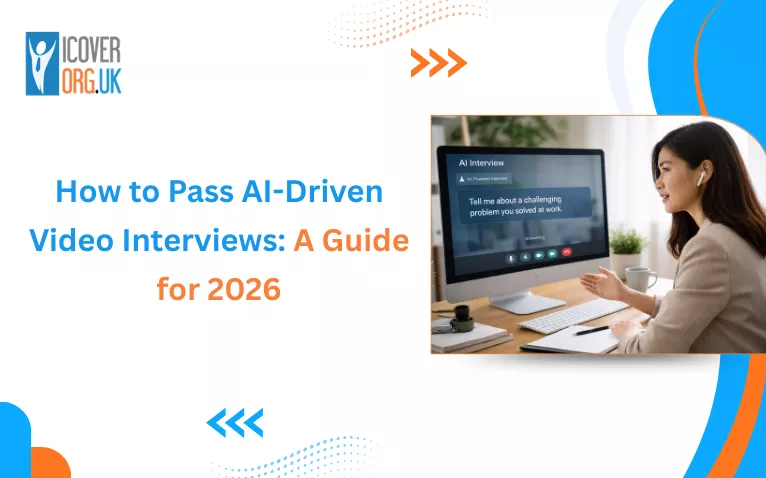
Video interviews might seem easy, but they are harder than you think. You need to understand what the AI measures, master the art of answering the questions that come across, and practice a lot to pass AI-driven video interviews.
Several companies in the UK have already shifted to AI-driven video interviews, and that has helped them fast-track the hiring process, reduce recruitment costs, and improve the screening of candidates.
While the shift was expected, the lack of preparation often leads to candidates failing in interviews. To ensure you don’t face problems while appearing for such interviews, we have prepared a guide on how to pass AI-driven video interviews.
Key Takeaways:
- AI interviews score data points like keywords, tone, eye contact, posture, and answer structure.
- Strong lighting, clear audio, and proper camera placement improve evaluation results.
- Use the STAR + R method and include measurable results in answers.
- Speak clearly and slightly slower for accurate AI transcription.
- Practice with AI mock tools to refine delivery and confidence.
- Avoid reading from screens, generic answers, poor eye contact, and background noise.
- Overly scripted or perfect responses can be flagged as inauthentic.
- Preparation and natural, structured responses are key to passing.
What Are AI Video Interviews?
AI video interviews can be defined as automated, pre-recorded, or live AI-guided assessments where candidates answer interview questions on camera without a human present.
The candidate shares video recordings answering the questions shared by the AI system. The system then analyzes the recordings to evaluate speech, facial expressions, body language, and word choice. It provides immediate, standardised, and objective scores to help employers screen candidates efficiently.
With more than 70% of the companies adopting AI-powered interviews, it is crucial to learn the right ways to crack them.
A Practical Guide on How to Pass AI-Driven Video Interviews for Candidates

There are a few things you need to know before you sit for an AI-driven video interview. The following will act as a practical guide for you to help you pass such interviews:
A. Understand What the AI Measures
You must remember that AI does not judge you; instead, it rates you on data points based on video, audio, and text transcripts. This is what it does:
- Verbal analysis (keywords) – The AI will scan your speech for specific terms and competencies found in the job description.
- Speech pattern/tone analysis – AI will measure your speed, confidence, volume, and use of filler words.
- Non-verbal cues – The system tracks eye contact, posture, and facial expressions.
- Content structure – The tool favours structured, logical answers more than free-form stories.
B. Proper Technical Setup
Video interviews that are AI-driven rely on your technical setup heavily. Poor lighting or audio can result in low scores, despite your qualifications and experience. Here’s what you need to pay attention to:
- Lighting – Make sure to position a light source right in front of you. Also, never have a bright window behind you.
- Camera position – Ensure to position and place your webcam at your eye level. It helps you appear engaging during the interview.
- The eye contact rule – Look directly at the camera lens, not at your own image on the screen. It helps reflect on your direct engagement.
- Background – Keep the background neutral, clean, and free of distractions to avoid being flagged for lack of professional preparation.
C. Master the Art of the Answer
You need to learn how to answer the questions. Take help from professional career services to understand the correct ways to answer questions in such interviews. The following are a few tips to answer AI-driven video interview questions:
- The STAR+R method – You know about the situation, task, action, and result method, right? When you sit for video interviews, add one more ‘R’ to the method. Add reflection while answering the questions. AI looks at such answers as high-quality answers.
- Keywords are king – Before you sit for the interview, go through the job description thoroughly and use the key technical terms and soft skills naturally in your answer. You must understand the importance of soft skills in CV and use that confidently during the interview.
- Speak 10% slower – You can expect a bit of latency in an AI-driven interview. To ensure that it does not play against you, speak slightly slower than you normally do. It will help the AI to transcribe your words accurately.
- Quantify results – Use numbers to demonstrate your impact. AI rewards metrics over vague descriptions.
D. Practice with AI Tools
The best part about preparing is using the system to beat the system. Use AI to your advantage:
- Mock interviews – Platforms like Google Interview Warmup, Yoodli, or CoPrep.ai can help you prepare and practice answering in timed, high-pressure environments.
- Analyse your own footage – Record yourself and analyse for filler words, lack of eye contact, and slouched posture.
- Use generative AI – Use AI tools to generate interview questions and prepare accordingly. Upload your CV on one of the tools and ask it to generate questions for practicing. A professional CV help companies get your CV tailored as per the job descriptions.
The tips will help you pass the video interviews and get called for the next round.
Why Video Interviews Feel More Difficult?
This is a question that is common among all candidates. Most of them find these interviews to be more difficult than physical interviews, yet they do not understand the reasons they find them difficult. Here are a few reasons video interviews feel more difficult:
A. Lack of Human Connection
It is difficult to establish rapport through a screen since the small, nuanced social cues and body language are almost missing. This makes the interaction feel impersonal.
B. Technological Anxiety
In these interviews, there’s always an added pressure of internet stability, audio/video issues, or computer crashes. This is one of the major reasons video interviews feel more difficult than physical interviews.
C. Unnatural Communication Flow
There’s always a chance of delay in video calls. Candidates often don’t understand if they are being heard properly and if all their words are recorded correctly. This creates stress and confusion among candidates, making things difficult.
D. Environmental Distractions
The need to find a perfect location free from noise or distractions is difficult. It feels even more difficult when an AI system is evaluating you. One extra sound other than your voice might ruin your chances of getting to the next round.
E. One-Way Video Interrogation
Speaking to an empty camera makes things difficult for all. Candidates find it hard to adapt to the fact that there’s no interpersonal connection and to complete their answers within the strict time limits.
All these make such interviews difficult for all candidates.
How to Prepare for AI-Driven Video Interviews?
The following are a few tips to prepare for these interviews:
- Technical setup – Test your webcam, microphone, and internet connection beforehand. Make sure to use good lighting and that your background is neutral and tidy.
- Platform familiarity – Make yourself familiar with the platform. Spend some time understanding the platform and its features before you attend the interview.
- Content preparation – Go through the job description for key skills and keywords, and prepare examples using the STAR method.
- Body language and delivery – Make sure to look directly into the camera lens and not at the screen. Also, sit upright and maintain a natural smile.
When you are attending the interview, follow these tips to make the most out of it:
- Speak naturally – Do not talk too much, since that can make you sound robotic and affect your score.
- Use time wisely – Keep all the answers concise and aim for 2-3 clear points. Remember, AI often evaluates the structure and relevance of your responses.
- Be authentic – Do not try to pose as someone you are not. Be yourself and answer the questions.
Wondering how to know if an interview has gone well or badly? Well, before we end the discussion, let’s take you through the things the video interviews evaluate and analyse.
What Video Interviews Actually Test?
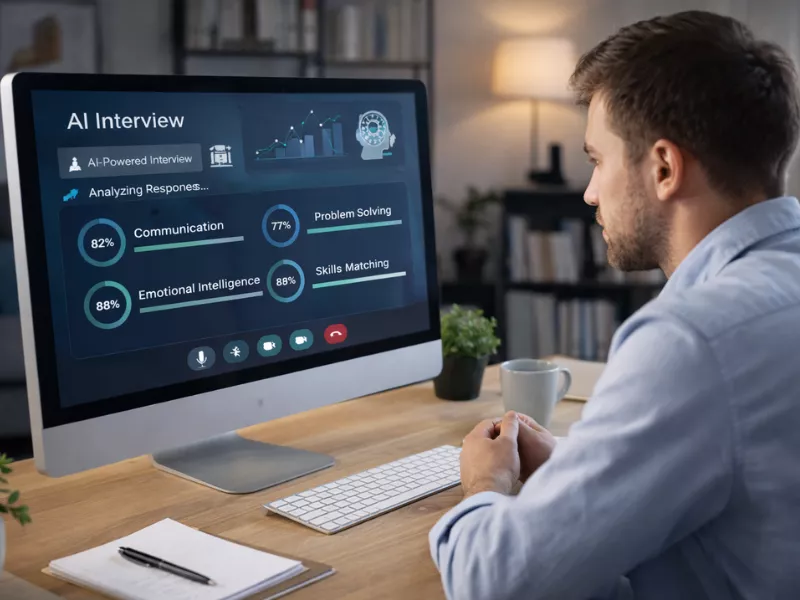
The video interviews evaluate quite a few things. Since this is the first step in the recruitment process, it is crucial to know what these actually test to prepare well:
A. Communication Skills and Clarity
The interviews assess the communication skills and clarity under three different areas:
- Verbal communication
- Conciseness
- Non-verbal cues
B. Behavioural Traits and Cultural Fit
The AI systems analyse your professionalism by evaluating your behavioural traits. The way you show yourself on camera helps the system understand these things and score you accordingly.
C. Technical Understanding
Candidates often need to showcase their technical understanding if they are applying for specific roles. Here, using the right keywords comes into play. The system evaluates your understanding by the way you use the keywords and scores you accordingly.
D. Response Structure
It evaluates your response structure and how you showcase your skills and understanding. Just as in answering the scenario-based interview questions, the STAR + R method is very important here as well. You need to show how you have used your skills to solve problems and reflect on the situations to get better scores.
This helps you be more prepared for the interview.
In addition to this, you need to be aware of one more thing for better preparation: the reasons for rejection.
What Are the Main Reasons for Rejection in AI Video Interviews?
Knowing the main reasons for rejection is important. You need to avoid such things at any cost while attending this interview:
- Reading answers from another screen
- Poor eye contact with the camera
- Unclear, generic, or very short answers
- Very ideal or overly theoretical answers that sound memorised
- Mismatch in data with the resume
- Low confidence or flat tone of voice
- Communication and fluency issues
- Background noise or interruptions
- Too many long pauses
- Not following instructions
A Few Probable Interview Questions You Might Encounter
The interview questions can be of various types. From strength-based interview questions to skill-based interview questions, you might encounter any of them. Here are a few probable questions you might come across:
➔ Strength-Based Interview Questions
- What is a task or project that you find truly energizing, and why does it resonate with you?”
- What are you doing when you are at your professional best?
- How do you stay motivated when working on a repetitive or high-pressure task?
➔ Skill-Based Interview Questions
- Describe a time you used a specific technical tool to solve a complex problem. What were the results?
- Walk me through a project where you had to manage multiple stakeholders with competing priorities.
- Tell me about a time you had to learn a new software or methodology on a very tight deadline.
➔ Behavioural and Situational Questions
- Describe a situation where you had to give difficult feedback to a colleague. How did you approach it?
- Tell me about a time a project failed. What was your role, and what did you learn from the experience?
- How would you handle a situation where a client or manager set an unrealistic deadline?
➔ Cultural Fit and Values Questions
- What does professional integrity mean to you in a remote or hybrid work environment?
- Describe a time you went above and beyond your job description to help a team member.
- How do you ensure your communication remains inclusive when working in a diverse team?
Final Thoughts,
Attending an AI-driven video interview is new for any candidate. Needless to say, adapting to it is difficult for all. However, with proper preparation, one can ace such interviews and move to the next round.
The expert tips mentioned here will help you prepare well for the interview and pass it. But you also need to pay attention to the reasons candidates get rejected and avoid making such mistakes.
Prepare well. Set things up properly and attend the interview with confidence.
All the best!
Frequently Asked Questions
How does AI score my video interview in 2026?
It uses Multimodal Analysis. Beyond keywords, AI now evaluates Semantic Depth (logic and STAR structure), Vocal Prosody (confidence and stress levels in your speech), and Behavioral Alignment (whether your facial expressions match the emotional tone of your story).
Can AI detect if I’m using an AI Copilot or a teleprompter?
Yes. Modern systems track Gaze Saccades (horizontal eye movement from reading) and Response Latency (the 1–2 second delay while an AI generates a prompt). If your speech has Perfect Syntax with zero human fillers (ums/ahs), it flags the response as AI-generated.
What are the best AI interview practice tools for 2026?
The best AI interview practice tools for 2026 include:
- InterviewPro AI: Best for adaptive, live feeling simulations.
- Yoodli: Best for real-time coaching on pacing and body language.
- Huru: Best for generating role-specific mock interviews from a job description.
- Google Interview Warmup: Best for free, high-level thematic feedback.
What is the Follow-up Trap in 2026?
AI interviewers are now Agentic, meaning they don’t just read a list. If your answer is too vague or sounds rehearsed, the AI will immediately Deep Probe with a hyper-specific technical follow-up. If you can’t answer the follow-up with the same level of polish, the AI flags the initial answer as Scripted or Assisted.
What is the Eye Contact Rule for AI interviews?
You must look directly into the camera lens, not at your own image on the screen. AI tracking software measures Direct Engagement by your gaze vector. Looking at your own video feed makes it appear as though you are looking down, which the AI may interpret as a lack of confidence or social connection.
Can I be rejected for Perfect answers?
Yes. If your answers sound overly theoretical, memorized, or too ideal, the AI may flag them as Inauthentic. The system looks for a mismatch between your resume data and your spoken response, as well as a flat vocal tone that suggests you are reading rather than speaking from experience.
How useful was this post?
Click on a star to rate it!
Average rating / 5. Vote count:
No votes so far! Be the first to rate this post.
We are sorry that this post was not useful for you!
Let us improve this post!
Tell us how we can improve this post?

Want To See My Profile — Click Here Jamie
- How to Pass AI-Driven Video Interviews: A Guide for 2026 - March 2, 2026
- How to Write an Executive CV: 2026 Guide for Senior Leaders - January 12, 2026
- Shop Assistant Cover Letter Examples (Download Free 50 Interview Q&A) - December 14, 2024

