
You need to address a career gap in 2026 by treating it as a neutral and productive period, instead of a flaw. Candidates can use concise labels, like skills development, and focus on transferable skill sets, freelance work, or upskilling completed during the time off.
With close to one-third of the UK’s workforce having a career gap of 6 months or more, it is crucial to understand the correct ways to address that in your CV.
Here, we will help you understand the correct ways to address a career gap. We will also share how to structure your CV and a few tips for interviews.
Key Takeaways
- Treat a career gap as a neutral or productive period, not a flaw.
- Highlight continuous learning, upskilling, freelance, or project work during the gap.
- Be transparent and brief, then pivot to why you’re ready to return.
- Use a hybrid CV format to emphasise skills and achievements over dates.
- Name the gap clearly (e.g., sabbatical, caregiver) within work history.
- Rebrand education as “Continuous Learning” to show growth.
- Use LinkedIn’s Career Break feature to explain gaps professionally.
- In interviews, apply the 3-S strategy: State, Share, Steer back to the role.
- Confidence and clear positioning matter more than the length of the gap.
4 Tips to Address a Career Gap in Your CV
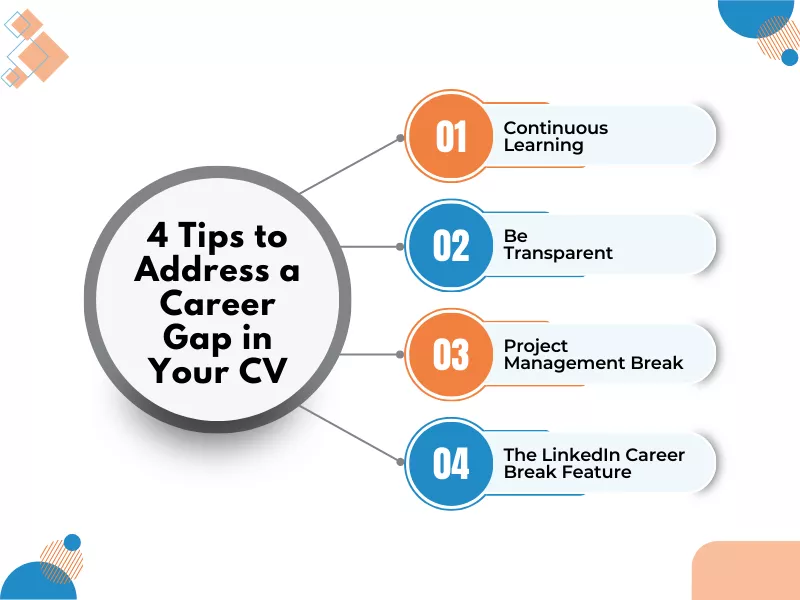
There are ways to address a gap in your CV. Earlier, what focused on why with an apologetic tone has now shifted to confident and intentional. However, since not all candidates understand how they can address a gap in employment, here are a few tips to help them with it:
A. Continuous Learning
In the age of AI, technical skills stop being relevant after a certain point in time. Use that to your advantage. Cover your employment gap by showcasing the skills you have learned during that period.
Presently, employers prefer candidates who are continuously learning than the one who are stagnant in their role. For example, if you have spent 10% of your time learning new tools, frame the gap in your CV as a ‘self-directed upskilling sabbatical.’
B. Be Transparent
Lying on your resume for bridging the gap careers is not recommended. You must talk about why you took a break and why you are willing to return to work now. Professional authenticity is of utmost importance.
So, if you have taken a break in your career for family care, health recovery, or burnout, state that clearly. It is wise to use the ‘brief and pivot’ technique to explain that you’ve had a career break. Keep the reason clear and brief, and pivot to the reason you are ready to return now. You can avail CV writing services to ensure the profile has all the necessary points placed correctly.
C. Project Management Break
Many work on projects. So, if you did any consulting, pro-bono work, or even managed a complex personal project, it will be considered project management. This can be used as one of the common reasons for employment gaps.
It is wise to use a ‘hybrid resume’ format to highlight skills and specific wins during the gap in careers. This will help employers understand what you did and how you did in it during your break.
D. The LinkedIn Career Break Feature
Another way to address a career break is by using the LinkedIn ‘career break’ feature. Since LinkedIn is a platform that is widely used by job aspirants and recruiters, leaving an employment gap without any description can harm your profile.
Candidates can use the description box to highlight the transferable skills. This will help employers understand the reason behind the gap and what you have done during that period. The experts from professional career services advise students to use this feature to avoid any problems in the future.
That will help you understand the correct ways to address employment gaps on your CV. It is recommended that you go through a few career gap CV examples to understand things better. However, it is equally important to understand the correct ways to structure your CV to address these gaps.
The Correct Ways to Structure Your CV with an Employment Gap
You need to follow a proper structure to address gaps in your employment. The best way to go about it is to stick to one structure. Here’s how you can structure it:
- Heading: personal and contact details
- Profile
- Key skills (optional)
- Employment history
- Education/training
- Languages
- Interests (optional)
The key is to define your gap in a way that justifies the reason you were in a break and convinces the recruiter to consider your profile. Below is an ideal way to structure your CV properly:
A. The First Points
Start your CV with a professional summary. A 3-line career narrative should be the right way to start. Do not talk about seeking a new role. Instead, showcase your expertise in new tools and your professional experience.
The top third of the page should talk about your skills. It helps hiring managers understand your skills and expertise and stops them from skipping your profile.
B. Name the Gap
Firstly, don’t create a separate section for the career gap in your CV or your career gap cover letter. Instead, use it as a formal entry in the professional history section. It helps avoid date skipping and helps explain the employment gap naturally.
Name the section as ‘professional sabbatical or family caregiver’ or anything that you have done during that time. List down everything you did during that period in bullet points. Do not explain too much. Also, include a link to any certificate you have received for course completion during that period.
C. Group Fractional or Freelance Work
In case you have multiple gaps or have worked on multiple projects during that period, mention that in groups to justify gaps in your employment history. Group them under one section. For example, if you have worked as a consultant for multiple projects, mention project consultant and list the names of the projects.
This makes the CV easy to scan and helps recruiters understand that you were not actually away from work. It also builds the trust that when you return to the workforce, you will not be stressed with the changes.
D. Continuous Learning Section
The education section must be rebranded as continuous learning. In case you have completed a certification course recently, move this section above work history. It helps prove that the gap was actually for proper professional growth.
It helps recruiters understand that you have upskilled yourself and justifies the reason you are seeking a new opportunity. This is a very good practice, and you must use this as a section to get better opportunities.
Here’s a list of common reasons for a career break on your CV:
- Took a break from work to find better opportunities
- Laid off due to internal changes that affected the entire organisation
- Taking a career break to be a caregiver
- Took some time away from work to be a stay-at-home parent
- Career break as part of maternity leave
- A long career break to pursue higher education
- Time off to relocate to a new place
- Took a break for personal and professional development
It is wise to find the right CV template to ensure every point is placed correctly. Moving on, we will take you through a few expert tips on how to handle a CV gap during a face-to-face or a virtual interview.
How to Explain a Career Gap in an Interview?

We will share a few expert tips in short before we end this discussion. Since numerous candidates get their CVs right, but ultimately fail to answer the questions on gaps during an interview, we feel it is necessary for all to know how to do it.
Here’s how you can handle questions on reasons for a career gap in an interview:
A. The 3-S Strategy
State, share, steer, that’s what you need to do while answering career break questions in an interview. Keep the explanation short, tell what you did, and steer it back to the job you are applying for. It will help in job search.
B. Talk to Career Counsellors
There cannot be a better way than talking to career counsellors before you attend an interview. They can help you with the correct ways to handle the questions and even provide sample scripts for a better understanding.
C. Assume the Questions
A career break in a CV often makes the recruiters question the candidate’s skill levels. To avoid such scenarios, prepare yourself beforehand. You will be asked questions on new technology, and being prepared for it will help you answer them confidently.
That will help you address career gaps in your CV and answer them well in your interview. Further, you must go through a few career gap cover letter examples to frame the entire application properly.
When Should I Explain a Gap in My CV?
A gap in your CV needs to be included if you feel it would make a difference to your applications. Understanding this can be difficult, and you need to look at your profile from an employer’s lens to understand if they would question what you were doing at that time.
You must consider two variables:
- How long was the gap – If your career gap is long, you must explain it in your CV
- How recent is the gap – If you have taken a break recently, it is crucial that you address that in your application
Once you have prepared your CV, go through it yourself to understand if the gap needs to be addressed or not.
The Types of CV Gap and How to Explain Them
When applying for a job after career gap, you need to find the right justifiable reason before sending the application. Here are a few justifiable reasons along with the right ways to explain them:
A. Illness
You can take a break due to physical or mental illness. This is something you cannot predict or have control over. In case you have taken a long time off for recovery, include that in a single sentence in your CV.
Example: Jan 2021 – June 2021: Took a break for recovery from illness
B. Travel/Gap Year
Travel time actually attracts employers. So, if you have taken a break for travel, it can be used to show recruiters how you are organised, confident, and hard-working. You need to do it the right way to ensure it connects well with the hiring managers.
Example: Career Break | Jan 2024 – Aug 2024
Planned international travel focused on cultural exposure and personal development. Maintained professional growth through online certifications and independent projects.
C. Job Searching
There are instances where candidates search for jobs and fail to land one for a long period of time. Career gap jobs search is difficult in these cases. In such cases, it is wise to highlight constructive things you have done during the job search period.
Example: Professional Development & Active Job Search | Jan 2025 – Present
Actively pursuing Software Developer roles while completing AWS Certified Solutions Architect certification and strengthening skills in Python, SQL, and cloud deployment.
D. Caring for Family
You can use caring for family as a reason for a career gap in your CV. This is a great way to show how you learned new skills and experience that are valued by employers. Do not stretch this section; keep it brief.
Example: Family Care Sabbatical | Jan 2024 – Dec 2024
Took a planned career break to provide full-time family care while maintaining professional skills through online learning and industry updates.
E. Layoff
If your role was made redundant by your previous employer, which resulted to layoff, don’t shy away from talking about it. In case you have been unemployed for months, show how learned new skills, volunteered to work in different roles, or have done anything at that time.
Example: Position Redundancy | Jan 2025 – Mar 2025
Role concluded due to organisational restructuring; actively pursuing new opportunities while engaging in professional upskilling.
F. Maternity
This is a common reason for employment gaps, and no employer will question you on this. Also, if you have taken maternity or paternity leave during work and came back to work for the same employer, you were actually never on a break.
Example: Dec 2024 – Apr 2025 – Maternity Leave
G. Study
Study leave is acceptable, and it adds a few good points to your CV. While you can briefly state what you studied, it is crucial to provide the proof when you are asked about it.
Example: Full-Time Study | Jan 2024 – Dec 2024
Took a planned career break to complete a Postgraduate Diploma in Data Analytics and strengthen skills in Python, SQL, and data visualisation.
That will help you understand and address the different types of gaps correctly in your CV.
Final Thoughts,
A career gap is not a crime. You need to know how to handle or address it properly in your CV and answer the tough question during your interview. That alone will help you get the job. Do not lose confidence just because you have a career gap. Instead, use it to your advantage.
Speak confidently in your interview, and mention everything you did during that period in your CV to grab the attention of recruiters. However, make sure to avoid redundancy and explain an employment gap in brief in your CV.
References:
Frequently Asked Questions
How much career gap is acceptable in CVs?
A career gap is a period of 3-6 months, and it does not require a deep dive. However, if the spaces on your CV are longer than 6 months, it should be noted. There’s no such acceptable gap period. You need to justify the career gap reasons properly.
Is a 2-year career gap bad?
No, a 2-year gap is not bad if you can explain the reasons behind the gap. The key is knowing how to explain the gap and justify the period as a positive impact or personal growth.
Can a long career gap be a problem for employees?
It can be a problem if you don’t justify the gap properly. A prospective employer feels skill rot. To avoid such situations, use a functional CV to highlight the skills and experiences you acquired while away, instead of focusing on chronological work experience.
How long is too long for a career gap?
There’s no such time limit to state that, but if your career gap is more than 3 or 5 years, you need to build a strategy to get back to work. It is necessary to prove your previous roles and how they are still relevant as per the current industry standards.
How do I address a career gap in a cover letter?
Explain the gap in one or two sentences briefly. Frame it as one of the legitimate reasons for the gap and state how you are completely focused and in good health to get back to work. Go through a few examples of cover letter for career gap to better understand the ways to frame them.
How can I show I am work-ready if I haven’t used any new technology?
You need to bridge the gap and explain through proof of activity, like:
- Volunteer
- Showcase life sessions
- Update your CV
- Explain the CV gaps using experiences during the interview
How do I list skills if my professional experience is several years old?
To list skills from your old experience, you can create a ‘core competencies’ or ‘technical skills’ section, or use an ‘early career highlights’ section. The focus should be on transferable skills, and using a functional or hybrid CV format is recommended.
Should I mention a specific reason for my gap (e.g., burnout, childcare, travel, etc.) on my CV?
Yes, you must mention the specific reason for your gap. The objective is to stay transparent and ensure the recruiters understand the reasons you took a break.
How useful was this post?
Click on a star to rate it!
Average rating / 5. Vote count:
No votes so far! Be the first to rate this post.
We are sorry that this post was not useful for you!
Let us improve this post!
Tell us how we can improve this post?

Want To See My Profile — Click Here Zak
- How to Address a Career Gap in 2026: The Returner’s CV Guide - February 17, 2026
- How to Write a CV with No Experience in 2026: Unskilled CV Example - January 22, 2026
- Nursery Nurse CV Example and Writing Tips| Nurse CV Examples - June 3, 2025

