

Stop failing interviews because you can’t recall a good story quickly! Scenario-based questions are the UK hiring manager’s favourite tool to test your critical thinking, and if you freeze up, you lose the job. Scenario based interview questions are widely used by hiring managers in the UK to assess candidates’ problem-solving, critical thinking, decision-making, and communication skills in hypothetical job-related situations. Evidently, it is essential to learn to answer situational questions.
This comprehensive guide includes:
- Common Interview Questions
- Sample answers
- How-to guide to answer these questions
- How-to guide to prepare for these interviews
- Mistakes you can avoid
At iCover.org.uk, we believe answering scenario-based questions is the foundation of every successful career. These questions test your problem-solving, decision-making, and communication skills in realistic job situations —they are designed to predict your on-the-job success, not just review your past.
What Are Scenario Based Interview Questions?
Well, Scenario-based interview questions present you with a realistic work situation and ask how you would handle it. Instead of focusing on your past experience, these questions test your:
- Problem-solving
- Communication
- Decision-making
- Teamwork
- Ability to stay calm under pressure
They help employers understand how you think, not just what you’ve done before.
What Are the Common Types of Scenario Based-Interview Questions?
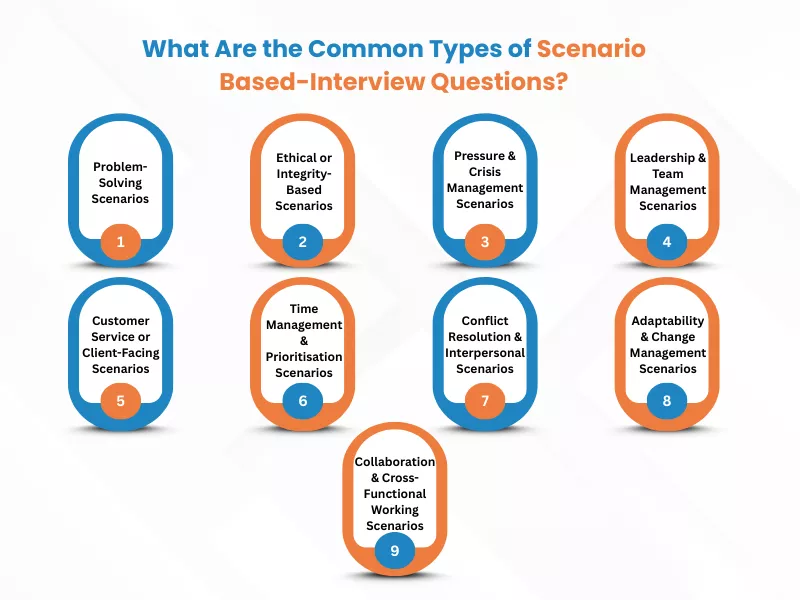
Problem-Solving Scenarios
As recruiters with years of experience in the UK job market and career services, we often ask these scenario based questions for interviews to evaluate how you approach challenges, analyse information, and make decisions.
Ethical or Integrity-Based Scenarios
Recruiters in job interviews ask these to test judgment, honesty, and alignment with organisational values.
Pressure & Crisis Management Scenarios
One of the favorite scenario-based interview questions for teaching assistants, this is designed to assess your calmness and clarity during urgent situations.
Leadership & Team Management Scenarios
If you apply for a leadership role, it is most likely that this scenario based team leader interview questions and answers will set your path.
Customer Service or Client-Facing Scenarios
Common in roles involving customers, clients, or stakeholders.
Time Management & Prioritisation Scenarios
These assess your ability to handle multiple responsibilities under pressure.
Conflict Resolution & Interpersonal Scenarios
These test your emotional intelligence, diplomacy, and communication style.
Adaptability & Change Management Scenarios
These test how well you cope with change, uncertainty, or new processes.
Collaboration & Cross-Functional Working Scenarios
Great for roles that require teamwork and stakeholder engagement.
20 Scenario-based Interview Questions Interviewers Ask Candidates
- A key deadline is approaching, but your team is falling behind. What actions would you take to get things back on track?
- You notice a colleague repeatedly making mistakes that affect the team’s performance. How would you handle this?
- A customer becomes angry and raises their voice at you. What steps would you take to calm the situation?
- You’ve been given an important task but not enough information to complete it. What do you do?
- You and your manager strongly disagree on an approach. How would you manage the situation?
- Two team members are in conflict and it’s affecting productivity. How would you resolve it?
- You’re assigned a project outside your usual skill set. How do you approach it?
- Your workload becomes unmanageable with several urgent tasks due at once. How would you prioritise?
- A colleague is resistant to a new system or process. How would you support them through the transition?
- You discover a mistake you made that could impact a client or the business. What do you do next?
- A client requests something that goes beyond company policy. How would you respond?
- You’re working with another department that is slow to respond, delaying your project. How do you handle this?
- During a meeting, a team member dominates the discussion, preventing others from contributing. What would you do?
- You’re given two conflicting instructions by different senior managers. How would you decide what to do?
- Your team misses a KPI or performance target. What steps would you take to improve future results?
- A junior colleague asks for help repeatedly and it’s affecting your productivity. How would you manage the situation?
- You witness behaviour that doesn’t align with company values or ethics. What’s your next step?
- You have to deliver difficult feedback to a colleague or team member. How would you approach it?
- A long-term customer is unhappy with a recent experience. How would you repair the relationship?
- You’re asked to present something last minute and you’re unprepared. What do you do?
5 Situational Interview Questions and Sample Answers
“What would you do if you were given a tight deadline with limited resources?”
Sample Answer (General Office Role):
“I would start by breaking down the task into smaller deliverables and identifying what must be completed first. I’d communicate early with my manager about any potential risks and explore alternative ways to speed up the process, such as reallocating tasks or using existing templates. I’d then track progress closely and adapt quickly if priorities shift. This ensures transparency, quality, and timely delivery.”
“How would you handle a conflict between two team members?”
Sample Answer (Team Leader/Managerial Role):
“I would speak to each colleague individually to understand their perspectives without judgment. Then I’d bring them together for a structured conversation, focusing on the issue—not personalities. My goal would be to agree on shared expectations and future working guidelines. I’d follow up later to ensure the solution is working and both feel supported.”
“A customer is frustrated and becomes confrontational. How would you respond?”
Sample Answer (Customer Service | Retail):
“I would remain calm, listen actively, and acknowledge their frustration. I’d apologise for the inconvenience and clarify the issue in simple terms. Then I’d offer practical solutions within company policy and check if they were satisfied. If needed, I’d involve a supervisor to resolve the matter swiftly. The focus is on empathy, clarity, and restoring trust.”
“You’ve been assigned a task you’ve never done before. What would you do?”
Sample Answer (Graduate/Entry Level):
“I’d begin by researching best practices and reviewing any available guidelines. Then I’d consult a knowledgeable colleague to confirm I’m heading in the right direction. I’d complete the task carefully, asking questions when needed, and request feedback at the end so I can improve next time. This approach ensures accuracy and continuous learning.”
“You realise you’ve made a mistake that could impact the team or client. How would you handle it?”
Sample Answer (Corporate/Professional Role):
“I would take responsibility immediately and assess the extent of the impact. I’d inform my manager with a clear summary of what happened and proposed solutions. Then I’d quickly resolve the issue and review my process to make sure it doesn’t happen again. Transparency and accountability help maintain trust.”
Situational Interview Questions and Answers as per the Industry
Now, check out some of the example questions and how to answer them in Group Interviews!
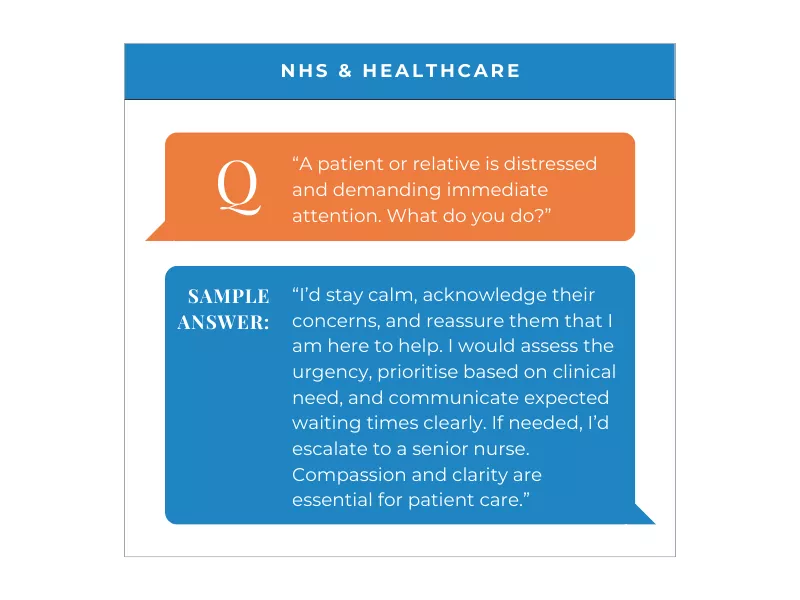
🏥 NHS & Healthcare
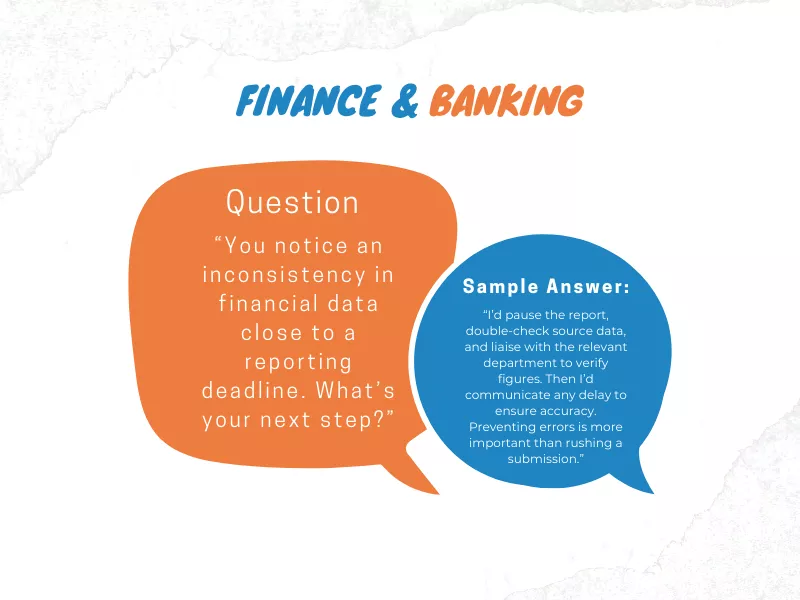
🏦 Finance & Banking
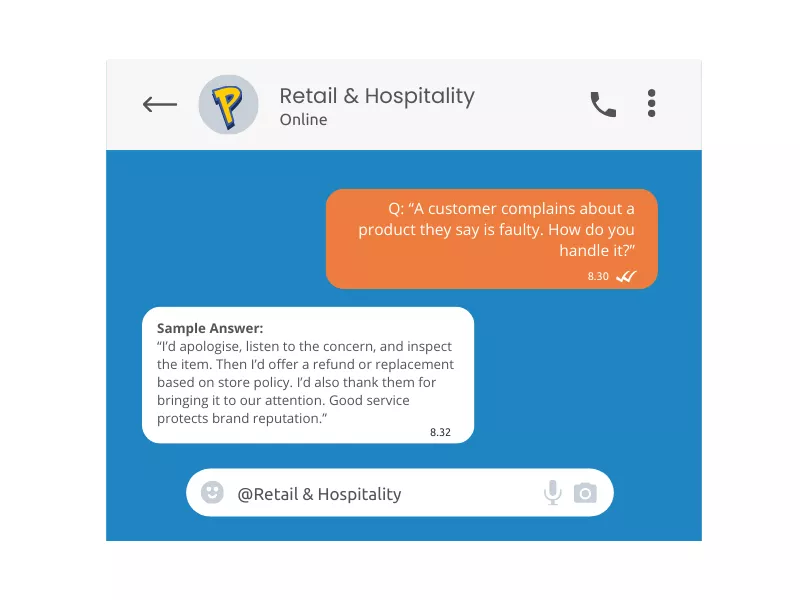
🛒 Retail & Hospitality
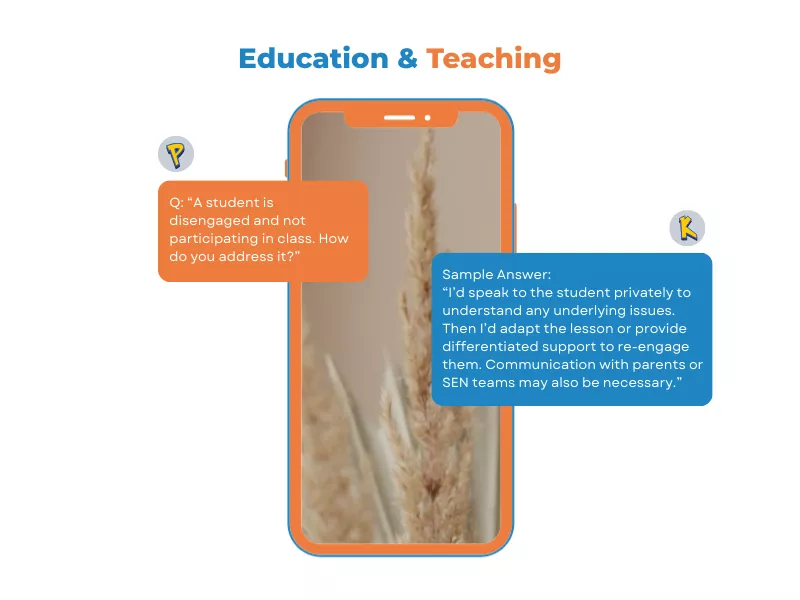
🧑🏫 Education & Teaching
💻 IT & Tech

How to Answer Scenario Based Interview Questions?
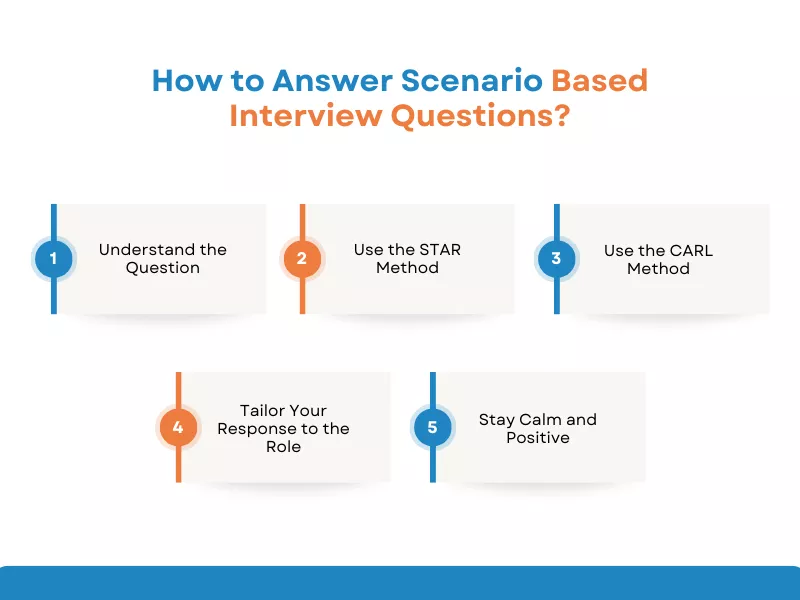
Understand the Question
First, listen carefully to what the questions focus on in the formal or Informal Interview. Are they testing your management skills (e.g., as a project manager), your ability to be a team player, or your technical problem-solving skills (e.g., as a software engineer)? This helps you select the most relevant experience to prepare answers.
Use the STAR Method
Be it the Strength based Interview Questions or scenario-based, the most common and effective framework for scenario-based questions is the STAR interview method.
- S (Situation): Briefly describe the context, who was involved (e.g., a small team), and when it happened.
- T (Task): Explain your responsibility or the goal you needed to achieve (e.g., to meet the deadline).
- A (Action): Detail the specific steps you took to handle the situation. This should be the bulk of your answer this question.
- R (Result): Describe the outcome of your actions.
Use the CARL Method
Another useful structure is the CARL method, especially if the interviewer asks about what you learned in a Formal Interview.
- C (Context): The background and challenge.
- A (Action): What you did.
- R (Result): The outcome.
- L (Learning): What you learned from the experience and how you’d apply it in your next interview.
Tailor Your Response to the Role
To excel, have several example answers ready that cover common themes:
- Conflict Resolution: A time you dealt with a difficult coworker.
- Meeting Deadlines/Prioritisation: A time you had to manage your time under pressure.
- Leadership/Delegation: A time you had to delegate tasks.
- Mistake/Failure: A time you made an error and how you recovered.
Stay Calm and Positive
Maintain a positive tone throughout. Even when describing a challenge, focus on your proactive actions and the positive resolution/learning.
Furthermore, it is one of the signs of a positive interview. Read How Do You Know If an Interview Has Gone Well to know all signs.
Why Do Interviewers Use Situational Interview Questions?
- Soft Skills: How you act as a team player, manage your time, and use clear communication.
- Practical Application: Your ability to handle the situation and solve real-world situations (e.g., in business analyst interview questions scenario based).
- Judgment: Your decision-making process when facing a set of challenges or needing to meet a deadline.
- Behaviour: How you structure your answer (e.g., using the STAR method) to discuss a time you performed a key job function. This is also a tip on how to pass AI-driven video interview questions.
How to Implement into the Interview Process?
Implementing scenario-based questions effectively ensures you gather reliable, predictive data about candidates. This requires careful preparation, structured execution, and objective evaluation.
| Phase | Key Actions | Keywords |
| Prepare | Define role soft skills and management skills. Develop realistic sample questions aligned with the job description and define a scoring rubric based on the STAR interview method to prepare answers. | soft skills, job description, sample questions, management skills |
| Execute | Ask structured questions. Prompt candidates to answer this question with full details (Situation, Action, Result) on how they handle the situation or delegate. Note how they address set of challenges like working to meet the deadline. | answer this question, handle the situation, delegate, meet the deadline |
| Evaluate | Use the rubric to objectively score responses, focusing on the quality of action and result. Compare results to select the best fit for the next interview. | set of challenges, next interview, objective scoring |
At What Stage of the Hiring Process Are Scenario-based Interview Questions Asked?
Scenario-based (or behavioural) questions are typically asked in the later stages of the hiring process:
- Second or Third Interview (Screening Stage): Often used by the hiring manager or team lead after initial HR screening to assess if the candidate possesses the necessary soft skills and experience.
- Final Panel/Team Interviews: This is the most common stage, used to see how the candidate would fit into the small team and handle the situation related to real-world situations or a set of challenges specific to the role.
They are rarely used in the very first screening interview, which usually focuses on general background and availability.
How to Prepare for Scenario Based Interview Questions?

Unlike traditional behavioural questions that ask about past events (“Tell me about a time when…”), these questions often present a hypothetical situation, testing your critical thinking interview questions based on hypothetical scenarios, decision-making, and problem-solving skills in the moment.
Preparing for this format requires a structured, proactive approach. By understanding the interviewer’s perspective, you can predict potential scenarios and formulate compelling, job-specific responses. Here is a guide on how to prepare effectively, following the key stages an interviewer considers when creating their questions.
Understanding the Job Role
Thoroughly analyse the job description to pinpoint the required technical skills (software engineer, project manager) and soft skills. This helps predict the nature of the question’s focus.
Identifying Key Competencies
Determine the core behaviours the interviewer is looking for, such as management skills, clear communication, delegation effectiveness, and the ability to be a team player.
Developing Scenarios
Write down sample questions covering frequent real-world situations, like resolving conflict within a small team or racing to meet the deadline.
Selecting Scoring Criteria
For each scenario, prepare answers using the STAR method (Situation, Task, Action, Result). Focus on the specific Action you would take to handle the situation.
Common Themes in These Types of Questions
Practice answering questions across universal themes: conflict, time management (manage your time), prioritisation, and failure/recovery. This ensures you have example answers ready for your next interview.
Mistakes to Avoid When Answering Situational Interview Questions
Candidate Execution Errors
- Failing to Use Structure: Providing a rambling narrative instead of using the STAR method to clearly articulate the specific Action and Result.
- Being Vague: Answering with what you would do, or failing to use “I” to detail your specific contribution to the small team or task (e.g., how you chose to delegate or manage your time).
- Blaming Others: Speaking negatively of a previous colleague or employer. Frame it as a set of challenges and focus on the positive resolution for your next interview.
- Overlooking Non-Verbal Cues: Displaying nervousness or poor posture, which can distract from your strong, well-prepared example answers.
Interviewer-Related Mistakes (To Be Aware Of)
- Biases in Scenario Design: Not recognising that a question might favour a specific background (e.g., prioritising project manager experience when interviewing a software engineer). Adjust your STAR interview story to focus on your relevant soft skills.
- Leading Questions: Being steered toward a specific answer by the interviewer. Stick to the facts of how you handled the situation based on your real-world situations.
- Ignoring Cultural Sensitivity: Failing to adapt your response if the scenario involves practices that vary by company or region. Focus on universal principles like clear communication and professionalism.
Key Takeaways: Tips for Success with Situational Questions
To summarise the best preparation and execution strategies, focus on these critical tips to ensure you perform your best when facing scenario based questions for interview:
Before the Interview (Preparation)
- Understand the Role: Analyse the job description to predict the questions focus (e.g., if you are a project manager or software engineer).
- Structure Answers: Prepare answers using the STAR method and have strong, multi-faceted example answers ready for common set of challenges.
During the Interview (Execution)
- Use “I”: Detail the specific Action you took to handle the situation or delegate. Avoid the vague “we.”
- Stay Calm and Clear: Maintain clear communication and focus on the positive outcome.
- Quantify Results: Prove you can meet the deadline by providing measurable results (the ‘R’ in STAR) to stand out for the next interview.
Now that you have it all, do you feel confident and prepared about Scenario Based Interview Questions? Well, iCover believes you are, but if you are not and need a little more help or encouraging, our experts are a click away!
Frequently Asked Questions
Are Scenario Based Interview Questions Useful?
Yes, scenario-based interview questions are highly useful. They move beyond a candidate’s past performance to assess their critical thinking, problem-solving skills, and decision-making process in a relevant, job-specific context. They provide strong predictive validity for future job performance, especially in roles requiring quick, logical judgment.
How to Answer Behavioural Interview Questions?
Behavioural interview questions (which ask about past experience, e.g., “Tell me about a time when…”) should be answered using the STAR Method:
- Situation: Briefly describe the context.
- Task: Define the goal or challenge you faced.
- Action: Detail the specific steps you took to address the task.
- Result: State the positive outcome and what you learned.
How to Reuse One Example for 10 Different Questions?
You should not reuse a single example for 10 different questions, as this signals a lack of breadth in experience. However, a strong, multi-faceted professional example (like leading a major project) can often be adapted to address 2–3 different competency areas by shifting the focus in the Action and Result steps.
Example: A project challenge can illustrate conflict resolution (focusing on team dynamics) or prioritisation (focusing on time management) based on the question asked. Always ensure the chosen focus directly answers the interviewer’s query.
How to Answer Nursing Scenario Based Interview Questions?
When answering nursing scenario based interview questions, candidates should prioritise patient safety, critical assessment, and adherence to protocol. Structure your answer by:
- Assessment: State what vital information you would immediately gather (vitals, history, current status).
- Action/Prioritisation: Detail the immediate, highest-priority intervention (e.g., stabilising the patient, calling for help, notifying the physician).
- Communication: Describe how and to whom you would communicate the situation (e.g., charge nurse, doctor, family).
- Documentation/Follow-up: Mention the necessary paperwork and continued monitoring.
How Do Interviewers Assess Your Responses in These Interviews?
Interviewers use scoring rubrics to assess responses based on predefined criteria, not subjective impressions. They look for:
- Thought Process: Did the candidate analyse the root cause and consider risks, not just jump to a solution?
- Relevance and Practicality: Was the proposed solution realistic, feasible, and appropriate for the given context?
- Structure and Clarity: Was the answer delivered logically, often following the STAR framework?
- Fit: Did the action align with the company’s values and standard professional ethics?
How useful was this post?
Click on a star to rate it!
Average rating / 5. Vote count:
No votes so far! Be the first to rate this post.
We are sorry that this post was not useful for you!
Let us improve this post!
Tell us how we can improve this post?

Want To See My Profile — Click Here Chloe
- 20 Scenario Based Interview Questions: What Are They and How to Answer? - December 4, 2025
- Cruise Ship Job Cover Letter Example and Writing Guide 2026 - November 26, 2025
- Professional Driver Cover Letter Examples (Templates Included) - September 24, 2025

