
Board appointments mostly happen through informal recruitment methods. Only a few are appointed to boards through recruiters or in response to an advertised opportunity. In the latter case, a candidate needs to submit a CV, a cover letter, and a personal statement or a supporting statement.
A personal statement for board position can be defined as a written document, generally 1-3 paragraphs, that you submit when applying to serve on a board of directors, advisory board, nonprofit board, or similar governing body.
While most candidates understand what needs to be in a CV or a cover letter, most of them struggle to write a personal statement. Here, we will walk you through the ways to write a personal statement for a board position.
Key Takeaways
- Board applications often require a personal statement alongside a CV and cover letter.
- Keep it concise (1–2 pages) and structured in 3 parts: intro, evidence, and motivation.
- Research the organisation and tailor your statement to its mission and needs.
- Focus on governance, strategy, and measurable impact (use examples with results).
- Start with a strong opening and maintain a confident, relevant tone.
- Avoid common mistakes like repeating your CV, being vague, or submitting generic content.
- Alignment with the organisation matters as much as experience.
The Right Ways to Write a Personal Statement for Board Position
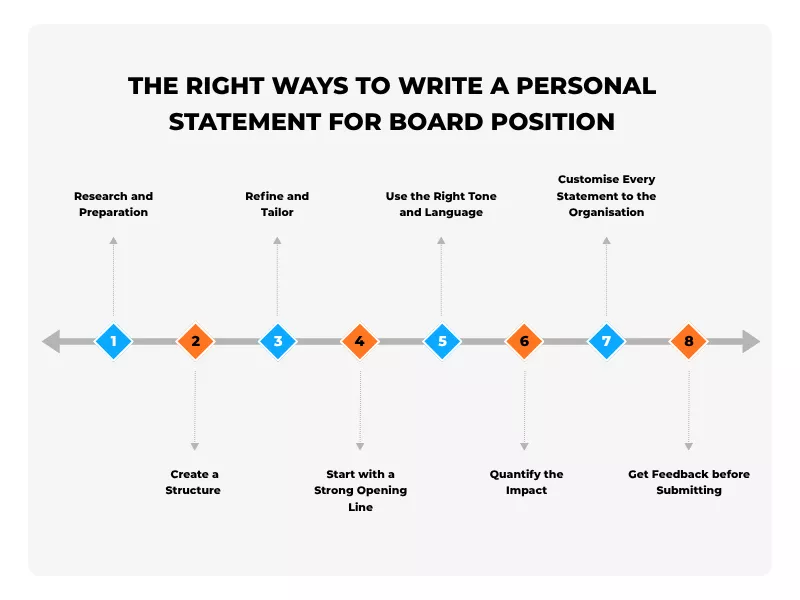
You must understand what a personal statement does to your CV. It is necessary to move beyond a traditional executive CV and showcase strategic oversight, governance skills, and commitment to the mission of the organisation.
Experts associated with professional career services understand the difference and can help you if you are confused about the ways to write one.
Follow these steps to ensure your personal statement serves the purpose:
A. Research and Preparation
Before you start writing, you need to research the organisation thoroughly by visiting the website. Go through their strategic plan, review recent annual accounts to understand more about the company. Identify the specific skills they are looking for in the candidate pack or job description.
This will help you tailor your personal statement according to the criteria and requirements set by the company.
B. Create a Structure
A standard three-paragraph structure for a personal statement is highly effective. Here’s a look at an ideal structure of a personal statement to support a board of directors resume:
- Paragraph 1: Introduction and credibility – In this section, introduce your background, relevant qualifications, and the specific value you bring. Also, include the motivation for applying early in this section.
- Paragraph 2: Evidence and impact – This is the heart of the statement. Map your experience directly to the selection criteria using the TEE method:
- Technical: State clearly that you meet the requirement
- Example: Give a concrete example of when you demonstrated this
- Evidence: Quantify the outcome of your action
- Paragraph 3: Motivation and commitment – Reiterate your personal connection to the cause and your commitment to the organisation’s long-term success.
C. Refine and Tailor
Once you have the structure, you must refine and tailor your supporting statement accordingly. It is necessary to ensure the statement is concise. Keep it to 1-2 pages, and avoid jargon.
You need to emphasise strategic oversight, instead of operational management. Before you finalise that, read it out loud to ensure it flows well and that it has no mistakes.
D. Start with a Strong Opening Line
The opening line of your personal statement is the most important sentence you will write. Most candidates start with generic sentences, and that leads to wasting an opportunity to make an impression.
It is highly recommended that you lead with your strongest credential. It helps the recruiters understand that you are a self-aware and confident candidate.
E. Use the Right Tone and Language
In board applications, candidates must follow a specific tone, which is different from the way you write a standard job application. These are the things you need to follow:
- Write in first person
- Use governance language
- Avoid operational language
- Be confident, not arrogant
- Match the organisation’s tone
F. Quantify the Impact
Board positions are result-oriented. This is why it is crucial to back up your claims with numbers and outcomes. Statements like ‘I have strong marketing experience’ will hold no value compared to specific evidence.
Quantifying your impact makes the statement memorable and credible, and supports the TEE method directly.
G. Customise Every Statement to the Organisation
Do not make the mistake of using the same personal statement for multiple board positions. The recruiters can understand when a statement is generic, and it shows a lack of genuine interest.
For every application, you must:
- Reference the organisation’s specific mission, values, or strategic priorities
- Address the exact skills and experience listed in the job description
- Explain the reasons the board matters to you personally, not just the boards in general
- Adjust your tone to match the culture of the organisation
All these might take extra time, but it also increases the chances of being shortlisted.
H. Get Feedback before Submitting
Do not submit the statement before getting it reviewed by another person. Talk to someone who has relevant board experience. It will help you understand if your statement is right and fits all the requirements. If you don’t find someone with such experience, ask a trusted colleague or mentor for review and feedback.
Additionally, you must also read the statement aloud for a final check. This will help you identify awkward phrasing, repetition, and errors that often get missed while reading silently.
The Common Mistakes to Avoid while Writing a Personal Statement
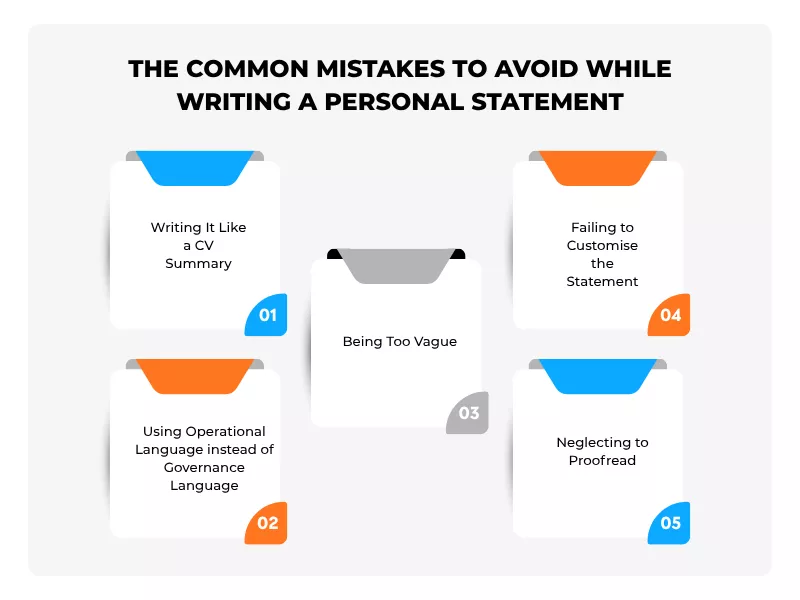
It is crucial to know about the common personal statement or CV mistakes candidates make and ensure to avoid all of them while writing the statement. The reason is that even experienced professionals make avoidable errors when writing a personal statement for a board position. The following are the common mistakes you must avoid while writing a personal statement:
A. Writing It Like a CV Summary
One of the common mistakes candidates make is that they simply write the personal statement like a CV summary. You must understand that the statement is not a repeat of your CV. In fact, it is your chance to bring your experience to life.
Also, this is where you demonstrate your strategic thinking and explain your motivation. The professional CV writing services UK offer help to candidates struggling to write these statements.
B. Using Operational Language instead of Governance Language
You must understand that boards govern; they don’t manage day-to-day operations. Therefore, a personal statement filled with operational language indicates that the candidate does not understand the nature of board-level work.
C. Being Too Vague
Using statements like ‘I have leadership skills’ or ‘I am passionate about the cause’ adds no value to the personal statements. These statements ruin your chances of getting a call for an interview and make your profile similar to others.
D. Failing to Customise the Statement
A generic statement gets rejected quickly. The recruiters can understand if the statement is written specifically for their organisation or not. Candidates often use the same statement for board positions, only to end up getting rejected by recruiters.
E. Neglecting to Proofread
Most candidates often ignore the entire process of proofreading. As a result, their personal statements and the entire application get rejected. Not proofreading carries the risks of submitting the applications with grammatical and spelling errors.
Here are two examples to help you understand what to avoid and what to include:
| Bad personal statement | Good personal statement |
| I am a results-driven professional with 10+ years of experience managing teams, improving processes, and delivering projects. I have strong communication and problem-solving skills and can contribute to organisational growth. I believe I am a great fit for this board role. | I bring over 10 years of leadership experience and aim to contribute at board level through strategic oversight and risk governance. Having supported audit and compliance initiatives, I offer independent judgement and constructive challenge. I am particularly aligned with your mission to expand education access and would add value through strong governance and stakeholder accountability. |
Availing the best cover letter writing services can be of great help in these cases.
Sample Board Application Supporting Statement
With over 12 years of experience in financial governance and a lifelong commitment to education equity, I am eager to bring my expertise to the board of [Organisation Name] at this critical stage of its growth.
Throughout my career as a Chartered Accountant and Senior Finance Director at [Company Name], I have developed a strong foundation in financial oversight, risk management, and strategic planning. I have served on two audit committees, where I was responsible for reviewing financial controls, ensuring regulatory compliance, and advising on long-term investment strategy. Most recently, I led a financial restructuring programme that reduced organisational costs by 18% while maintaining service delivery standards — an outcome that required both rigorous financial analysis and board-level stakeholder engagement.
I am particularly drawn to [Organisation Name] because of its mission to provide equal access to quality education for underserved communities. Having grown up in a community where educational opportunities were limited, this cause resonates deeply with me on a personal level. I have reviewed your most recent annual report and strategic plan, and I believe my expertise in financial governance directly addresses the board’s current priority of strengthening its financial oversight framework. I am committed to contributing meaningfully to your mission and to serving the full term of the appointment with dedication and integrity.
You can go through a few more personal statement examples to understand the correct ways to write it and how a board-level statement is different from others.
Pre-Submission Checklist for Candidates
While that will help you write a perfect statement, it is crucial that you go through this checklist before you send it for review:
- Thoroughly researched the organisation’s mission, values, and strategic priorities
- Addressed the specific criteria listed in the job description
- Opened with a strong, compelling first line
- Used governance language throughout
- Backed up every claim with a specific example and a measurable outcome
- Customised the statement specifically for the organisation
Final Thoughts,
Writing an executive personal statement for a board position is not as easy as it seems. You need to follow all the steps to ensure your application stands out from the crowd and improves your chances of getting a call for an interview.
An important thing to remember is that board members are not just selected on the basis of their credentials alone. The recruiters or the selection panel look for candidates who genuinely connect with the organisation’s mission and demonstrate commitment and integrity.
The personal statement is your chance to prove that you are the best fit for the position. Therefore, take your time to work on the statement and go through each aspect before you submit it.
Frequently Asked Questions
What should a personal statement for a board position include?
A personal statement should include a strong opening, your relevant experience and qualifications, specific examples of impact backed by evidence, your alignment with the organisation’s mission, and a clear statement of motivation and commitment.
How do you write a board biography for the first time?
Start with your current or most recent role, highlight governance-relevant experience, include any committee or advisory board involvement, and close with a brief personal note on your connection to the sector. Keep it to 150–200 words and write in the third person.
What is the difference between a board biography and an executive biography?
A board biography emphasises governance, strategic oversight, and mission alignment, while an executive biography focuses on career progression, operational achievements, and industry expertise. The tone and purpose are different; one is written for a governing role, the other for a leadership role.
How long should a board application supporting statement be?
Most supporting statements should be 400–600 words or one to two pages. Always check the executive and non-executive director application guidelines first, as some organisations specify a word count or page limit.
What do nominating committees look for in board candidates?
Nominating committees typically look for relevant domain expertise, governance experience, alignment with the organisation’s values, diversity of perspective, availability to commit to the role, and a genuine connection to the organisation’s mission.
Can you use the same personal statement for multiple board applications?
No, you should not use the same personal statement for multiple board applications. Each statement must be tailored to the specific organisation, reflecting its mission, values, and requirements. A generic statement can signal a lack of genuine interest and reduce your chances of being shortlisted.
How useful was this post?
Click on a star to rate it!
Average rating / 5. Vote count:
No votes so far! Be the first to rate this post.
We are sorry that this post was not useful for you!
Let us improve this post!
Tell us how we can improve this post?

Want To See My Profile — Click Here Jamie
- How to Write a Personal Statement for Board Position? - April 3, 2026
- Executive CV for Career Change: How to Reposition Your Leadership Profile - March 24, 2026
- How to Pass AI-Driven Video Interviews: A Guide for 2026 - March 2, 2026

