
In the UK job market and higher education domain, the ability to tell the right story in the right manner is a key part of getting ahead. When it comes to your career, be it academic or professional, two important documents, the cover letter and personal statement, play an important role apart from the curriculum vitae.
However, a common point of confusion for applicants is understanding the specific roles and requirements of a Cover Letter vs Personal Statement. Although these documents have the same intent, their proper use is the key to an effective application.
If you’re looking for a competitive position in the corporate world or seeking admission to a university, the key to getting noticed and making an impact is knowing which document to send first and how to customise your message.
In this article, we have cleared up the confusion with all the details to help you take the right action. Keep reading!
Key Takeaways on Cover Letter vs Personal Statement
- A cover letter is a pitch for a particular vacancy, while a personal statement outlines your career path.
- Every professional CV should feature a brief personal statement (profile summary) at the top.
- Limit cover letters to one A4 page and CV profile summaries to 3–5 lines.
- The personal statement on a university application (UCAS) is different from a CV personal statement and is longer.
- Never use the same cover letter for each job application.
What Is a Personal Statement on a CV?
A personal statement for job application UK is a brief introductory paragraph that comes at the beginning of your CV, just after your contact details. It serves as a short elevator pitch that summarises your qualifications, key competencies, major achievements, and value to the employer.
What to Write in a Personal Statement for a Job Application?
A professional personal statement writing service provider considers including these elements:
- Present your current position or profession and years of experience.
- List two or three core skills that match the job description.
- Present one positive outcome or accomplishment from experience.
- Propose your value by explaining what you will bring to the new company.
Is the Personal Statement on My CV the Same Thing as a Cover Letter?
No, the personal statement on your CV is not the same thing as a cover letter. A cover letter is a one-page document sent with your CV when you apply for a job. It will introduce you to the employer, explain why you are looking for the position, and highlight your best talents.
What's the Difference Between a Cover Letter and a Personal Statement in the UK?
A cover letter should only talk about the one position you’re applying for; a personal statement should be used to discuss your career story, values, and motivations. Here’s a quick table on the key difference between a cover letter and a personal statement:
Feature | Cover Letter | Personal Statement |
Primary Focus | Role-specific alignment | Individual development and story |
Core Audience | Corporate hiring managers | Academic boards or recruiters |
Tone | Formal and professional | Reflective and introspective |
Format | Standard business letter layout | Narrative essay or short bio |
Content | Explicit company-focused value | Personal character and motivations |
Customisation | Rewritten for each individual position | Broadly applicable to a field |

A refreshed CV makes your story clear
Career change, gap, or restart — our builder structures your CV section by section so it reads clean. Free to build — download from £3.99.
How Long Should a Personal Statement and a Cover Letter each be for UK Applications?
Most hiring managers spend under a minute scanning an application, so a cover letter should be short and to the point—no more than a single page. A personal statement is, on the other hand, a longer narrative or a short bio depending on the use.
Here’s how long should a personal statement and a cover letter each be for UK applications:
Document Type | Ideal Length | Word Count (Approx) |
Cover Letter | 1 page A4 | Within 300–400 words |
Personal Statement for Graduate Scheme or University Admission | 47 lines max | Within 450–550 words |
CV Personal Statement | 3–5 lines | Within 100–150 words |
Sample on Personal Statement vs Cover Letter UK for Job Application
Sample 1: CV Personal Statement (The “Profile”)
A highly motivated Project Coordinator with 5 years of experience in the UK construction sector. Expert in managing multi-site operations and reducing project overheads by 15% through streamlined resource allocation. Seeking to apply proven organisational skills and PRINCE2 accreditation to a challenging role within [Company Name].
Check out more CV personal statement examples.
Sample 2: Job Cover Letter (Standard UK Format)
[Your Name]
[Your Address]
[Your Phone Number]
[Hiring Manager Name]
[Company Name]
[Company Address]
[Date]
RE: Application for Senior Marketing Executive (Ref: 9876)
Dear [Name],
I am writing to apply for the Senior Marketing Executive position at [Company Name], as advertised on LinkedIn. Having followed your company’s recent digital transformation projects, I am eager to contribute my expertise in multi-channel campaign management to your team.
In my current role at [Current Company], I successfully led a rebranding initiative that resulted in a 25% increase in organic web traffic over six months. I am confident that my ability to combine creative strategy with data-led analysis makes me an ideal fit for your current objectives.
I have long admired [Company Name] for its commitment to sustainable innovation, and I would welcome the opportunity to discuss how my background can help drive your upcoming Q4 targets.
Yours sincerely,
[Your Name]
When to Write a Cover Letter?
If you are wondering when to use a cover letter, instances include:
- The employer specifically asks for one
- If you’ve had an employment gap
- Or, if you are applying for a job in a different field
This is also useful if you’re already referred and wish to draw attention to certain contexts that aren’t included in your resume.
Skip writing a cover letter if
- The job listing tells you not to submit a cover letter
- If the direct application portal doesn’t have any field or attachment slot to upload it
Can You Use a Personal Statement Instead of a Cover Letter?
Generally, no. If a cover letter is specifically requested, it cannot be substituted with a personal statement. Both have different formats and functionalities. They are used for different purposes as per the academic and job board requirements.
Do I Need a Cover Letter If I Have a Personal Statement?
For job applications, your CV contains your personal statement, and it is always a good idea to have a cover letter ready, tailored to the specific JD. It is ideal to have a cover letter along with a personal statement when:
- Applying via email.
- If the direct application form has a dedicated section for a cover letter.
Using both is highly effective in the following scenarios:
- Aiming for high-competition roles: Positions where thousands of applicants are competing or applying for leadership or executive roles that require multi-layered screening.
- Transitioning: Entering a corporate office after serving in the military or changing career path from a sales executive to a digital marketer.
Note: If you are applying for a medical residency, grad school, or an academic job, you only need a personal statement.
Personal Statement Vs Cover Letter for Graduate Scheme Applications
A graduate scheme application is a formal request by a university student or recent graduate to be considered for a place on a structured, multi-year placement scheme. Now, graduate schemes may ask for a personal statement and a cover letter for online application questions and for email applications. Let’s see how they compare in structure (with examples):
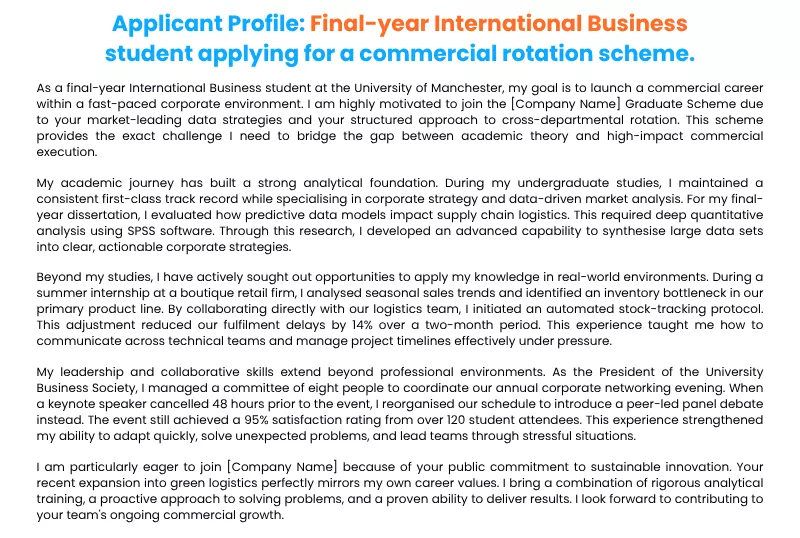
Personal Statement for Graduate Scheme Application
Along with a graduate CV, you’ll need to write a separate personal statement that describes the reason behind your choice of career and how your education and skills make you a fit for a leadership career. Here’s how to structure it:
- Paragraph 1: Outline your qualifications, your short-term goal, and why this particular graduate scheme is a good fit for you.
- Paragraph 2: Emphasise your accomplishments in college and how they benefit you in your corporate career.
- Paragraph 3: Share a specific instance where you used soft and hard skills to solve a business or organisational problem.
- Paragraph 4: Give an illustration of teamwork, dealing with project constraints, or organising an extracurricular project.
- Paragraph 5: Remind the reader why you picked this one particular company and give a summary of the special value you will provide.
Cover Letter for Graduate Scheme Application
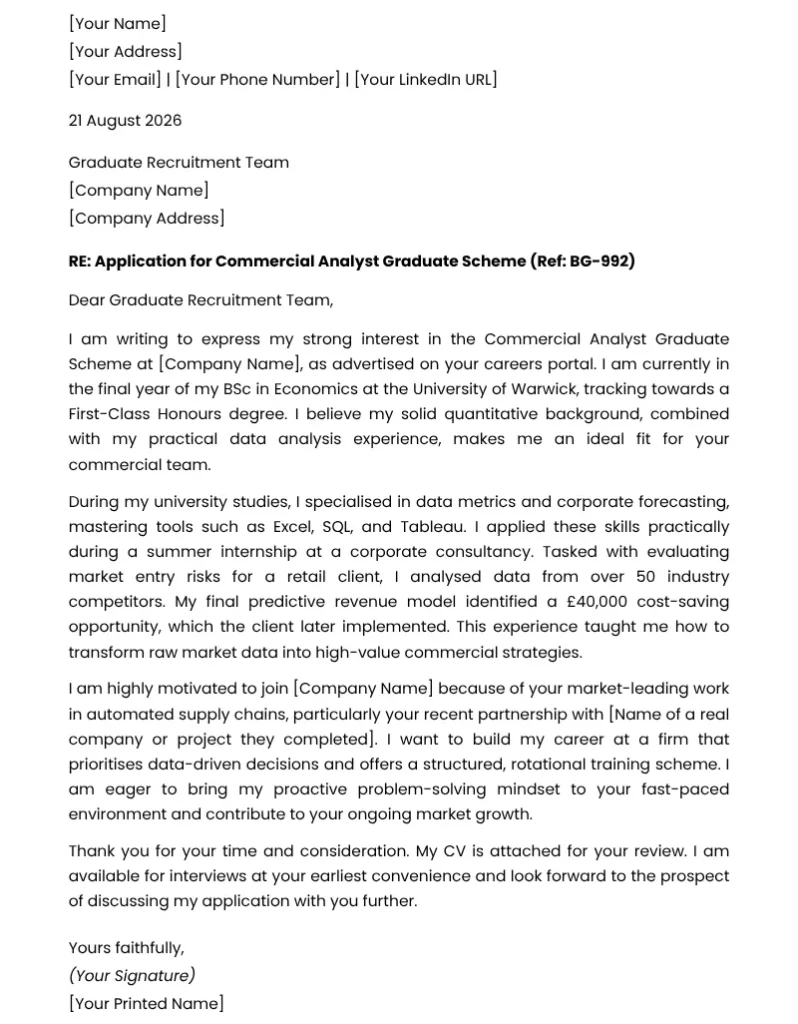
For graduate scheme applications, your cover letter must answer the question: “Why should we hire you over other graduates?” Here’s how to write a cover letter for a graduate scheme application:
- Header: Your contact information, date, company address.
- Opening (Introduction): Identify and specify the position you are applying for, your current level of study, and a short paragraph that summarises why you are a good fit.
- Why You? (The Evidence): List your academic or professional accomplishments. Use metrics to prove your value.
- Why Them? (The Motivation): Explain exactly why you want to work for this specific company. Refer to a recent project, deal, award or news article to show you have done your research.
- Closure: Restate your interest and let them know you are available for interviews.
How Is a UCAS Personal Statement Different from a Job Application Cover Letter?
UCAS is the Universities and Colleges Admissions Service. It is the shared online organisation that handles applications for undergraduate courses at universities and colleges in the UK. Students apply for up to five courses at one time in a single central form through UCAS.
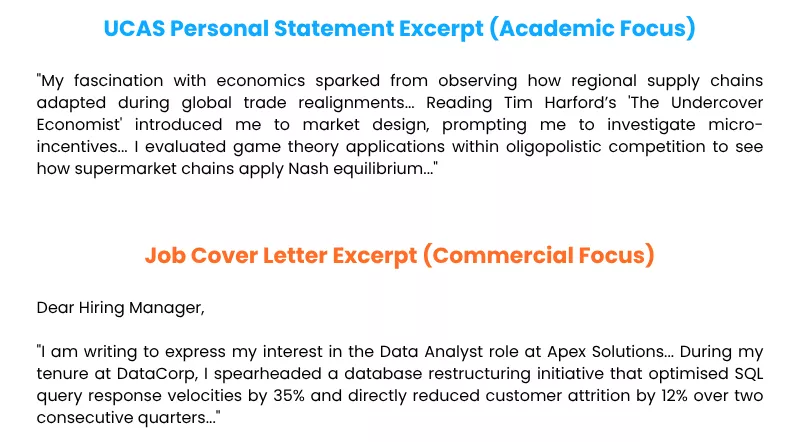
Personal statements at UCAS are generally written for a broad application, with emphasis on academic abilities, subject interest, and independent study. A job application cover letter is a commercial pitch, specific to one particular employer and position. It targets a specific employer’s commercial needs, proving via a formal business letter how your work history matches a distinct vacancy.
Check out this sample on UCAS personal statement vs cover letter:
The NHS Job I'm Applying for Asks for a Supporting Statement — Is that a Cover Letter?
An NHS supporting statement is not a cover letter. An NHS supporting statement (which is part of the “Supporting Information” section of NHS Jobs) is a highly structured, evidence-based document. It is the most important component of your application as it is the one that recruiters mark against the Person Specification and determine whether or not you will receive an interview.
Pros and Cons of Using a Personal Statement vs a Cover Letter
Types | Pros (Advantages) | Cons (Disadvantages) |
Cover Letter |
|
|
Personal Statement |
|
|
Common Mistakes to Avoid
To make an effective personal statement or cover letter, avoid these pitfalls:
- Mixing up personal statement and cover letter: Although personal statements and cover letters share many features, it is important not to confuse them. Avoid using a cover letter instead of a personal statement and vice versa.
- Using the wrong tone: Formal and professional language is required throughout the cover letter, whereas a personal statement can be a bit more informal and personal. Be certain to write in the right tone and language for the right document!
- Writing a cover letter using a generic template: When writing a cover letter, you want it to be noticed and make a good impression on the reader.
- Not following job application standards: In the UK, the conventions governing job applications are generally formal and professional, and prefer to-the-point, concise narratives.
- Avoiding the customisation of content: When you’re sending out personal statements or cover letters, you should always use different content for each position. Take time to know what the employer is seeking, and make your personal statement or cover letter correspond.
Professional Cover Letter and Personal Statement Writing Service UK
When applying for a job or a university place in the UK, your cover letter or personal statement is often one of the first things a recruiter or admissions officer reads. Because generic templates rarely make a good impression, iCover provides a professional writing service to help your application stand out.
Our UK-based experts have an in-depth understanding of what employers and universities are looking for. We don’t use a one-size-fits-all approach, with individualised documents better suited to your experience and objectives. From a cover letter for a corporate job to a personal statement for a UCAS application, we provide a custom-designed service with a quick turnaround for your first draft.
Our career service is practical and effective, designed to present your skills clearly. To improve your chances of success, visit iCover to find out how we can support your next application.
A refreshed CV makes your story clear
Career change, gap, or restart — our builder structures your CV section by section so it reads clean. Free to build — download from £3.99.
Frequently Asked Questions
I’m applying for a job in the UK — do I need both a personal statement and a covering letter?
No, typically, you do not require a separate personal statement and cover letter when applying for a job in the UK. A personal statement is included in your CV and is sent automatically when you submit your CV. A covering letter is a one-page document that accompanies a CV when applying directly by email or through job boards. If applying through an application form online, a covering letter is not required unless specifically requested in the application form.
Can I reuse my personal statement as a cover letter for different jobs?
No, you should not reuse a personal statement as a cover letter for different jobs. You need to write a cover letter separately in a different format.
Should I write my CV personal statement in the first person or the third person?
Write your CV personal statement using first person implied style by dropping the pronoun like “I” or “my.” Avoid the third person (“he,” “she,” or your name).
Should I include a cover letter in the body of an e-mail message or send a copy as a PDF attachment?
For email applications, make sure to copy and paste a clean, brief cover letter into the body of the email. If requested by the employer, include a cover letter in PDF format.
Should I include my references in a cover letter or personal statement?
No, don’t refer to or list references in your cover letter or personal statement.
How useful was this post?
Click on a star to rate it!
Average rating / 5. Vote count:
No votes so far! Be the first to rate this post.
We are sorry that this post was not useful for you!
Let us improve this post!
Tell us how we can improve this post?

Want To See My Profile — Click Here Scott
- Cover Letter vs Personal Statement: When to Use Each - August 26, 2026
- Beginner Cover Letter Format – Free Template with Samples - June 30, 2026
- How to Write a Cover Letter in the UK? [Secret Tips And Templates] - March 11, 2024
