
You just got the email. Your interview is confirmed. Now what?
Most people panic. They skim a few tips online, pick an outfit the night before, and hope for the best. But the candidates who walk out feeling confident are the ones who prepared properly, not just for an hour, but with a real plan.
This interview preparation guide gives you exactly that. Whether you’re applying for your first job or making a career move, this is your complete guide for how to prepare for an interview UK in 2026, from the moment you get the invite to what you do after you leave the room.
Key Takeaways on Interview Preparation
- Start your interview preparation at least one week in advance, not the night before.
- Research the company, the role, and (if possible) the interviewers themselves.
- Use the STAR method to structure your answers to competency-based questions.
- Prepare your own questions to ask; it signals confidence and genuine interest.
- Know the seven common interview questions UK employers almost always ask, and have strong answers ready.
- Plan your journey, outfit, and logistics so nothing trips you up on the day.
- After the interview, reflect, follow up, and request feedback if unsuccessful.
What Good Interview Preparation Actually Looks Like?
Good interview preparation is not just reading your CV the night before. It’s a process that starts the moment your interview is booked and covers research, practice, logistics, and mindset. Think of it as building a case for why you are the right person for the role, and then rehearsing how to present that case clearly and confidently.
How to Prepare for the Interview Questions: Step by Step Tips
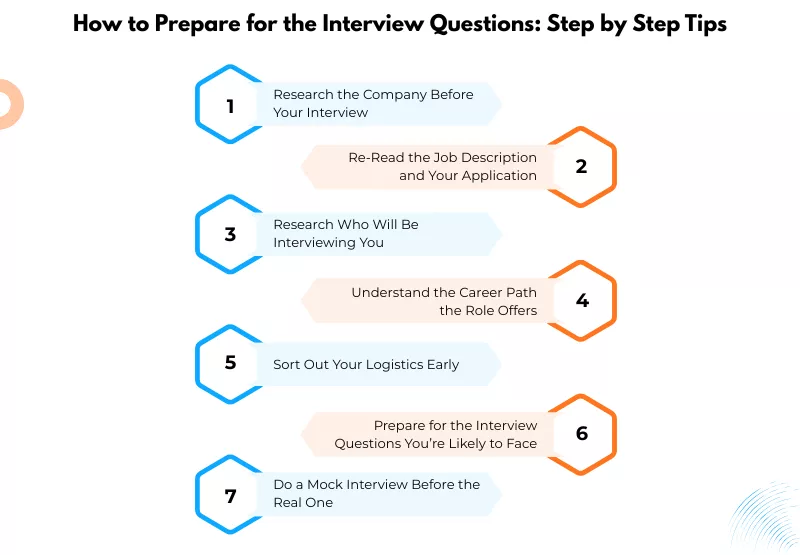
Here are the job interview tips and tricks to help you succeed:
Step 1: Research the Company Before Your Interview
Does researching a company before an interview really make a difference? Yes, it makes a significant difference apart from you having skills and experience. Interviewers notice immediately when a candidate has done their homework. They notice just as quickly when someone hasn’t.
Knowing the company’s current projects, recent news, key clients, and culture tells the interviewer you’re genuinely interested, not just chasing any role. It also helps you tailor your answers and gives you natural material for the questions you ask at the end.
Step 2: Re-Read the Job Description and Your Application
The job description is your best guide to what questions are coming. Before preparing your answers to become the best fit, go back to basics. Re-read the job description in full, then re-read your own CV and application form. The job description is a map. It tells you which competencies matter most, and those are exactly the areas the interviewer will probe.
You need to be able to:
- Explain clearly why you want this specific role
- Demonstrate that you understand what the job involves
- Make the case for why the employer should choose you over other candidates
Highlight the key requirements in the job description and match each one to a specific example from your experience. This step alone transforms the quality of your answers.
Step 3: Research Who Will Be Interviewing You
If you know who will be on the group interview panel, look them up. Understanding a panel member’s professional background helps you connect your experience to things they’ll value, ask more targeted questions, and feel less nervous. They become a real person, not an intimidating stranger.
The invitation email often includes names, or you can check the company website and LinkedIn. It’s a small step that makes a real difference to your confidence on the day.
How to prepare for a panel interview?
To prepare for a panel interview, research each interviewer’s role to tailor your technical and cultural answers effectively. During the session, maintain balanced eye contact with the entire group, even when responding to a single person, to ensure everyone stays engaged.
Step 4: Understand the Career Path the Role Offers
Research how the role fits within the wider team and business. Understanding the progression path tells the interviewer that you’re thinking long-term and are serious about joining the organisation, not just collecting job offers. Mention the skills related to the job role. Personalise the CV using the CV editing service.
If there are relevant professional qualifications or training courses linked to the role, consider mentioning an interest in learning and development during the interview. Do this naturally and briefly; it signals initiative without making it look like your main focus is what the company can do for you.

Step 5: Sort Out Your Logistics Early
This sounds basic, but it is the most important job interview preparation tips, but poor journey planning causes more pre-interview stress than almost anything else.
- Plan your route online and identify your transport options.
- Add at least 20–30 minutes of buffer time on top of your estimated journey.
- If possible, do a trial run in advance so you know exactly where the entrance is.
Arriving flustered or late can undermine weeks of preparation in seconds. Arriving ten minutes early, calm and composed, puts you in the right headspace before you even sit down.
Step 6: Prepare for the Interview Questions You’re Likely to Face
Most UK interviews use a mix of question types:
- Competency-based questions ask for specific examples from your past (“Tell me about a time when…”)
- Strength-based questions explore what energises and motivates you
- Situational questions present a scenario and ask what you would do
- General questions cover your motivations, background, and career goals
Prepare three to five strong examples from your work, studies, or personal life. Choose examples that are recent, relevant, and show a clear outcome. You can adapt these across different types of interview questions.
Step 7: Do a Mock Interview Before the Real One
This is one of the most effective interview preparation tips for job seekers. Talking through your answers out loud feels very different from thinking them through in your head. A mock interview helps you identify gaps in your answers before they appear in the real thing, get comfortable with phrasing your experiences clearly, manage nerves through practice, and receive honest feedback. This can also be one of the best video interview tips; practising well can help you stay prepared.
The Seven Interview Questions UK Employers Almost Always Ask

While no two formal interviews are identical, these are the questions that come up again and again. Prepare confident, specific answers for all of them before you walk in.
1. “Tell me about yourself.”
This is usually the opening question, and it sets the tone for everything that follows. Keep it professional and relevant.
How do you answer “Tell me about yourself” in a UK interview?
Cover your background briefly, highlight two or three key achievements or skills, and explain why you’re genuinely interested in this role. Don’t simply recite your CV; add personality and context, and keep it to around two minutes.
2. “Why do you want to work here?”
This is where your company research pays off. Show that you’ve thought about why this organisation, not just this type of role. Reference something specific, their culture, a recent project, their market position, or values that align with yours.
3. “Why should I hire you?”
Focus on what makes you different. Outline what you can offer in terms of experience, personality, and enthusiasm. The job description tells you what they’re looking for; make sure your answer directly addresses those qualities with specific examples from your work experience. If it seems confusing, then professional career services can help you in preparing these questions.
4. “What are your strengths and weaknesses?”
For strengths, choose qualities genuinely relevant to the role and back them up with evidence. For weaknesses, pick a trait you’ve already made positive steps to address. For example: “My IT skills weren’t where I wanted them to be, so I completed an online course and now use the tools confidently day-to-day.” This shows self-awareness and a growth mindset.
How do you answer “What are your weaknesses” without hurting your chances?
The key is to choose a real weakness, not a thinly veiled strength like “I work too hard,” and show that you’ve actively done something about it. Name the weakness honestly, explain what impact it had, describe the specific steps you took to improve, and show the outcome. This tells the interviewer you’re self-aware, proactive, and not defensive about your development areas.
5. “Where do you see yourself in five years?”
Talk about the kind of role you’d like to grow into, but always link it back to what this company can offer. Research their career development programmes and reference them where relevant. An interviewer will be impressed if you’ve thought about both your short and long-term goals.
6. “How do you handle pressure or tight deadlines?”
Use a real example and structure it. Show that you stay organised, prioritise well, have skills and qualifications, and maintain quality under pressure. Avoid examples where things went seriously wrong through poor planning. You can do that by using the STAR method.
Is the STAR method used in UK job interviews?
Yes. STAR stands for Situation, Task, Action, Result. It’s the most widely used framework for answering competency-based questions in the UK.
7. “Do you have any questions for us?”
Always say yes. This is your chance to demonstrate that you’ve researched the role thoroughly and are genuinely invested. Prepare at least four or five questions, so you have backups if some are answered during the interview.
What Questions Should You Ask the Interviewer?
Asking good questions at the end is one of the most underused ways to impress. It shows engagement, preparation, and genuine interest. Always avoid asking about salary, holidays, or benefits at this stage.
Strong questions for the interviewer include:
- “Why has this position become available?”
- “How does this role fit within the wider team structure?”
- “What does career progression typically look like for someone in this position?”
- “What are the biggest challenges someone in this role will face in the first six months?”
- “How would you describe the team culture?”
- “What are the company’s main priorities over the next year?”
- “What does success look like in this role after the first three months?”
Prepare four or five questions so that if one or two come up naturally during the conversation, you still have solid ones left to ask at the end. For a fuller list broken down by topic, see Questions to Ask the Interviewer at the End of an Interview.
Prepare for AI Screening and One-Way Video Interviews
Before you ever speak to a human, you’ll likely face an automated stage. The majority of large UK employers now use AI-powered applicant tracking systems (ATS) and one-way video interview platforms, tools such as HireVue, Spark Hire, and Sonru, as the first filter in their hiring process.
According to CIPD research, over 60% of large UK organisations used some form of automated assessment in their 2024–25 hiring cycles. Not knowing what to expect here is one of the most common reasons strong candidates fail before the first human conversation.
What is a one-way video interview?
A one-way video interview presents pre-set questions on screen and records your answers. There is no interviewer on the other side; you film yourself responding and submit the recording.
Some platforms give you a fixed window to prepare (often 30 seconds) before your response time begins (typically 1–3 minutes per question). Once you start recording, you usually cannot re-record. Your responses are then reviewed by the hiring team, and in some systems, scored by AI before a human sees them.
How to prepare for a one-way video interview?
The same content rules apply as in any interview: clear STAR-structured examples, specific evidence, and genuine enthusiasm, but the format demands extra preparation in four specific areas:
- Test your kit first. Check your camera, microphone, and internet connection the day before. Most platforms offer a practice question; use it. A technical failure on the day cannot be undone.
- Control your environment. Choose a plain, uncluttered background with good front-facing light. Dress as you would for an in-person interview from the waist up. Silence your phone and close other applications.
- Look at the camera, not the screen. Eye contact with the camera reads as eye contact with the reviewer. Glancing down at your screen creates the impression that you are reading notes or avoiding eye contact.
- Use your preparation time. When the question appears, read it fully before your preparation countdown starts. If you can, then jot a quick note of your opening sentence. Starting crisply matters far more in a recorded format than in conversation.
What about ATS screening?
Before any interview is booked, many large employers pass applications through an ATS that scans for keywords from the job description. This is not something you can control on the day; it is something you build into your CV and cover letter before you apply. The relevant preparation at the interview stage is awareness: if you are invited to interview, it means your application cleared the ATS.
Conclusion
Learning how to prepare for a job interview step by step is one of the most valuable career skills you can develop. The candidates who consistently perform well in UK interviews are not necessarily the most qualified; they’re the most prepared.
Use these interview preparation tips for job seekers 2026 every time you have an interview coming up. Research thoroughly. Practise out loud. Plan every practical detail. Know your STAR examples inside out. And remember, the interview is a two-way process. You’re evaluating them just as much as they’re evaluating you.
Now go in there and show them what you’ve got.
Frequently Asked Questions
How long to prepare for an interview?
For most roles, 3 to 5 days of dedicated preparation (about 1–2 hours per day) is ideal to thoroughly research the company and practice your responses. For senior executive or highly technical positions, you should plan to spend 1 to 2 weeks preparing.
How far in advance should you prepare for a job interview in the UK?
Ideally, start your preparation as soon as the interview is confirmed, not the night before. A week gives you enough time to research the company, prepare your answers, practise out loud, sort your logistics, and feel genuinely ready. If you have less time, condense the steps, but don’t skip them entirely.
What should you wear to a job interview in the UK?
Dress to match the company’s industry and culture. When in doubt, lean slightly more formal than you think necessary. Blue and black are widely seen as the most professional colours. Plan your outfit several days in advance so there are no surprises in the morning.
How do you research a company before a job interview?
Visit the company website, check recent news coverage, scroll through their social media, and look at the LinkedIn profiles of the people interviewing you. Look for recent projects, key clients, any announcements, and the company’s stated values. This research underpins both your answers and the questions you ask.
What to bring to a job interview?
Bring printed copies of your CV, the job description, any relevant portfolio work, a notepad, and a list of your questions. If the employer has requested documents such as ID or qualification certificates, make sure these are ready in advance.
How do you calm interview nerves before and during an interview?
Preparation is the single most effective way to reduce nerves; the more thoroughly you prepare, the more confident you feel. On the day, take slow, deep breaths, remind yourself that nerves are normal, and focus on the conversation rather than your own performance. A brief walk before going in can also help.
What should you do after a job interview in the UK?
Write down the questions you were asked and how you answered them while they’re fresh. Send a brief thank you email within 24 hours. If you’re successful, take time to review the offer carefully before accepting. If you’re unsuccessful, ask for feedback and use it to improve.
How to answer competency based interview questions?
An effective way to handle competency-based questions is to map your key achievements to the job’s core requirements before the interview
Should you send a thank you email after a job interview in the UK?
Yes, sending a thank-you email within 24 hours is highly recommended in the UK as it reinforces your professionalism and interest.
How useful was this post?
Click on a star to rate it!
Average rating / 5. Vote count:
No votes so far! Be the first to rate this post.
We are sorry that this post was not useful for you!
Let us improve this post!
Tell us how we can improve this post?

Want To See My Profile — Click Here Jonathan
- OKR vs KPI: What’s the Difference? (With UK Workplace Examples) - August 14, 2026
- 25+ Questions to Ask the Interviewer at the End of an Interview - August 8, 2026
- Video Interview Tips UK: How to Succeed in a Remote Job Interview - July 3, 2026
