
Congratulations! We have decided to move forward with your application. In order to proceed further, we request you to attend the second interview on 10th May, 2026 at 12 PM. Please confirm your availability at the earliest.
If you have received this email, then great you are halfway there to work in your preferred company. Though you might be elated, you might also get jitters. While being jittery is fine, you still must prepare well. One of the significant things to crack an interview is to confidently present yourself and your knowledge. Furthermore, you must learn the art of answering second interview questions. As this will either make or break your career goals.
Today, we will share 20 examples of second interview questions and their answers. These will help you better articulate your thoughts and prepare ahead of time.
Key Takeaways: Checklist for Answering Second Interview Questions
- The first interview checks if you have the right skills, but the second interview is about proving you can actually do the work and solve real problems.
- Instead of general answers, use the STAR or CAR method to tell specific stories about your past work, focusing on clear results like “increased sales by 15%”.
- Employers want to see if your personality and work style match the company culture and if you will get along well with the team.
- Be ready to talk about what you would accomplish in your first 30, 60, and 90 days on the job to show you are thinking like a part of the team.
- Research your interviewers beforehand, dress professionally, and always send a personalised thank-you email within 24 hours of finishing the interview.
Why the Second Round Interview Matters?
The second round interview matters because it gives employers a closer look at your skills, personality, and overall fit for the role. At this stage, companies often compare top candidates, ask more specific questions, and look for the person who can add the most value to the team.
- While in your first interview, the interviewer assesses your qualifications, the second interview is conducted to evaluate you more deeply.
- Recruiters often assess your problem-solving skills, decision-making capabilities, and how you handle real-world problems.
- Employers also try to assess if you fit the culture of the company and your flexibility.
- 2nd interview questions are usually more detailed, based on practical scenarios, or one-to-one interviews with senior team members.
The second round of the interview can also be a group interview where hiring manages review you against other candidates to choose the best fit for the role.
How Does the Second Interview Differ from the First?
| Aspect | First Interview | Second Interview |
| Main purpose | To screen candidates and check basic qualifications | To evaluate top candidates in more detail and support the final hiring decision |
| Question style | Broad, general, and introductory question | Deeper, more specific, and situational questions |
| Focus/Objective | Skills in CV, communication, and basic fit | Experience, problem-solving, leadership, and cultural fit |
| Interviewer | Often, an HR representative, recruiter, or hiring manager | Often, a senior manager, director, or multiple interviewers |
| Length | Usually shorter | Usually longer and more detailed |
| Outcome | Selects candidates for the next round | Helps decide who gets the job offer |
If you are now thinking what questions are typically asked in a second interview, read the next section. We have categorised the probable interview questions for second interview.
What Are Second Round Interview Questions?
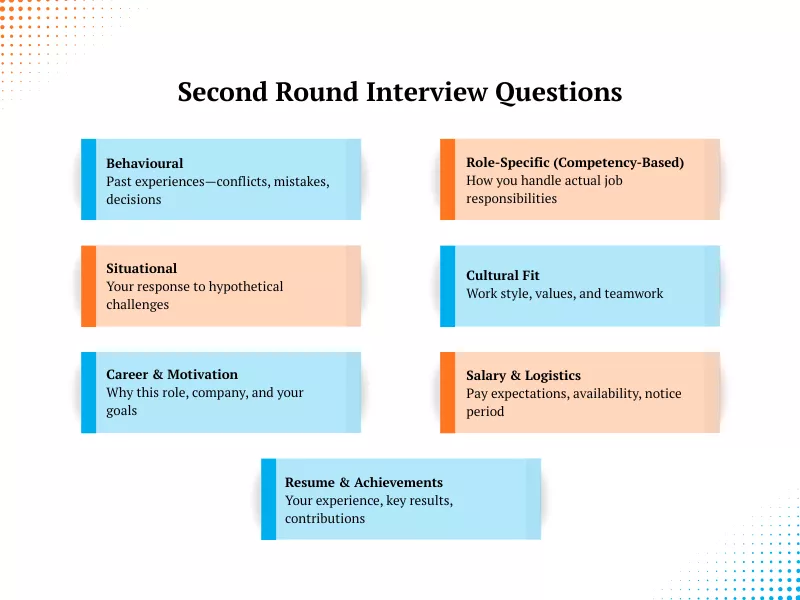
Here are the types of second interview questions for hiring managers to ask candidates:
- Behavioural questions: These ask about past situations, like conflict, mistakes, or difficult decisions.
- Role-specific questions: These go deeper into how you would handle the actual job and its responsibilities, as known as competency-based interviews.
- Situational questions: These test how you would respond to workplace problems or new challenges.
- Cultural fit questions: These explore your work style, values, and how you work with a team.
- Career and motivation questions: These ask why you want the role, the company, and where you see your career going.
- Salary and logistics questions: In some second interviews, employers may discuss compensation expectations or availability.
- Questions about your resume and achievements: Interviewers may ask you to explain your background, key accomplishments, or biggest contributions.
20 Second Interview Questions with Answers
Here are the most common second round interview questions and answers that, as HR recruiters and now working as CV writers, we have read, asked, and followed.
Second Interview Questions with Sample Answers for General / All Industries
1. What would your first 90 days look like in this role?
Answer: “In the first 30 days, I’d focus on understanding processes, stakeholders, and team dynamics. By 60 days, I’d start contributing to key projects and identifying quick wins. By 90 days, I aim to deliver measurable impact, whether that’s improving efficiency, hitting targets, or solving a key challenge.”
2. Tell us about a time you handled a difficult situation at work.
Answer: “In my previous role, we faced a tight deadline due to a client change. I coordinated with cross-functional teams, prioritised tasks, and kept communication transparent. We delivered on time, and the client appreciated our responsiveness.”
3. Why should we hire you over other candidates?
Answer: “I combine relevant experience with a proactive approach. I don’t just complete tasks, I look for ways to improve processes and contribute to team goals. I believe that balance of execution and initiative sets me apart.”
4. What concerns do you think we might have about you?
Answer: “You might wonder about my transition from X to Y. However, I’ve built transferable skills like problem-solving and adaptability, which I’ve already applied successfully in similar situations.”
5. How do you handle feedback?
Answer: “I see feedback as a growth tool. I actively seek it, reflect on it, and apply changes quickly. For example, after feedback on my presentation style, I improved clarity and engagement, which led to better stakeholder responses.”
Second Interview Questions and Answers for IT / Tech Roles
6. How do you approach solving a complex technical problem?
Answer: “I break the problem into smaller parts, analyse root causes, and test solutions iteratively. I also document the process and collaborate with team members when needed to ensure efficiency.”
7. Tell us about a project where you improved system performance.
Answer: “In a recent project, I identified inefficient database queries causing delays. After optimisation, system response time improved by 30%, enhancing user experience.”
8. How do you stay updated with new technologies?
Answer: “I regularly follow industry blogs, take online courses, and experiment with new tools in side projects to stay current and relevant.”
Second Interview Behavioural Questions Examples for Finance / Accounting
9. How do you ensure accuracy in financial reporting?
Answer: “I follow strict reconciliation processes, double-check entries, and use automated tools where possible. I also maintain clear documentation for audit trails.”
10. Describe a time you identified a financial risk.
Answer: “I noticed inconsistencies in expense reporting that could lead to compliance issues. I flagged it early, corrected the process, and helped implement stricter controls.”
Final Round Interview Questions for Healthcare
11. How do you handle high-pressure situations?
Answer: “I prioritise tasks, stay calm, and follow established protocols. Clear communication with colleagues ensures patient safety and efficient care.”
12. Tell us about a time you improved patient care.
Answer: “I introduced a simple tracking method for patient follow-ups, which reduced missed appointments and improved overall patient satisfaction.”
Second Interview Questions for Marketing / Sales
13. How do you measure campaign success?
Answer: “I track KPIs such as conversion rates, engagement, and ROI. I also analyse data to refine strategies for better performance.”
14. Describe a campaign that didn’t perform well. What did you learn?
Answer: “A campaign underperformed due to incorrect audience targeting. I analysed the data, adjusted the segmentation, and improved results in the next campaign.”
Round 2 Interview Questions for Customer Service
15. How do you deal with an unhappy customer?
Answer: “I listen actively, empathise, and resolve the issue quickly. If needed, I escalate while keeping the customer informed.”
16. What does excellent customer service mean to you?
Answer: “It’s about understanding customer needs, responding promptly, and exceeding expectations while maintaining professionalism.”
Second Round Interview Questions for Engineering / Manufacturing
17. Tell us about a time you improved a process.
Answer: “I streamlined a workflow by removing redundant steps, which reduced production time and improved efficiency.”
18. How do you ensure safety in your work?
Answer: “I strictly follow safety protocols, conduct regular checks, and encourage a culture of awareness within the team.”
Tough Second Interview Questions for Senior Level Roles for HR / Management
19. How do you handle conflict within a team?
Answer: “I address issues early, listen to all perspectives, and work towards a fair resolution that aligns with team goals.”
20. How do you motivate your team?
Answer: “I set clear goals, recognise achievements, and provide growth opportunities to keep the team engaged and productive.”
How to Prepare for Your Second Round Interview?
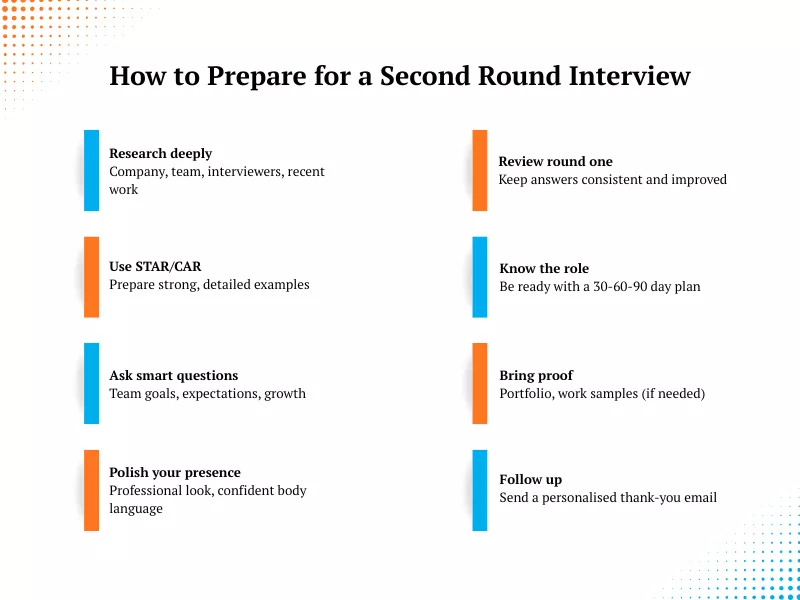
The second interview gives the employers a clear idea if you are the right fit for the company, so to prepare for an interview like that, you must not only understand the answering but also improve your body language and attitude.
Here’s what you can do to approach a second interview confidently:
- Research the interviewers, the company’s recent work, and the team’s priorities so you can speak with confidence.
- Review the answers you gave in the first interview, so your responses stay consistent.
- Prepare deeper examples using the STAR or CAR method to answer behavioural and situational questions.
- Be ready to discuss role-specific challenges, your 30-60-90 day plan, and how you would add value in the position.
- Prepare thoughtful questions to ask about the team, expectations, and growth opportunities.
- If relevant, bring a portfolio, work samples, or any presentation the employer requested.
- Dress professionally, maintain good body language, and show consistent enthusiasm throughout the interview.
- Send a job interview thank-you email afterwards that mentions specific points from the conversation.
5 Tips to Answer Second Round Interview Questions Confidently
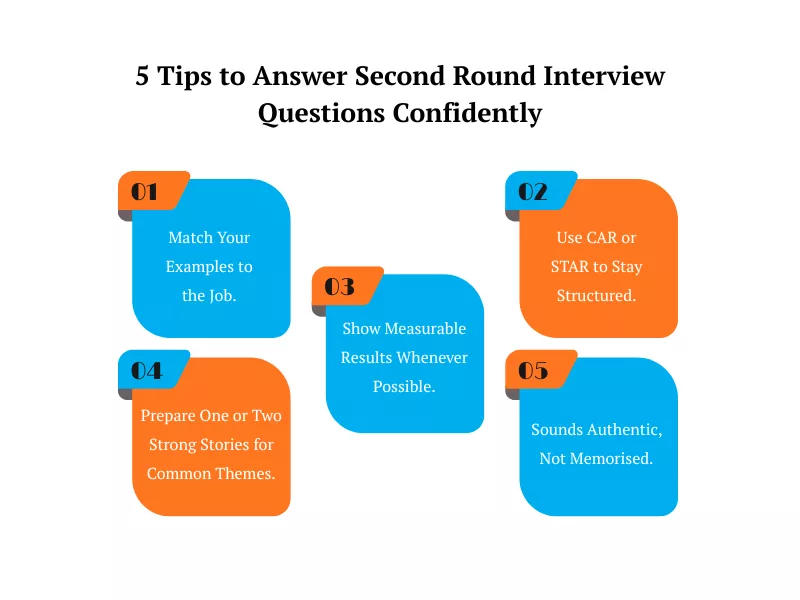
To answer second-round interview questions confidently, focus on real examples, clear structure, and specific results. The best answers to common second interview questions show how you think, act, and solve problems in actual workplace situations.
How to answer questions in a second interview tips:
Match Your Examples to the Job.
Choose stories that show skills the role actually needs, such as leadership, problem-solving, or client handling. For example, if the job involves customer communication, talk about a time you turned around an unhappy client and kept the account.
Use CAR or STAR to Stay Structured.
Briefly explain the context or challenge, the action you took, and the result for scenario-based interview questions. For example, if asked about a difficult decision, describe the situation, what you decided, and how that decision helped the team.
Show Measurable Results Whenever Possible.
While in the first round of interviews, the questions are broader, more general, and introductory, when you are back for a second interview round, the questions will be more detailed, situational, and strategic. Instead of saying you “improved performance,” say you reduced turnaround time by 20% or increased sales by 15%. Concrete outcomes make your answer more credible.
Prepare One or Two Strong Stories for Common Themes.
A good example is conflict resolution: “Two team members disagreed on deadlines, so I organised a quick alignment meeting and split responsibilities clearly.” This shows leadership and communication in real life, and managing conflict at work interview questions.
Sounds Authentic, Not Memorised.
Interviewers want real thinking, not polished scripts. Thus, you must prepare for the interview but not memorise the answers. If you made a mistake in a project, explain what happened, what you learned, and how you handled it better the next time.
Should You Prepare Differently for a Second Interview?
Now, if you are having doubts about preparing for an interview, please understand you should! So, yes, because if you treat a second interview like the first one, you’re leaving points on the table. A second interview isn’t about basic fit anymore. It’s about proving you can actually do the job, mesh with the team, and handle real scenarios. So your prep needs to level up.
Earlier, you thought about whether they would like you; now, you must think about whether they will hire you. So, you go deeper as you might meet future teammates or senior leadership. They’re assessing: “Would we actually enjoy working with this person?”
Be authentic, communicate clearly, and show collaboration skills. Our guide to Questions to Ask the Interviewer at the End of an Interview covers what to ask at each stage.
Skip generic questions. Ask things like:
- “What challenges are the team or employees currently facing?”
- “How do different teams collaborate here?”
This shows you’re already thinking like an insider. You can prepare answers for these beforehand, but remember, they’re not just evaluating you; you’re also evaluating them. Show genuine interest, not desperation.
Now, if you are thinking: How to Answer Second Interview Questions about Salary Expectations? Well, you are in luck because we covered it at large!
Frequently Asked Questions
What is the purpose of a second interview?
The objective of a second interview is to evaluate your deeper fit for the role, including skills, problem-solving ability, and cultural alignment, while confirming whether you can meet team expectations and deliver results.
How long does a second interview usually last?
A second interview typically lasts between 45 minutes and 2 hours, depending on the role, discussion, seniority, and whether multiple interviewers or practical assessments are involved.
What should I bring to a second interview?
Bring extra copies of your CV, a notebook, references if requested, a portfolio if relevant, and prepared questions to demonstrate your interest and professionalism.
How many candidates are invited to a second interview?
Usually, 2–5 candidates are shortlisted for a second interview, though this varies by company size, role urgency, and hiring process structure.
How soon after a second interview do you get a job offer?
You may receive feedback or an offer within a few days to two weeks, depending on internal approvals, other candidate interviews, and company decision-making timelines.
What happens if you fail a second interview?
If unsuccessful, you may receive a rejection or feedback. Use it to improve and refine your interview approach and apply those learnings to future opportunities.
How do you follow up after a second interview?
Send a polite thank-you email within 24 hours, expressing appreciation, reinforcing your interest, and briefly highlighting why you’re a strong fit for the role.
What questions should I ask the interviewer in a second interview?
Ask about team struggles, success metrics, growth opportunities, and expectations for the first 90 days to show genuine interest and strategic thinking.
How do you prepare for a second interview in 24 hours?
Review the job description, research the company deeply, prepare STAR-based answers, refine your story, anticipate technical or situational questions, and practice clear, confident communication.
Are second interview questions harder than first interview questions?
Yes, they are typically more in-depth, focusing on real scenarios, problem-solving, and cultural fit rather than basic qualifications or general background. You may also be given a tour of the office.
Do they ask the same questions in a second interview?
Some questions may repeat to test consistency, but most will go deeper or explore new areas like technical skills, team fit, and real-world problem-solving.
Does a second interview mean you got the job?
No, it means you’re a strong candidate, but the employer is still comparing finalists before making a final hiring decision.
Can you get rejected after a second interview?
Yes, rejection is still possible if another candidate is a better fit or aligns more closely with the company’s needs, expectations, or team dynamics.
Is a second interview a good sign from the employer?
Yes, it’s a positive sign that the employer sees strong potential in you and is seriously considering you for the role.
How useful was this post?
Click on a star to rate it!
Average rating / 5. Vote count:
No votes so far! Be the first to rate this post.
We are sorry that this post was not useful for you!
Let us improve this post!
Tell us how we can improve this post?

Want To See My Profile — Click Here Jonathan
- OKR vs KPI: What’s the Difference? (With UK Workplace Examples) - August 14, 2026
- 25+ Questions to Ask the Interviewer at the End of an Interview - August 8, 2026
- Video Interview Tips UK: How to Succeed in a Remote Job Interview - July 3, 2026
