
An effective resignation letter must explain your intent to leave your current organisation. Adding on to that, you need to be thankful and offer help for a smooth transition. Be it leaving for a new job, exploring better career opportunities, or making a personal change, a well-written resignation letter acts as an important part of the change.
With close to 66% of UK workers struggling to write the letter, it is necessary to understand how to write a resignation letter to convey the message professionally.
Here, we will guide you through the correct ways to write one and will also share a few examples for a better understanding.
Key Takeaways
- A resignation letter should clearly state your intent to leave and last working day.
- Keep the tone professional, polite, and positive throughout the letter.
- Thank your employer for the opportunities and experience gained.
- Offer support for handovers and a smooth transition process.
- Include notice period details based on your contract or company policy.
- Giving a reason for leaving is optional, but keep it brief and professional.
- Avoid complaints, negativity, or mentioning workplace grievances.
- Speak with your manager before formally submitting the letter when possible.
- Use formal structure with date, greeting, closing, and signature.
- Different situations may need different formats, such as immediate or short notice letters.
What Is a Professional Resignation Letter?
A professional resignation letter is a formal document to show your intent to leave a position. Its primary focus is to provide an official record of notice, but it also acts as a demonstration of courtesy. The letter helps in the maintenance of a cordial relationship with the employer and ensures you leave an organisation on a good note.
The letter can also be used to communicate important details, such as your last day of work and notice period. Further, you can add brief feedback about your time at the company or highlight positive aspects of your work experience. This helps ensure you leave on good terms. You can go through a few mutual resignation letter examples to understand the correct ways to write one. It will help you learn how do you politely write a resignation letter.
How to Write a Resignation Letter UK: 6 Tips for Professionals
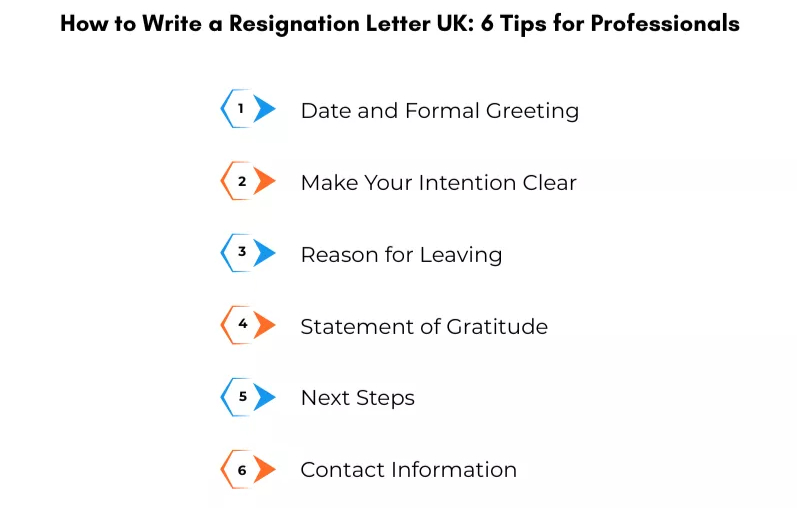
The letter of resignation helps set a professional tone for your departure. It is crucial to talk to your manager or HR before you write the letter. The reason is that you must know the company procedures before you write it. Here are a few tips to write a resignation letter:
A. Date and Formal Greeting
If it’s a printed letter, start with a date along with a formal greeting. Address the letter to your manager the HR, or the relevant recipient. In case you are emailing the letter, the date might not be essential.
B. Make Your Intention Clear
You need to make your intention of resigning clear from the beginning of the letter. Keep it professional and don’t beat around the bush. When you start writing, mention it like this, ‘I am resigning from my role as a Sales Manager at (name of the organisation), with effect from 15th April, 2026.’ Availing CV editing services can help you ensure the letter is perfect.
C. Reason for Leaving
This is optional, but it can be wise to include a brief, professional reason for leaving. If you choose to share the reason, make sure to keep it brief and positive. Sharing some details about your resignation can help maintain a positive relationship with your employer. It might be useful if you need a letter of recommendation. Also, mention your last day of work.
D. Statement of Gratitude
A resignation letter can be used as a medium to express gratitude for the opportunities you had. Do not use the letter to complain about the company, and leave on a positive note. It can help with a smooth transition.
E. Next Steps
After you have written these sections, list any key information that your team or manager might need. Make sure to mention how you will wrap up all the pending work and offer support for the transition period. Use sentences like, ‘Please let me know how I can help with training my replacement,’ to show your concern and your willingness to help. In case you have to join immediately, you must know how to write a resignation letter with immediate effect.
F. Contact Information
Close the letter with ‘sincerely,’ followed by your name and signature. Include personal contact details, like your phone number or email address. This is optional, but it is good to add these details in the letter.
Before sharing examples of both good and bad resignation letter examples, let’s take you through the things you should not do while writing a resignation letter for a new job opportunity:
- Don’t talk about your grievances, even if you are tempted to write about them. If you do this, it will ruin your future endeavours and might also lead to problems during transition.
- Don’t submit or send your resignation email before speaking with your manager. Generally, the discussion is better in person, but if that is not possible, talk with your manager over a video call.
- Do not assume you can work less than your contracted notice period. If your new employer wants you to start early, you must discuss it with your current employer before committing to it.
It is wise to avail CV writing services to ensure you get help from a professional in writing the letter.
Dos and Don’ts of Writing a Resignation Letter
| Dos | Don’ts |
| Keep it professional and brief | Don’t talk about grievances |
| Honour your notice period | Don’t be vague about dates |
| Express gratitude | Don’t resign verbally |
| Offer a handover | No accusations |
| Send it to the right person | Don’t forget your contractual obligations |
| Keep a copy | Don’t be impulsive |
That will help you understand the right ways to write the letter and address one of the concerns every candidate has: ‘what should I include in a resignation letter in the UK?’ In the following section, we will take you through a few examples based on different situations to help you understand better.
Free Well-Structured Resignation Letter Templates

To understand and finalise a resignation letter template, you need to understand the various situations under which an employee resigns and how to write a letter based on the situation. This will also help you learn what is the correct format for a resignation letter:
Simple Resignation Letter Sample
[Your Name] [Date] Dear [Manager’s Name], I am writing to inform you that I am resigning from my position as [Job Title] at [Company Name], effective [last working date]. Thank you for the opportunity to be part of the team. Sincerely, [Your Name] |
Professional Resignation Email Template
[Your Name]
[Your Address]
[City, State, PIN]
[Email Address]
[Date]
[Manager’s Name]
[Job Title]
[Company Name]
[Company Address]
Dear [Manager’s Name],
I am writing to formally tender my resignation from my position as [Job Title] at [Company Name], effective [last working date — typically two weeks from today].
Working at [Company Name] has been a valuable and rewarding experience. I am grateful for the opportunities I have had to grow professionally, and I hold the team and leadership in high regard.
I am committed to ensuring a smooth transition and am happy to assist with handover responsibilities, training a replacement, or documenting ongoing projects before my departure.
Please let me know how I can best support the team during this period.
Thank you sincerely for your guidance and support throughout my tenure.
Yours faithfully,
[Your Name]
Sample for Two Week Notice Letter of Resignation
[Your Name]
[Date]
Dear [Manager’s Name],
I am writing to formally resign from my role as [Job Title] at [Company Name]. As per my notice period, my last working day will be [date — two weeks from today].
I have genuinely valued my time here and am proud of what the team has accomplished together. This was not an easy decision, but I feel it is the right step for my career at this time.
Over the next two weeks, I will do everything I can to hand over my responsibilities effectively and support a seamless transition. I am happy to prepare handover notes, brief my replacement, and complete any outstanding work.
I wish the company and the team continued success, and I hope to stay in touch.
Warm regards,
[Your Name]
Sample for 24-Hour Notice Period Resignation Letter
[Your Name]
[Date]
Dear [Manager’s Name],
Please accept this letter as formal notice of my resignation from my position as [Job Title], effective tomorrow, [date].
I sincerely apologise for the very short notice. I am aware this is not ideal, and I regret any inconvenience it may cause the team. Unfortunately, due to [brief reason if appropriate, e.g., personal circumstances / a time-sensitive opportunity], I am unable to serve a longer notice period.
I am available today to brief a colleague on my current tasks and hand over any relevant files or documentation.
Thank you for the support, experience, and opportunities during my time here.
Sincerely,
[Your Name]
Resignation Letter with Immediate Effect No Notice
[Your Name]
[Date]
Dear [Manager’s Name],
I am writing to notify you of my resignation from my position as [Job Title] at [Company Name], with immediate effect as of today, [date].
I understand this is highly unusual, and I sincerely apologise for any disruption this may cause. Due to [optional: personal/medical/urgent circumstances], I am unable to continue in my role or serve a notice period.
I am willing to make myself available for a brief handover call or to respond to urgent questions by email [if applicable], to minimise any impact on ongoing work.
I wish you and the team all the best going forward.
Yours sincerely,
[Your Name]
Why Should You Write a Professional Resignation Letter?
The purpose of a resignation letter is to maintain a positive reputation and is a sign of professionalism. When you leave your job, you need to hand in your resignation letter. It is a formal document that specifies your final working day and is generally addressed to your boss, the HR manager, or both.
The reasons to write the letter are:
- To maintain a positive reputation
- To establish a formal record
- To ensure a smooth transition
- To provide clarity and prevent miscommunication
- To keep the door open for future opportunities
You can be proactive and talk about your interest to assist in the hiring process and training your replacement.
In some cases, employers may place you on garden leave after you resign, so understanding your garden leave rights in the UK is crucial.
How Does a Notice Letter Differ from a Resignation Letter?
These two terms often create confusion. While both are used interchangeably, a notice letter is mostly used in the US. Like you need to know American resume vs British CV, this is equally important.
A resignation letter is the formal document you give your employer to announce your decision to leave. It confirms your intention to resign and typically includes the start date of your notice period.
A notice letter, on the other hand, refers to any formal letter that informs someone of an upcoming change or end to an arrangement. While it can come from either the employee or the employer, it is sometimes used as a substitute for letter of resignation in the US.
Endnote:
A resignation letter is a crucial document for employees switching jobs. It acts as a courteous way to leave a job on a good note. However, it is important to understand the right ways to write the letter.
The letter not only serves as a professional way to depart from the current company, but it also acts as a written record to help the HR department address administrative matters. Understand the importance of the letter and follow the correct ways to ensure a smooth transition.
Frequently Asked Questions
What should I include in a formal resignation letter in the UK?
Your resignation letter in the UK must include a clear statement that you are resigning, your job title, and employer’s name, the notice period you are giving, and your intended last working day. You can add a brief thank you (optional), an offer to help with the handover, and a request for confirmation of accrued holiday pay.
How much notice do I need to give when resigning in the UK?
The notice period depends on your employment contract. The statutory minimum under UK law is one week’s notice if you have worked for at least a month. If an employee has worked for less than a month, no notice is technically required. Generally, most contracts require four weeks’ (one month) notice. It can be more for senior roles, mostly two to three months.
Do I have to give a reason for resigning in the UK?
No, it is not mandatory to explain why you are leaving. Treat your letter as formal notice and a confirmation of your resignation. If you want to include a reason, keep it brief and professional.
How do you write a resignation letter for a job you just started?
Keep the letter short, polite, and apologetic in tone. Include all the details when you write your resignation letter. It is not necessary to over-explain if you are leaving a job you just started.
What happens if I don’t hand in a resignation letter in the UK?
Not handing in a resignation letter can cause numerous problems. Without a written notice, it is considered a breach of contract, and your pay can be put on hold. It will risk damaging your relationship with your employer.
Is it okay to resign via email in the UK?
Yes, resigning via email in the UK is perfectly acceptable. You need to ensure that the email is formal in tone and carries all the key details, like the intention to resign, notice period, and your last working day.
How useful was this post?
Click on a star to rate it!
Average rating / 5. Vote count:
No votes so far! Be the first to rate this post.
We are sorry that this post was not useful for you!
Let us improve this post!
Tell us how we can improve this post?

Want To See My Profile — Click Here Jamie
- How to Write a Resignation Letter: Tips, Templates, and Dos and Don’ts - April 21, 2026
- Do You Need a Cover Letter in 2026? UK Data Reveals the Truth - April 11, 2026
- How to Write a Personal Statement for Board Position? - April 3, 2026
