
Writing an executive CV for career change is one of the most important things you will do when you want to switch industries. You need to start with a good professional summary that specifies your new direction and replaces generic responsibilities with those that prove your impact. You have to keep it focused, cut everything that is not relevant, and use the language of the industry you are in.
Key Takeaways
- Start your executive skills-based CV from scratch. Never recycle an old one for a career change.
- Your professional summary must lead with where you are going.
- Transferable skills are your strongest asset. Map them clearly to your target role.
- Back every claim with a number, and communicate leadership impact across every industry.
- Use a hybrid CV format, your relevance leads, and your history support it.
- ATS optimisation matters at executive levels too; use keywords from the target job description.
What Is an Executive Career Change CV?
It is a document written to help a candidate to move into a new industry, function, or type of role. It is not a standard CV with a few changes. It is a completely different piece of writing which prioritise your skills and leadership impact over your job title and sector history.
The goal is simple: It is to make a recruiter feel why your background is important.
Key Principles to Write a Career Change CV
Before you write a career-change CV or cover letter, you should get these principles clear in your mind. They shape every decision about what to include, how to frame it, and what to cut. However, you can take professional career help to add these principles to your career change CV.
| Principle | What It Means in Practice |
| Focus on transferable skills | It’s the connection between your old role and your new one. |
| Add a strong summary at the top | Your opening profile should show your motivation to move to a new sector. |
| Be strategic with ordering | You shouldn’t feel distracted by the employment-first approach. |
| Highlight your learning | Add your certifications and courses to show that you are serious about switching |
How to Structure Your Executive CV for Career Change: Step-by-Step
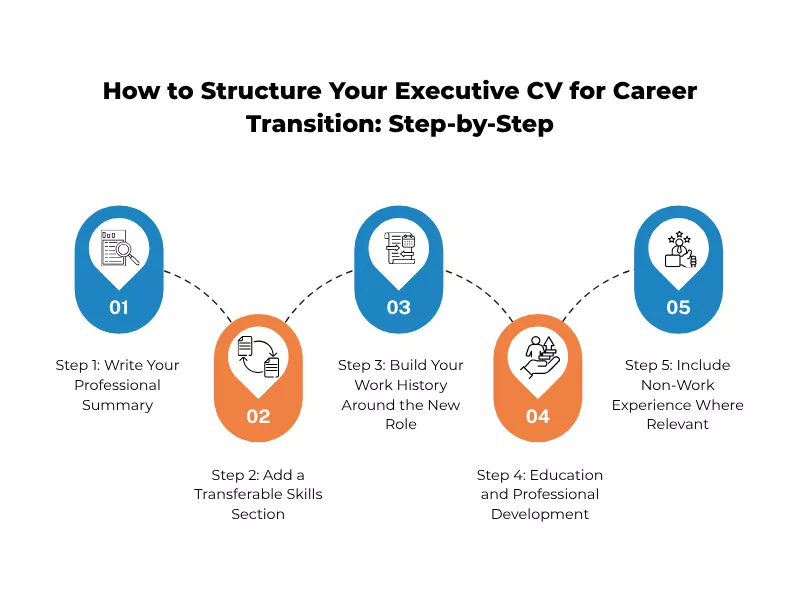
Go for a hybrid format or take CV writing services. This works best for executive career changers. It starts with your professional value before walking through your work history. Here’s how to change your CV into an executive one UK.
Step 1: Write Your Professional Summary
This is the first thing every recruiter reads. For a career changer, it is the most important section on the page.
Write 4-5 lines of Executive profile for career transition that do three things:
- Name your new direction clearly in the first sentence.
- Connect your leadership experience to the new role in one or two lines.
- Write your strongest and most relevant achievement.
Use an executive bio for career switch and not an objective statement. An objective statement tells employers what you want. A summary tells them what you offer. At the senior level, this difference matters.
Step 2: Add a Transferable Skills Section
Pull up 3-5 job descriptions in your sector. Write down the relevant transferable skills executive CV they want most. Cross-reference them with your own experience.
The matches become your transferable skills for CV. Write them in the language of the new industry, not your old career.
These are the key skills that travel across sectors at the executive level:
- Strategic planning and business development
- Stakeholder and board-level relationship management.
- P&L ownership and commercial accountability.
- Change management and organisational transformation.
- Cross-functional team and talent development.
- Programme and project delivery at scale
Step 3: Build Your Work History Around the New Role
List your roles according to chronology and new career path, but first reframe what you write.
For every position, drop the generic list of responsibilities and replace them with 3-4 achievement bullets, each with a number.
| Instead of this | Write this |
| Responsible for managing regional sales teams | Led 4 regional sales teams across the UK, growing combined revenue by £6.2m in 18 months |
| Managed the implementation of a new CRM system | Delivered a £1.4m CRM rollout across 3 business units, 6 weeks ahead of schedule |
| Managed a team of 25 people | Built and developed a 25-person operations team, reducing staff turnover by 40% in 12 months |
| Involved in cost reduction | Identified and delivered £800k in operational savings across 2 financial years |
Step 4: Education and Professional Development
List your qualifications with the institution and year. If you have completed any courses, certifications, or memberships relevant to your new field, put them here and show commitment to the transition.
If you are applying for a lower-level job, ensure you tailor your CV properly and address overqualification in your application, showcasing your overqualification as a strength and focusing more on the relevant qualifications to the job you are applying for.
Step 5: Include Non-Work Experience Where Relevant
Build positions, advisory roles, voluntary leadership, including anything that builds your credibility in the new sector.
These entries help recruiters to understand your interest in the new field, which goes beyond a job application. That matters.
Executive Career Change CV Template
Use this executive CV template as your starting point:
Name & Contact Details
Name, phone, email, LinkedIn URL, and city. No full address needed.
Professional Summary
4–5 lines: open with your new target direction, bridge your leadership background to the role, and lead with your strongest achievement. Use keywords from the job description.
Core Skills
8–12 transferable skills drawn from target job descriptions. Write them in the language of your new industry, not your old one.
Work Experience
Roles in reverse chronological order. For each position, write 3–4 achievement bullets with numbers: revenue, team size, cost saved, and percentage improved. No responsibilities-only descriptions.
Education
Degree(s), professional qualifications, and relevant certifications. Include institution name and year.
Professional Development
Recent courses, industry certifications, and professional memberships relevant to your new sector. These signal genuine commitment to the transition.
Additional (if relevant)
Board positions, advisory roles, voluntary leadership, speaking engagements, or publications, particularly if they build credibility in your new field.
You might ask how long should an executive CV be; it should be two pages for most executives. Three pages maximum if you have 20+ years of directly relevant experience to show.
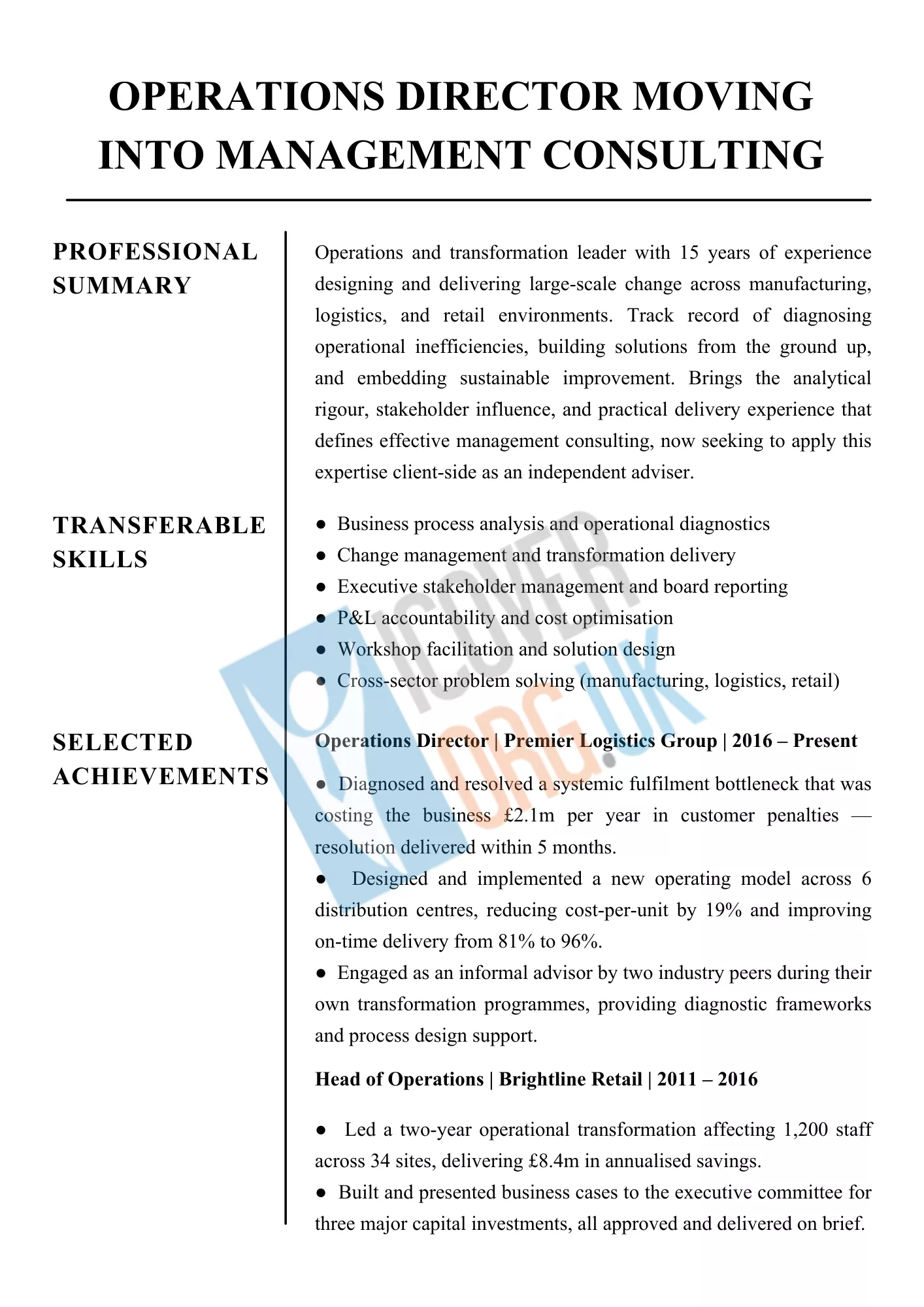
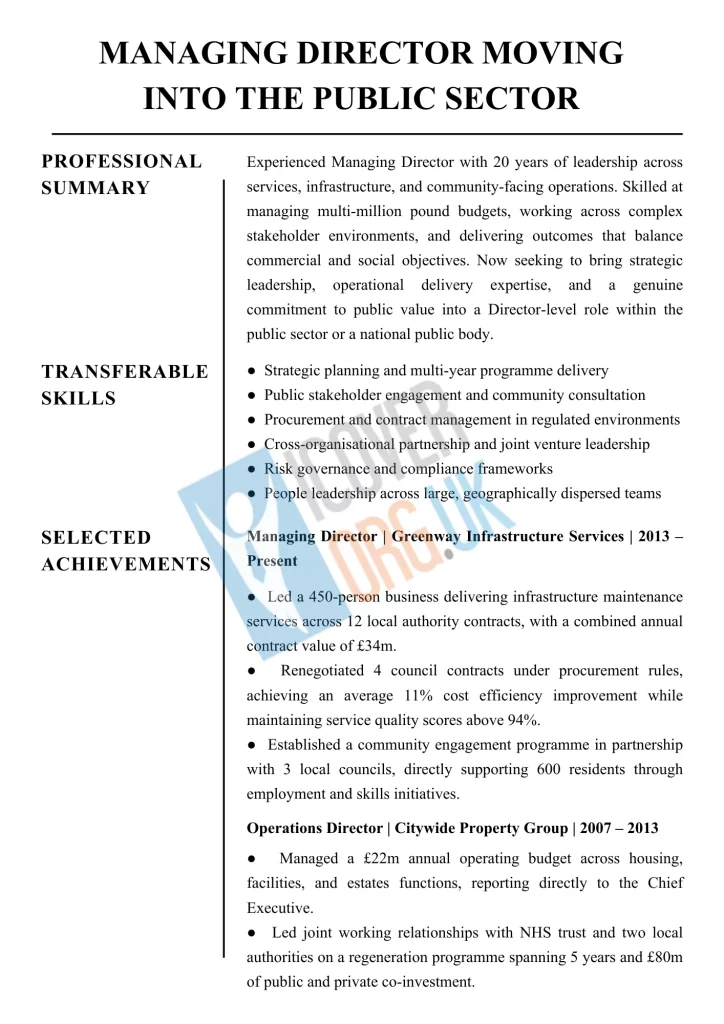
Executive Career Change CV Examples
Here are the executive CV examples in different scenarios and how to write an Executive CV:
Common Mistakes to Avoid in an Executive Career Change CV
Here are the mistakes that cost senior professionals interviews while changing from their old career to their new career, even when their experience is strong.
Recycling your old executive CV sample with a few changes will not help you. You should start fresh.
- Avoid mentioning your previous role in the unrelated sector while writing a professional CV for career switch.
- Listing your responsibilities instead of achievements. Recruiters at changing careers want to see what you delivered, not what you were responsible for doing.
- Using terms from your old industry. Using sector-specific language creates distance between you and the recruiter. Write everything in plain terms.
- Ignoring ATS. Even executive roles go through applicant tracking systems. If your CV does not contain keywords from the job description, it may never reach a human reader.
- Making the CV too long. More than two pages without clear relevance on every line is a liability, not an asset.
- Leaving out non-work experience. Board roles, advisory work, and voluntary leadership often provide the most direct evidence of relevance to a new sector; do not skip them.
Additional Tips for Executive Career Change CV Success
Here are some high-impact executive CV writing tips for career change CVs:
Personalise for every application
Your professional summary and skills required should be tailored to the role for which you are applying. Use the language that is used in the job description. A personalised CV will always outperform a generic one.
Write your opening paragraph using the job description
Read the job description carefully and identify the three or four things they care about the most. Make sure you write those things in your first five lines.
Do not apologise for the career change
Your executive CV for career transition is not the place to explain why you are changing your career. It is a place to make the case for why you are right for the new role. Confidence in how you present yourself shows confidence in the decision.
Use the PAR method for every achievement
Problem, Action, Result. For each bullet point, describe the challenge you faced, what you did as senior leaders, and the measurable outcome. This framework works across every industry.
Close gaps proactively
If there qualification gap between you and the role, make sure you address it. A relevant certification or professional membership added to your Career change CV for executives shows initiative and turns a potential objection into a demonstration of commitment.
ATS-optimised executive career change CV
- Use exact keywords from job descriptions for ATS optimisation.
- Do not use any text boxes, columns, or graphics.
- Use standard section headings: Work Experience, Skills, Education.
- Save as .docx unless the application asks for a PDF.
Final Thoughts on Executive CVs for Career Changers
An executive traditional CV for a new career is not about hiding where you come from. It is about presenting everything you have built, your leadership experience, in a way that makes complete sense to someone hiring in a new field.
The executives who succeed in switching careers are not always the most qualified ones. They are the ones who tell the clearest, most compelling story about why their background is best for the new role.

A refreshed CV makes your story clear
Career change, gap or restart — the editor structures your CV section by section so it reads clean. Free to build — download from £3.99.
Frequently Asked Questions
How do I show “impact” if I don’t work in Sales or Finance?
Showing impact outside revenue roles needs translating your actions into organisational efficiency. Focus on the before and after of your project.
What is the “Golden Ratio” of bullets on an executive CV?
The golden ratio for executive bullets is a 60:40 ratio to balance the content between impact and action. Most candidates ignore this. An executive CV should prioritise outcomes.
How many years of experience should I include?
For an executive, the standard is to show 10 to 15 years of detailed experience. Anything beyond 15 years should be relegated to the prior experience section without bullets to save space and avoid age bias.
What skills should I highlight on an executive CV for a career change?
When changing career at an executive level, don’t add hard skills and demonstrate your ability in transferable strategic competencies. Highlight change management skills, stakeholder influence, and operational scalability.
How useful was this post?
Click on a star to rate it!
Average rating / 5. Vote count:
No votes so far! Be the first to rate this post.
We are sorry that this post was not useful for you!
Let us improve this post!
Tell us how we can improve this post?

Want To See My Profile — Click Here Jamie
- How to Write a Resignation Letter: Tips, Templates, and Dos and Don’ts - April 21, 2026
- Do You Need a Cover Letter in 2026? UK Data Reveals the Truth - April 11, 2026
- How to Write a Personal Statement for Board Position? - April 3, 2026
