
Make your application stand out! Use our targeted advice to write a compelling NHS Job Cover Letter that captures the recruiter’s attention and secures your interview.
When a job advert simply asks for a CV, or when you’re speculative networking, a covering letter is your secret weapon. Here is why it matters:
- It introduces you as a candidate: It acts as a bridge, instantly highlighting the key skills, strengths, and attributes that make you a great match.
- It shows your personality: While a CV is a relatively factual document, a covering letter allows you to write more personably, letting your enthusiasm and passion shine through.
- It aligns with the employer: It must be strictly tailored to the job, using the job advert, job description, person specification, and company values as your roadmap.
For those targeting healthcare roles, studying a solid NHS Job Cover Letter Example is a great way to understand how to weave these distinct criteria together seamlessly.
Key Takeaways: 5 Tips to Write an NHS Cover Letter
- NHS recruiters score applications against specific criteria. Therefore, tailor to the specification every time. Match your examples directly to the essential requirements listed in the job advert, not to a generic idea of the role.
- Saying you are “hardworking and passionate” proves nothing. Thus, always use evidence, not adjectives. You must use the STAR method (Situation, Task, Action, Result) to show concrete examples with measurable outcomes wherever possible.
- A strong cover letter is focused and concise. Highlight 2–3 of your most relevant achievements rather than summarising your entire CV on one page. If you want to expand further, write a proper supporting statement.
How to Write a Cover Letter for NHS Jobs?
If you are wondering “how do I write a cover letter for an NHS job?”, the answer is surprisingly straightforward.
The best NHS applications are structured, evidence-based, and tailored to the role. NHS recruiters often score applications against the person specification, so random paragraphs about being “hardworking and passionate” without proof usually disappear into the void alongside forgotten gym memberships and New Year’s resolutions.
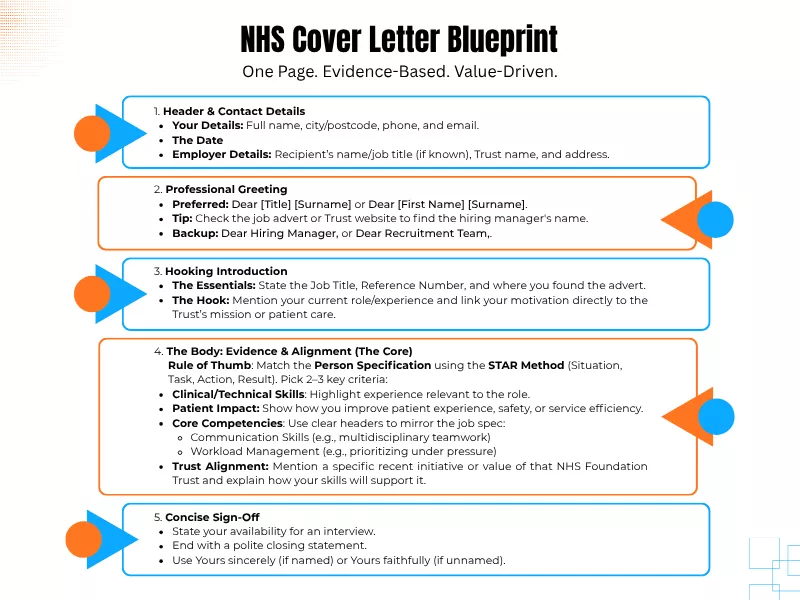
In short, you must write a short, tailored, professional cover letter (one page) that names the NHS role you’re applying for. Here, you need to highlight 2–3 strong examples that match your specification, show knowledge of the NHS Foundation Trust or the department and NHS values, and end with availability and a polite sign-off.
A strong NHS supporting statement should include:
Cover Letter Header
State the job title, reference number (if given) and where you saw the advert. Show enthusiasm for the role and employer.
Include your contact details at the top, followed by the date and the employer’s details:
- Your full name
- Your address (city and postcode are enough)
- Your phone number and email
- Date
- Recipient’s name (if known), job title, NHS Foundation Trust name, and trust address
How long should an NHS cover letter be?
NHS professionals must keep the layout clean and use the same font and size as your CV writing. The header should be compact so the whole letter fits on one A4 page.
Cover Letter Greeting
- If you know the hiring manager’s name, you can use “Dear Mr/Mrs/Ms [Surname],” or “Dear [First Name] [Surname],”
- If you don’t know the name, you can “Dear Hiring Manager,” or “Dear Recruitment Team,”
To find a named contact, you can visit a trusted website. Furthermore, you can call the department. Adding a greeting to a particular name is more personal and shows initiative.
Cover Letter Introduction
When you write an NHS job cover letter, your opening paragraph must have:
- Start by stating the job title, reference number (if given), and where you saw the advertisement (e.g., NHS Jobs website, trust website, LinkedIn).
- Then, briefly mention your current role or most relevant background.
- Lastly, show enthusiasm for the role and employer, and link your motivation to patient care or the trust’s mission/values.
Cover Letter Middle Part (Body)
Use 1–2 short paragraphs to tailored NHS cover letter based on the person specification from the job advert:
- Pick 2–3 key criteria (e.g., clinical skills, organisational skills, communication skills, teamwork, leadership, admin, quality improvement).
- When listing each skill, give a concise example to back it up using the STAR method to apply for a job.
Examples of content to include:
- Clinical or technical skills relevant to the role
- How you’ve improved patient experience, reduced waiting times, or supported safety/quality
- Evidence of teamwork, communication with multidisciplinary teams, or leadership
- Any experience with NHS values in action (respect, dignity, compassion, commitment to quality, working together, improving lives)
One of the major mistakes candidates commit is that they repeat their CV line by line. Instead of resting the CV, highlight the most relevant skills and experience and explain their impact.
Additionally, keep the tone professional, confident, and specific to this NHS role and trust.
You can also add a short paragraph showing knowledge of the NHS Foundation Trust or department, such as:
- A recent initiative, service improvement, or value they are promoting
- Why their approach or specialism appeals to you
- How your skills fit their team and service needs
How do I align my NHS cover letter with the person specification?
This is the most important section.
Read the job description carefully and respond directly to the essential criteria. Many successful applicants use headings mirroring the specification itself.
For instance:
- Communication Skills: Show how you communicate effectively with patients, colleagues, or the public in general.
- Ability to Manage Workloads: Explain how you prioritise tasks, complete deadlines, and work under pressure.
Teamwork: Provide examples of working within a multidisciplinary team or supporting colleagues.
How to Close an NHS Cover Letter (Conclusion and Sign-off)
In your final paragraph:
- Reiterate your interest in the role and the trust.
- Here, you must state your availability for an interview (e.g., “I am available for an interview at short notice”) and, if relevant, your earliest start date.
- Thank the reader for considering your application.
Then sign off:
- If you have used a named greeting: “Yours sincerely,”
- If you have used a generic greeting: “Yours faithfully,”
Finally, type your full name. If submitting by email, you can also add “(signed)” after your name if you’re attaching a signed letter.
6 NHS Values You Must Know about
| Value | What it means |
| Working together for patients | Patients come first in everything we do; needs of patients and communities take priority over organisational boundaries |
| Respect and dignity | Every person (patient, carer, staff) is valued as an individual; their aspirations, needs, privacy, and beliefs are respected |
| Commitment to quality of care | Insisting on quality every time, safety, confidentiality, integrity, accountability, and good communication |
| Compassion | Responding with humanity and kindness to pain, distress, anxiety, or need; finding ways to comfort and relieve suffering |
| Improving lives | Striving to improve health, wellbeing, and people’s experiences of the NHS; valuing excellence and innovation |
| Everyone counts | Resources are fairly distributed for the whole community; nobody is excluded, discriminated against, or left behind |
The NHS recruits against these six values directly, an approach known as Values Based Recruitment — so your examples need to evidence them, not just mention them.
How to Use the STAR Method for an NHS Job Cover Letter?
A recurring tip from successful NHS applicants is to use the STAR format:
- Situation
- Task
- Action
- Result
This helps recruiters see evidence instead of vague claims.
Example:
During my previous administration role in the said company, I noticed inconsistencies within the monthly reporting data. It was affecting scheduling accuracy. Thus, I took the initiative to review the records, collaborated with colleagues to identify errors, and implemented a clearer checking process. As a result, it improved reporting accuracy and reduced the delays.
This kind of example showcases:
- Initiative
- Attention to detail during duty
- Problem-solving ability
- Teamwork
- Accountability
Much stronger than simply writing “I am organised.” Humans do enjoy making each other prove obvious things in paragraph form.
Template NHS Cover Letter for a Healthcare Position

Quick Tip: Always match keywords from the job description exactly. NHS Applicant Tracking Systems UK adore bureaucratic repetition.
NHS Cover Letter Examples
Professional NHS Cover Letter with No Experience

NHS Cover Letter Example for Admin Role UK

NHS Job Application Cover Letter for Nursing Role

NHS Cover Letter for Healthcare Assistant Position Example

NHS Cover Letter Sample
Here is a short sample structure you can adapt:

Suggested Read: NHS Hospital Manager Cover Letter Example
Do You Need a Cover Letter for NHS Jobs in the UK?
One of the most common questions applicants ask is: Do I still need to send a cover letter NHS applications require?
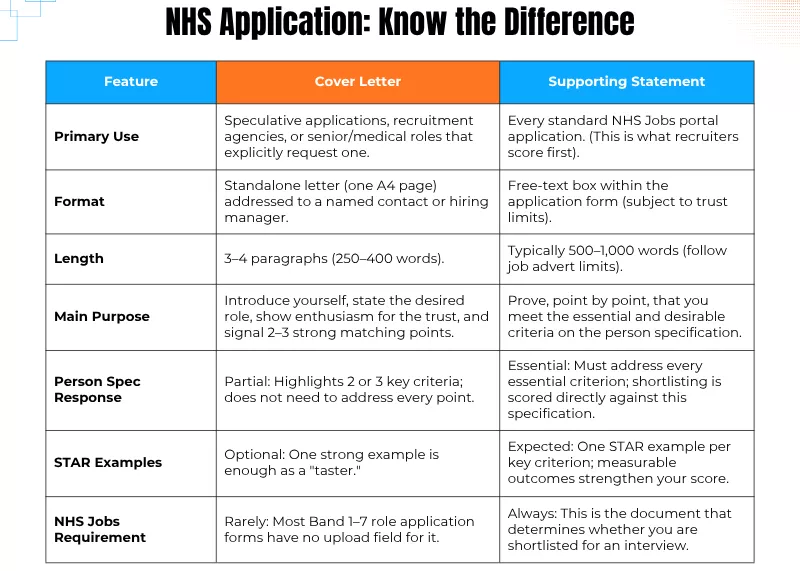
In most cases, NHS Jobs applications do not require a separate uploaded cover letter. Instead, the application form includes a “Supporting Information” or “Personal Statement” section. This is where you explain why you are suitable for the role.
Think of it as your NHS cover letter UK equivalent.
Your goal is not to repeat your CV. Recruitment managers already have your employment history. The supporting statement should instead focus on:
- Your relevant experience
- Key achievements
- Your understanding of the role
- Examples that demonstrate your skills
- How do you meet the person specification
What Should I Include When Writing an NHS Cover Letter?
If you are searching “what should I include in an NHS cover letter?”, here are the essentials:
Include:
- Relevant experience
- Your Achievements
- Examples using STAR
- NHS values alignment
- Understanding of the role
- Ability to manage responsibilities
- Communication and teamwork skills
- Motivation for joining the NHS sector
Avoid:
- Copying your CV word-for-word
- Generic statements
- Long unrelated life stories
- Spelling and grammar mistakes
- Using AI-generated text without editing it
Many NHS recruiters can immediately spot generic applications because they sound robotic, repetitive, and strangely enthusiastic in a way no real person has ever sounded at 11:43 PM while completing job applications.
Quick Tips: Hire a professional cover letter writing service. Professional cover letter writers craft a cover letter as per NHS guidelines, meeting the proper format, ensuring you get 2X more interviews.
How Do I Write a Personal Statement for the NHS for the Application Process?
Applying for an NHS role can feel oddly intimidating. One minute you are updating your CV, the next you are staring at a blank page wondering: “Do you need a cover letter for NHS jobs?” Meanwhile, half the internet says yes, the other half says the supporting statement matters more. A deeply efficient system humans have created for each other.
The truth is this: for most NHS applications in the UK, the supporting information or personal statement writing is far more important than a traditional cover letter. However, many applicants still search for a cover letter NHS example or NHS cover letter template because the purpose is essentially the same. You are proving why you fit the role better than everyone else applying.
Whether you are applying as a healthcare assistant, administrator, or registered nurse, your application needs to clearly demonstrate your experience, values, and ability to work within the NHS setting.
NHS Cover Letter Tips for First Time Applicants UK
If you are applying for your first NHS role, do not panic if you lack direct NHS experience.
Many successful candidates come from:
- Retail
- Hospitality
- Customer service
- Education
- Care work
- Administration
Focus on transferable skills.
Examples of transferable skills:
- Communication
- Time management
- Ability to work under pressure
- Managing confidential information
- Team collaboration
- Problem-solving
- Compassion and empathy
A first-time applicant can still create a strong NHS cover letter template by showing how their previous career experience applies to the healthcare setting.
NHS Cover Letter Vs Supporting Statement for Application: Know the Difference
Final NHS Application Tips
Before submitting your NHS job cover letter for application:
- Write your statement in Word first
- Proofread carefully
- Tailor every application
- Address every essential criterion
- Keep examples specific
- Use professional language
- Demonstrate measurable achievements where possible
The strongest NHS applications are not necessarily written by the most experienced candidates. They are written by applicants who clearly demonstrate how their experience matches the role.
That is what recruiters are looking for. Evidence. Structure. Relevance. Not twelve paragraphs about being “a people person.” Every applicant says that. Even people who visibly hate answering emails.
How useful was this post?
Click on a star to rate it!
Average rating / 5. Vote count:
No votes so far! Be the first to rate this post.
We are sorry that this post was not useful for you!
Let us improve this post!
Tell us how we can improve this post?

