
Wondering if the way you present your degree on the CV is right? Could that formatting be the difference between landing an interview and being overlooked?
The education part of your CV is more than a list of qualifications. It presents your academic journey, and it is a powerful tool to showcase that you are suitable for the job. Many candidates either bury their achievements in chunks of text or use formats that confuse recruiters.
Whether you are about to graduate, juggling multiple degrees, or starting your education later in your career, knowing how to write your degree on a CV can help your application stand out.
In this guide, we’ll cover the formats and examples that apply, no matter your field or level of experience. Here, we will also discuss CV education section examples and common mistakes to avoid while listing a degree on a CV.
Key Takeaways - Essential Tips on How to Write Your Degree on a CV
- Always use a clear and consistent format when listing your degree on a CV.
- Place your education section according to your career stage: higher up for recent graduates, lower for experienced professionals.
- List ongoing or unfinished degrees honestly, specifying “expected” or “in progress.”
- Avoid clutter by focusing on relevant qualifications and using standard UK abbreviations.
- Proofread your education section carefully to prevent spelling and factual errors.
What is the Best Way to Write Your Degree on a CV?
Getting your degree details on your CV is crucial for making a positive impression on UK employers. The best way to write your degree on a CV is to provide the information concisely, clearly, and in a standardised format.
It presents your qualifications to applicant tracking systems (ATS) and makes it easy for hiring managers to assess your relevance.
The key elements to include are:
1. Full Degree Title
Always write the official title of your degree, using the correct UK abbreviation. If you obtained an honours degree, include “(Hons)” after the abbreviation. For example:
- BSc (Hons) Computer Science
- BA (Hons) English Literature
- MSc Marketing
2. Degree Classification
Include your degree classification if it is strong (e.g., First Class, 2:1) or if the employer requests it. This gives employers a quick indication of your academic performance. For example:
- Achieved: 2:1
- Awarded: First Class Honours
3. University or Institution Name
List the name of the university or higher education institution where you studied for your degree.
4. Dates Attended
Include the years (or months and years) you attended or are attending the course. If you have not graduated yet, write “Expected [Year]” or “In Progress.”
5. Additional Details
If you’re early in your career and want to add more context, list relevant modules, dissertation titles, final year projects, or notable academic achievements as bullet points beneath the main entry.

Multiple degrees made easy to read
Master’s, ongoing degrees, or career pivots — present every qualification clearly without cluttering your page. Free to build — download from £3.99.
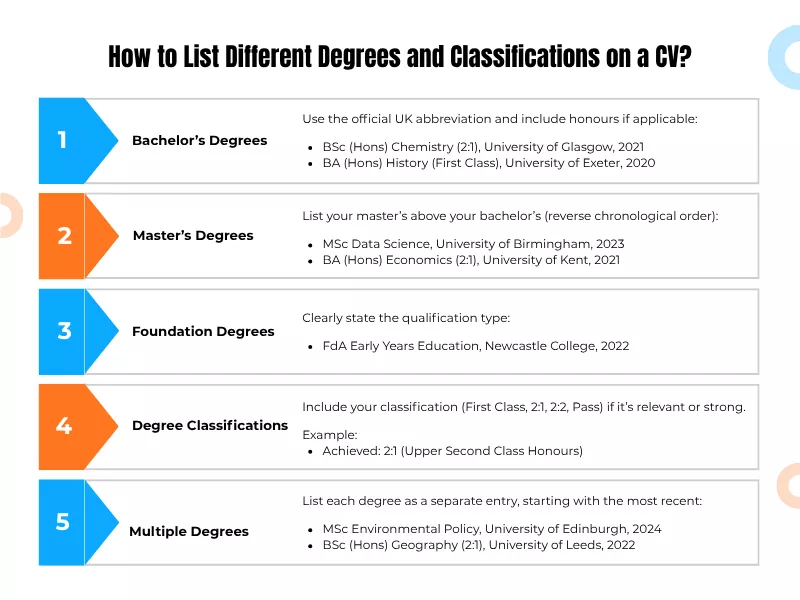
How to List Different Degrees and Classifications on a CV?
Knowing how to list qualifications on a CV, especially when detailing multiple degrees or specific classifications, helps employers immediately grasp your academic achievements. Here is how to format each type clearly:
Where to Put Education on a CV?
Understanding where the education section sits on your CV depends heavily on your career stage and the relevance of your qualifications to the job you’re applying for. Getting this order right ensures that your most impressive credentials are seen quickly by recruiters.
For Recent Graduates or Students
If you have recently graduated or are still studying, your education is likely your strongest asset. Using a tailored graduate CV writing service can help you highlight this effectively, but as a rule of thumb, place your education section immediately after your personal profile before your work experience.
This allows employers to quickly see your relevant qualifications and academic achievements, especially if you have limited professional experience.
Example structure:
- Contact Information
- Personal Profile
- Education
- Work Experience
- Skills
For Experienced Professionals
If you have several years of relevant work experience, feature your professional background first. In this case, the education section should follow your work history. Employers will be most interested in your practical experience, and your qualifications will reinforce your expertise further down the page.
Example structure:
- Contact Information
- Personal Profile
- Work Experience
- Education
- Skills
For Roles Requiring Specific Qualifications
If a job posting specifically requires a certain degree or professional qualification, consider placing your education section higher up, even if you have experience. This highlights your eligibility and ensures you meet the employer’s criteria from the outset.
General Tips
- Use clear headings like “Education” or “Qualifications.”
- Keep your layout consistent throughout your CV.
- List your most recent qualification first, using reverse chronological order.
How to Format Your CV Education Section?
A well-formatted education section improves your CV’s readability and professionalism. The goal is to present your qualifications in a structured, easy-to-scan way that highlights your academic achievements without overwhelming the reader.
1. Use Clear Headings and Consistent Structure
Start with a bold heading like Education or Qualifications. Consistency is key: use the same layout for each qualification to create a tidy, professional appearance.
2. List Entries in Reverse Chronological Order
Always start with your most recent or highest level of qualification and work backwards. This helps employers see your latest and most relevant education first.
3. Essential Details to Include
For each degree or qualification, include:
- Degree title and classification (e.g., BSc (Hons) Psychology, 2:1)
- University or institution name
- Dates attended (e.g., 2020 – 2023)
Additional details (recommended for recent graduates): relevant modules, dissertation title, or key academic achievements.
If you have completed professional development alongside your main degree, listing micro-credentials and short courses beneath your higher education entries can further showcase relevant skill sets.
4. Formatting Example
Education
MSc Data Science (expected 2027), University of Birmingham, 2025 – Present
– Dissertation: “Machine Learning for Healthcare Applications”
BSc (Hons) Mathematics (First Class), University of Leeds, 2021 – 2024
– Final Year Project: “Statistical Modelling in Finance”
Tips:
- Bold your degree or university name to make key information stand out.
- Use bullet points for added achievements to enhance clarity.
- Keep formatting simple: avoid excessive colours, graphics, or fonts.
5. Keep It Concise
Only include details that are relevant to the role you’re applying for. For experienced professionals, a simple listing is usually enough. For recent graduates, add brief descriptions or bullet points to showcase relevant coursework or projects.
6. Proofread for Consistency
Check through your section to ensure all entries follow the same format. Consistent spacing, bolding, and date formatting make your education section look polished and trustworthy.
How to List an Unfinished or Foundation Degree?
If you haven’t completed your degree yet or have studied for a foundation degree, it’s important to present this information clearly and honestly on your CV. Employers value transparency and want to understand both your progress and your commitment to further education.
Listing an Unfinished Degree
If you’re currently studying or left a degree before completion, you should still include it in your education section. This shows your current academic pursuits and any relevant knowledge gained so far.
What to Include:
- Degree title (with classification if known)
- University or institution name
- Start date and either “Present,” “In Progress,” or “Expected [Year]” for ongoing studies
- If you left before graduating, state the years attended and add “partially completed” or “studied until [year].”
- Optional: relevant modules or achievements
Examples:
Ongoing degree:
BA (Hons) English Literature (expected 2028), University of Sheffield / 2025 – Present
Partially completed degree:
BSc (Hons) Environmental Science (partially completed), University of Nottingham/2023–2025
Listing a Foundation Degree
A foundation degree (such as FdA, FdSc, or FdEng) sits at Level 5 on the UK qualifications framework, equivalent to the first two years of an honours degree. Clearly state the qualification type and subject.
What to Include:
- Qualification (e.g., FdA, FdSc) and subject
- Institution name
- Dates attended
- Optional: grade or relevant modules/projects
Example:
FdA Business and Marketing, The Manchester College/2023 – 2025
CV Education Section Examples
A well-structured education section allows employers to quickly see your academic background and suitability for the role. Below are examples tailored to various situations:
1. Recent Graduate
Education
BSc (Hons) Computer Science (2:1), University of Bristol, 2022 – 2025
Final Year Project: “AI for Healthcare”
Relevant modules: Machine Learning, Data Structures
2. Experienced Professional
Education
MSc Marketing, University of Manchester
2023 – 2024
BA (Hons) Business Administration (2:1), University of Leeds
2015 – 2018
3. Ongoing or Unfinished Degree
Education
BA (Hons) English Literature (expected 2028), University of Sheffield / 2025 – Present
BSc (Hons) Environmental Science (partially completed), University of Nottingham
2021 – 2023
4. Foundation Degree
Education
FdA Children and Young People, Newcastle College / 2023 – 2025
Understanding UK qualification – UCAS
5. Multiple Degrees
Education
MSc Data Science (expected 2027), University of Birmingham / 2025 – Present
BSc (Hons) Mathematics (First Class), University of Leeds / 2021 – 2024
6. A Levels (for Early-Career Applicants)
Education
A Levels:
Biology (A), Chemistry (B), Geography (B)
The Sixth Form College, Colchester, 2020 – 2022
Common Mistakes When Listing a Degree on a CV

Even well-qualified candidates can undermine their job applications by making avoidable errors in the education section of their CV. Recruiters look for clarity, accuracy, and professionalism, so steering clear of these common pitfalls will help your qualifications make the right impression.
1. Using Inconsistent Formatting
Switching between different layouts or styles for each qualification can make your CV look unprofessional and confusing. Always use the same format for degree titles, institutions, dates, and classifications throughout your education section.
2. Omitting Key Details
Leaving out important information such as the degree classification, dates attended, or the name of your institution can raise questions for employers. Ensure every entry includes:
- Degree title (with honours, if applicable)
- University or college name
- Dates (start–end or expected completion date)
- Classification (if applicable)
3. Exaggerating or Misrepresenting Qualifications
Avoid overstating your degree classification or claiming you have completed a degree if you haven’t, as employers may verify academic records.
4. Forgetting to Include Ongoing or Unfinished Degrees
If you’re currently studying or didn’t finish a course, don’t leave it off your CV. Instead, clearly state “expected [year]” or “partially completed.” This shows transparency and helps employers understand your current situation.
5. Listing Qualifications Out of Order
Your most recent or highest-level qualification should always come first. Listing qualifications in a random or chronological order makes it harder for recruiters to identify your latest achievements.
6. Overloading With Irrelevant Details
When deciding whether to include your GCSEs, keep in mind that listing every school qualification when you already have higher education can clutter your CV. Focus on the most relevant qualifications and modules for the role you’re applying to.
Wrap Up Your CV with Confidence
Presenting your degree accurately and professionally on your CV is essential for making a strong impression on UK employers.
By using a clear format, including all relevant details, and adapting your education section to your career stage, you give recruiters the information they need to see your value at a glance. Avoid common mistakes and tailor your CV to each job application to maximise your chances of success.
Ready to take your CV to the next level?
If you want expert feedback or a professionally written CV that stands out in the UK job market, explore our CV writing services.
Multiple degrees made easy to read
Master’s, ongoing degrees, or career pivots — present every qualification clearly without cluttering your page. Free to build — download from £3.99.
Frequently Asked Questions
Should I include my 2:2 degree classification on my CV or leave it off?
Including your 2:2 degree classification on your CV is generally recommended if the employer asks for it or if it meets the job’s entry requirements. Write it as “BSc (Hons) Biology (2:2)” to be transparent. If your classification is not requested and you have strong work experience or achievements, you can leave it off and focus on other strengths.
How do I list a degree I’m still studying for on my CV?
To list a degree you’re currently studying for on your CV, include the degree title, the university name, and your expected graduation date. Add “(expected [year])” or “(in progress)” after the degree title to show it’s ongoing. For example:
BA (Hons) English Literature (expected 2028), University of Sheffield, 2025 – Present.
If you have not finished your degree, you can write your qualification followed by the university and the dates that you attended. You can also write in progress to note that you are currently studying for the degree. For example, you can write BSc (Hons) Psychology (expected 2028).
What’s the correct way to abbreviate BSc Hons or BA on a CV?
Use standard UK abbreviations for degrees on your CV. Write BSc (Hons) for a Bachelor of Science with Honours and BA (Hons) for a Bachelor of Arts with Honours. (Hons) indicates an honours degree, awarded with a classification such as First, 2:1, 2:2 or Third.
How to put an expected graduation date on a CV?
Add the expected date in brackets straight after the degree title, then the institution and dates attended. Write it as “(expected 2027)” if you know your finish year, or “(in progress)” if you don’t. Keep the same bracket format across every unfinished entry so it reads consistently. For example: MSc Data Science (expected 2027), University of Birmingham, 2025 – Present.
How do I show a master’s and a bachelor’s degree on my CV without it looking cluttered?
Keep each entry brief and expand only on the qualification most relevant to the role.
For example:
- MSc Marketing, University of Manchester, 2023 – 2024
- BA (Hons) Business Management (2:1), University of Leeds, 2020 – 2023
How useful was this post?
Click on a star to rate it!
Average rating / 5. Vote count:
No votes so far! Be the first to rate this post.
We are sorry that this post was not useful for you!
Let us improve this post!
Tell us how we can improve this post?
Lorem ipsum dolor sit amet, consectetur adipiscing elit. Ut elit tellus, luctus nec ullamcorper mattis, pulvinar dapibus leo.

Want To See My Profile — Click Here Jessica
- How to Write Your Degree on a CV (With Examples & Formatting Tips) - August 22, 2026
- How Many Pages Should a CV Be? A Guide to Land Your Job Interview! - June 16, 2026
- Part time Jobs in UK for Students: 15 Best Options with Pay Rates - June 4, 2026
