
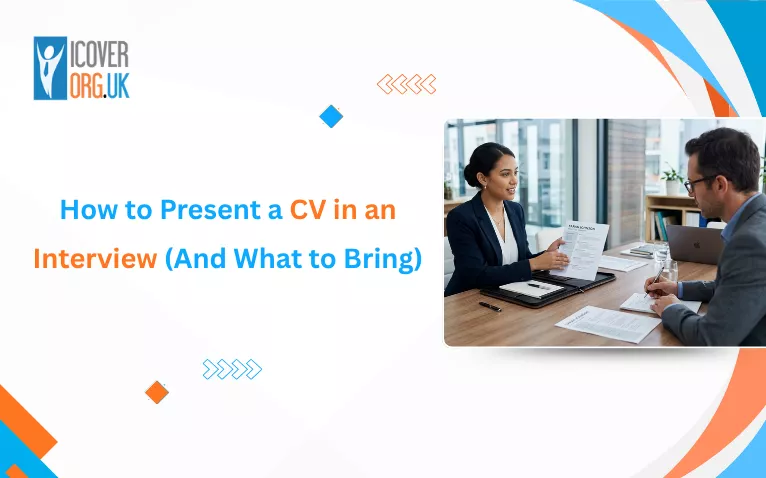
If you think your CV is no longer required once it has passed through the ATS and landed you an interview, that assumption could cost you the offer.
Technology and innovation might have changed the way recruitment works in the UK market. But when you finally sit down with your recruiter during an interview, walking through your skills and experience mentioned in the CV is something that has never changed over the years.
The interviewer will manually go through it during the interview and ask you to present your CV. This is the most strategic conversation that decides whether you will be onboarded or dismissed. In this article, we will discuss how to present a CV in an interview professionally so that you get to work in your dream company.
Key Takeaways on How to Present a CV in an Interview
- Candidates are expected to present their CV, which they submitted while applying for a job, during the interview stage.
- Interviewers ask candidates for a CV presentation to know their work history and qualifications, check communication fluency, spot discrepancies, and determine whether they are a good fit for the role.
- Presenting your CV means giving structured answers about your qualifications and where you gained them.
- Your response must be tailored to the job description’s needs and must be structured around the “Present-past-future” framework.
- Presenting printed CV copies at interview is not mandatory, but is highly recommended to show preparedness.
Why Are You Asked to Present CV to Employer During an Interview?
Interviewers ask candidates to present their CV for the following reasons:
- To get a quick overview of your work history and qualifications
- To assess your ability to communicate your professional story and fluency
- To spot any discrepancies, whether your verbal narrative differs from the details listed in the CV
- If the CV has any gaps, to understand the background content for better clarification.
- To connect the dots to decide whether you have the skills and experience for the position
Therefore, presenting your CV to an interviewer is your chance to build a coherent narrative that will increase the chances of getting a confirmed offer.
However, be mindful that if you fail to align your work history to the position’s expected job roles, hiring managers may face difficulty assessing your profile properly. So, in the next section, we have laid out an easy rule for presenting a CV at interview properly.
How to Present CV Professionally in an Interview?
Many candidates end up presenting their CV when they are asked: “Tell me about yourself”. But the answer to this specific question is to provide a short career summary focusing on the qualities that qualify you for the position and why you are interested. You have to present your CV when the interviewer asks, “Walk me through your CV”.
So, what’s the best way to present a CV in an interview?
Here’s the thumb rule: start the opening with a structured overview of your qualifications and the jobs that helped you earn those qualifications. Then, let the interviewers decide which parts of your history they want to know more about.
To help you structure your answer, here are some effective tips on how to present your CV:
1. Keep it Concise
Be aware that you will have a few minutes in hand to describe your CV. So, keep the response short and quick. The goal is simply to give the conversation a direction to move forward without taking excessive time, as there will be more competency-based interview questions that need addressing.
Here’s a practical time allocation:
The CV walk-through should take 2 – 3 minutes. If there is good flow, interviewers will allow you to run for five minutes.
Use this time guide:
- Current role: 45–60 seconds.
- Past experience: 45–60 seconds.
- Qualifications: 20–30 seconds.
- Why this role: 20-30 seconds.
Begin with a 15-second introduction identifying yourself. Conclude with 15 seconds connecting the background to this particular position.
If an older role is more applicable, modify these timings. Make sure that your story is the top priority.
2. Tailor Your Response by Analysing the Job Advertisement
The best approach is to highlight skills, qualifications, and achievements that align specifically with the job description.
According to TwinEmployment, 47% of interviewers won’t favour a candidate who has little knowledge of the company and job description. The best way to understand the company’s needs is by analysing the job advert. Then prepare a rough note and do the following:
- Write down your educational qualifications and professional experience to closely match the job role needs.
- Identify the parts of the history that do not align with the target role. While giving your response, place less emphasis on non-aligned parts.
Understanding high-focus and least-focused areas will help you tailor your answers accordingly and briefly.
Important Note: Save specific examples and achievements for competency-based questions later in the interview.
Also, compare your LinkedIn profile and CV before your interview. Hiring managers check both for consistency. Differences in dates or titles create doubt. Take ten minutes to align your roles and achievements. Ensure your professional story matches across both platforms.
3. Provide Context for Your Work History and Skills and Use a Clear Structure
While presenting cv in an interview, you need to provide context for each role you have served in the past, as well as the achievements. If you are an experienced professional, focus on roughly the last 10-15 years of relevant experience. For new graduates, covering all relevant experience is recommended.
There’s no single ‘correct’ order. Recruiters, however, accept two main structures.
- For a logical flow, a chronological walkthrough (earliest relevant role to present) tells a clean progression story.
- ‘Present-Past-Future’ framework leads with your current role and works well when your latest job is your strongest selling point. This is an effective and professional way to present CV during an interview:
| Present |
|
| Past |
|
| Future |
|
Pick whichever makes your most relevant experience land first.
Also, for career changers entering a new field, highlighting transitional skills is highly recommended. Be sure to explain the reason for switching. In this case, you can also quickly mention your hobbies and passions if they have a direct link with the role and industry.
Interviewers are most engaged during the start and conclusion of an answer. Therefore, ensure the response begins and ends strongly.
4. Acknowledge any Gap in Employment
Don’t let career gaps (3 months or more) in CVs go unmentioned to avoid misinterpretation. You can fill this gap naturally when you’re explaining your past work experience. Here’s what to do:
- Describe what the gap is for. These reasons might include work, family, graduation, or personal growth and skill development.
- Be transparent and honest. Avoid oversharing.
5. Practise The Delivery
Do not forget to practise the answer orally. This pre-interview practice helps you to be confident and polished. Not only does this avoid rambling, but it also positions you professionally to make a great impression.
Content in your words, confidence in your delivery. Both are assessed during the interview. As you are walking through your CV, remember the following:
- Maintain natural eye contact. If there is a panel, look at all of them.
- Slow down. Over-fast speaking indicates nervousness. Talk at a steady pace to look composed.
- Sit upright, both feet on the floor. Avoid hunching or leaning backward.
- Put brief pauses in between parts. This shows thinking, not ‘recalling’.
If possible, try recording your practice on your phone. You will be able to recognise when to pause and when to slow down.
Now, look at some examples for presenting CV in interview for various roles:
1. Strategic Analyst

2. Operational Lead

3. Career Changer

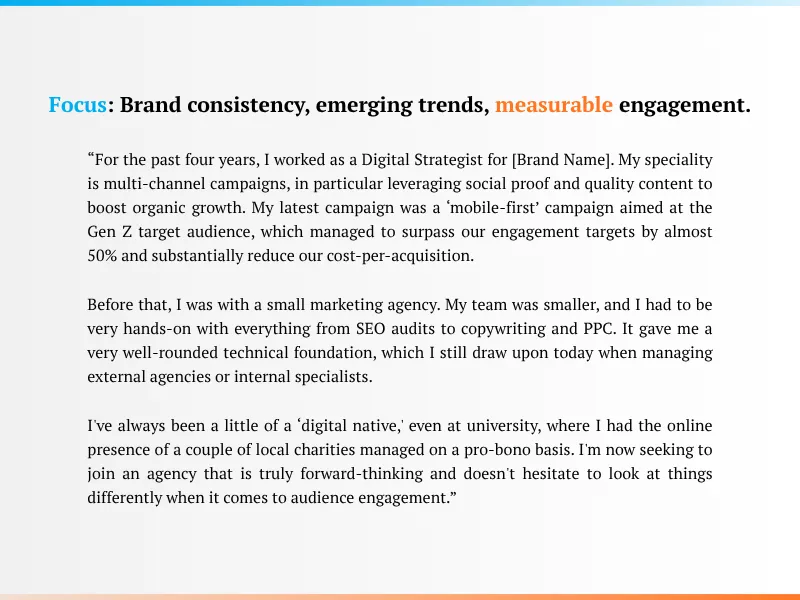
4. Digital Marketing Specialist
You can always seek professional career services if you need interview assistance or CV preparation for the interview.
What to Bring to an Interview?
Many candidates wonder: Should I bring a copy of my CV to an interview? The answer is that there’s no strict requirement to bring a CV to an interview. The HR will already have your digital file that was screened by the ATS.
However, bringing extra copies of CV to interview is generally recommended (at least 2 – 3 physical copies). It simply shows your preparedness and also acts as a backup document in case the interviewer forgot theirs.
Apart from these, you can bring the following items to an interview:
- Any ID documents (if specifically requested by the employer in advance). For example: right to work documents.
- Portfolio or samples of your work
- Pre-written questions to ask the interviewer at the end.
- For taking notes in an interview, bring a notepad and a pen.
Important note: The best way of handing your CV to the interviewer is to present the CV in a portfolio folder along with the other documents, like samples of work. Always make sure your CV is easy to read for both the ATS and the human recruiters while being strongly formatted and curated to get selected. For CV writing service help, contact iCover.
Common Mistakes to Avoid When Presenting Your CV
Knowing what to do is 50% preparation. Here are the common errors that kill otherwise promising candidates during a CV Walkthrough:
1. Reading from your CV word for word
CV is on the interviewer’s desk. If it’s just a recitation, no extra value is added. Don’t use your CV as a script.
2. Describing each individual role in sequence
A full career history narrative is boring to hear and can be very time-consuming when interviewing. Focus on relevance rather than completeness.
3. Oversharing on employment gaps
It’s best to acknowledge a gap but briefly. End by explaining the reason in one line. The following sentence should be about your return to work and what you brought back with you. Candidates who over-explain gaps make them the centre of the conversation.
4. Mixing up the questions ‘Tell me about yourself’ and ‘Walk me through your CV’
These are different questions that require different answers. Having them all mixed up indicates a lack of preparation.
| Feature | Tell me about yourself | Walk me through your CV |
| Purpose | A personal and professional snapshot. | A summary of the career. |
| Tone | Personal. Tell about what inspires you. | Professional. Keep it to the facts, the results. |
| Length | 60–90 seconds. | 2–3 minutes. |
| Starting Point | A defining moment of the present. | Your current role. |
Special Tips for Presenting Your CV in a Virtual Interview
The basics of CV presentation are similar, but there are some differences when interviewing virtually through Microsoft Teams, Zoom, or Google Meet. For a professional delivery, do the following:
- Open your CV PDF on screen or print it out beside you. Avoid sharing a screen unless requested to do so, as that will take the focus away from your face.
- Place your camera at a height similar to your eye level. Use a stack of books to raise your laptop if needed. This is like real eye contact.
- Test the microphone before the call. For maximum clarity, use headphones with an integrated microphone.
- Log on 2 to 3 minutes before the starting time.
Conclusion
What do you say when handing over your CV in an interview?
You might say, ”I’ve brought a copy of my CV in case it’s useful for our conversation — just let me know if you’d like it.”
Is it okay to review my own CV during the presentation?
Yes, you can. It aids in maintaining accuracy when it comes to dates and details. You shouldn’t read from it directly, though. Follow it and maintain eye contact with the interviewer.
Do I need to say what my hobbies are when doing a CV walkthrough?
If a hobby is relevant to the role or industry in question, mention it; otherwise, do not. For example, you can sell leadership skills to employers if you have been a football team captain. Avoid mentioning any passion that doesn’t relate directly to keep the narrative to the point.
What to do if my CV has multiple short-term contract positions?
Outline job roles clearly, and demonstrate a clear career progression. Explain that you chose contracting because you wanted to have a broad experience within the shortest time possible. Focus on the value and outcomes you added, rather than the time you served in the role.
Frequently Asked Questions
What do you say when handing over your CV in an interview?
You might say, ”I’ve brought a copy of my CV in case it’s useful for our conversation — just let me know if you’d like it.”
Is it okay to review my own CV during the presentation?
Yes, you can. It aids in maintaining accuracy when it comes to dates and details. You shouldn’t read from it directly, though. Follow it and maintain eye contact with the interviewer.
Do I need to say what my hobbies are when doing a CV walkthrough?
If a hobby is relevant to the industry passion of the concern, mention it; otherwise, do not. For example, you can sell leadership skills to employers if you have been a football team captain. Avoid mentioning any passion that doesn’t relate directly to keep the narrative to the point.
What to do if my CV has multiple short-term contract positions?
Outline job roles clearly, and demonstrate a clear career progression. Explain that you chose contracting because you wanted to have a broad experience within the shortest time possible. Emphasize the value and outcomes you added, rather than the time you served in the role.
How useful was this post?
Click on a star to rate it!
Average rating / 5. Vote count:
No votes so far! Be the first to rate this post.
We are sorry that this post was not useful for you!
Let us improve this post!
Tell us how we can improve this post?

Want To See My Profile — Click Here Jonathan
- How to Present a CV in an Interview (And What to Bring) - June 22, 2026
- What Are Group Interviews? Expert Tips to Stand Out - February 20, 2025
- Understanding Time Off In Lieu (TOIL) - September 22, 2023
