
You do not need to have multiple degrees to land a new job. If you have transferable skills, your chances are already high! These are portable abilities (e.g., problem-solving and leadership) that work in any industry.
67% of UK hiring managers have started prioritising skills and experience over formal qualifications. This simply means that your past roles can transition your future into a better position.
Whether you are switching sectors or moving to senior roles, these skills make you indispensable. Want to know how to pivot without starting from zero? This guide reveals how to identify your hidden talents, master the functional CV, and prove your value to any UK employer.
Your transition starts here.
Key Takeaways on Transferable Skills
- Portable skills are transferable skills useful in many different industries and jobs.
- UK employers now prioritise skills and experience over academic qualifications.
- Skills can be acquired through volunteering, university work, and experience.
- A functional CV format allows job seekers to emphasise skills over experience.
- Demonstrating skills (using the STAR method) is crucial during interviews.
What Are Transferable Skills?
Skills that are transferable help you to be highly functional in many different jobs or industries. Also known as “portable skills” – a combination of soft and hard skills. A person generally gains these skills while working, studying, and even in everyday life.
Some of the examples include communication, teamwork, problem-solving, accounting, using AI, etc. They’re very useful when it comes to changing careers and support the transition towards leadership positions.
What Is the Importance of Transferable Skills?
Transferable skills for CV have several advantages for both job seekers and recruiters:
- Flexibility: These skills enable you to take on various roles. Employers value workers who can adapt to different tasks.
- Diversity: These skills make you a more diverse employee. You can draw on your learning or interests in any role.
- Portability: They are essential career transition skills that improve as you progress. You can take these abilities with you when you change jobs.
- Employability: These also bolster your CV even when you are inexperienced. They demonstrate your ability to adapt and pick up skills fast.
What Are the Most Valuable Transferable Skills for Career Change in the UK?

Here’s a list of adaptable skills that employers in the UK look for when recruiting talent from diverse backgrounds.
1. Leadership Skills
A person with good leadership skills motivates others to work towards a common organisational objective. They are proactive during peak times and keep the team motivated during difficult company restructuring. They know how to delegate responsibilities to ensure team members are working on the right projects.
- Example: Effectively managed a team of five volunteers to complete a regional project.
2. Writing Skills
Someone with excellent writing skills produces clear and comprehensible documents. This ability is useful for drafting everything from simple client emails to detailed project proposals.
- Example: If you are preparing a CV for career change and want to highlight this skill, consider presenting it like “Compiled monthly reports on department output that were praised for their clarity”.
3. Adaptability
Adaptability is the ability to be productive despite changing tasks or surroundings. It’s an attribute of transferable skills mid-career change UK professionals who can manage a steep learning curve. An adaptable worker quickly finds ways to work in a new department.
- Example: Adapted from a retail to a high-pressure office environment.
4. Empathy
A person uses empathy to understand the feelings of others and develop positive employment relationships. It enables people to offer improved customer service and support to their team in times of stress. It showcases the importance of soft skills in CV as it helps create a supportive work culture.
- Example: Coached a colleague who was underperforming by listening to their issues and giving suggestions.
5. Active Listening
A professional with the skill of active listening listens carefully to understand the needs of others. This includes paying attention to body language as well as the spoken word. This fosters trust and allows specific instructions to be carried out.
- Example: Asked clarifying questions during client meetings to ensure all project details were understood.
6. Time Management Skills
Having strong time management skills enables a person to structure their daily routine in order to meet tight deadlines. They can handle several tasks at a time and not be swamped by a heavy workload. It is an effective way to ensure optimal productivity in a stressful work environment, such as being part of a redundancy process UK.
- Example: Managed three different client accounts and completed all reports on time.
7. Problem-solving Skills
Problem-solving skills help one to identify logical ways to bypass hurdles in the workplace. They develop solutions to problems that hinder a business’s performance. This may require thinking outside the box to find innovative and affordable ways to solve technical issues.
- Example: Developed a new stock tracking system to fix an inventory problem.
8. Communication Skills
Effective communication skills mean relevant information is communicated clearly both within and outside the organisation. An effective worker communicates complex concepts to all stakeholders clearly and concisely. This minimises confusion and facilitates internal collaboration.
- Example: Wrote short daily reports for directors to update them on project milestones.
9. Commercial Awareness
Knowledge of market trends is the best transferable skills to highlight on a UK CV. An individual with this skill understands the economic principles that contribute to the success of a business. They understand what their employer needs to do and how they can support their bottom line.
- Example: Conducted research on local competitors’ rates to assist the company in setting competitive prices.
10. Critical Thinking
In the list of transferable skills for changing careers, one of the most important ones is critical thinking. A person who can analyse data before making a logical conclusion is a potential future leader. Instead of following the process blindly, it is about looking for the most efficient way to achieve a result. They can weigh up options to decide on the best course of action.
- Example: Assessed different transport options to obtain the cheapest option for a logistics company.
11. Conflict Resolution
Professional Transferable Skills Examples include being able to manage workplace conflicts fairly. An effective individual negotiates with a client and team to reach an agreement. Therefore, differences do not impact the team’s productivity.
- Example: Mediated a scheduling conflict among staff to ensure adequate coverage for the shop.
12. Project Management
A person uses these transferable skills for career change UK CV to oversee a task from the initial plan to the final result. They coordinate staff and resources to ensure the project remains on budget and meets quality standards. They are skilled at monitoring activity and identifying any potential issues back to management.
- Example: Co-ordinated a department launch for 50 clients on a tight budget.
13. Verbal Communication
Effective verbal communication is the ability to present information in an engaging and professional manner. A person adopts appropriate pitch, tone, and volume for the audience (whether it is customers or management). This can help establish rapport and ensure instructions are understood.
- Example: Delivered a quarterly review to the management board with confidence.
14. Negotiation
An individual can find a mutual agreement through discussion and compromise in these transferable skills from teaching to corporate UK contexts. They guard the business’s bottom line while maintaining client satisfaction. This skill fosters business relationships and increases profits in the long run.
- Example: Negotiated a discount with a regular supplier of office supplies for bulk orders.
15. Digital Literacy
Possessing a high level of transferable skills for career change in the digital area allows a person to master new software quickly. They can use a range of online platforms to organise data and communicate with team members. They are not afraid of changing technology and can learn new tools quickly.
- Example: Maintained a client database through a cloud-based CRM system.
16. Collaboration
A team-focused professional cooperates with different types of team members to achieve a goal. They take joint responsibility for success and ownership for their role in each project. This allows for an efficient process and avoids duplication of tasks across the organisation.
- Example: Helped the sales department develop more efficient client brochures.
17. Resilience
A resilient person is able to keep up their positive attitude, even when under pressure. They are able to accept criticism or failure and work to improve in the future. This makes them a valuable resource to any business during a period of high demand or stress.
- Example: Designed a project plan within a short time after the original version was returned by the client.
18. Creativity
The ability to use their imagination to come up with new ideas is the hallmark of a creative individual. They seek to find innovative solutions to existing problems or new audiences for the brand. This person can revitalise the company’s marketing strategy or processes with new ideas.
- Example: Proposed a marketing campaign for social media that drove traffic to the corporate website.
19. Attention to Detail
A candidate who produces error-free work shows excellent attention to detail in every task. They will notice minor errors in a contract or invoice before it is sent to the client. This helps to maintain the company’s reputation and avoid losses due to poor record-keeping.
- Example: Reviewed a 50-page audit report for complete accuracy before the deadline.
20. Decision Making
Decision-making involves selecting the most effective course of action. It’s all about evaluating all available data—including the strategic balance of OKR vs KPI metrics—and potential risks. I It takes confidence to take responsibility for choices that impact the wider team or business operations.
Professionals who can make timely and logical decisions help maintain momentum. It also prevents delays.
- Example: Selected a new software provider by comparing costs and long-term scalability.
Do UK Employers Value Transferable Skills Over Qualifications?
Employers in the UK are favouring transferable skills over degrees. Around 67% of hiring managers prefer interpersonal skills like teamwork, critical thinking, and solving problems over degrees. This trend helps companies fill talent gaps more effectively.
More organisations are adopting skill-based hiring and putting their focus on competence instead of credentials. This can lead to improved performance outcomes.
Are Transferable Skills Enough to Change Careers in the UK?
Transferable skills are typically enough to change careers in the UK. Nowadays, recruiters prioritise your ability to perform tasks over specific industry experience. However, you must be able to prove how the skills you gained from the previous roles translate to a new sector for a new role.
To succeed, applicants need to show exactly how their expertise solves a new employer’s problems. This means you must effectively tailor your CV to bridge any experience gaps. Through the alignment of your strengths with the job description helps demonstrate your value more clearly.
How Do I List Transferable Skills on a UK CV? Top 5 Tips

Here’s how to list your skills and attract employers’ attention.
1. Analyse the Skills Needed for the Position
Read the position description and be aware of the skills needed for the specified job role. You need to align your skills with the skills required to demonstrate fit. This ensures your application goes past initial recruitment screening.
2. Emphasise Transferable Skills Applicable in Any Sector
Identify skills that can be used regardless of the industry, such as project management or budget handling. These “hot” skills make you more likely to find employment. Only showcase those skills relevant to the specific role you are applying for.
3. Remember Where Your Skills Can Come From
Genuine skills can come from many sources. Include skills you gained from volunteer work, college projects, or a hobby. This is a great way to build on your experience if you are looking to apply for a job in an entirely new industry.
4. Quantify Your Skills and Experience
Show you have demonstrated your skills and experience with data or measurable results. Don’t say you are good at “organisation”. But explain how you managed a schedule for a large team. Use this data to craft a convincing argument for your hiring.
5. Use a Skills-Based Layout
Organising your document by ability rather than just dates allows you to present information more strategically. List your best qualities under headings at the top. This will help the recruiter recognise your strength.
If you are unsure how to bridge the gap between industries, professional CV writing services can help you refine your profile.
How Do I Identify My Transferable Skills?
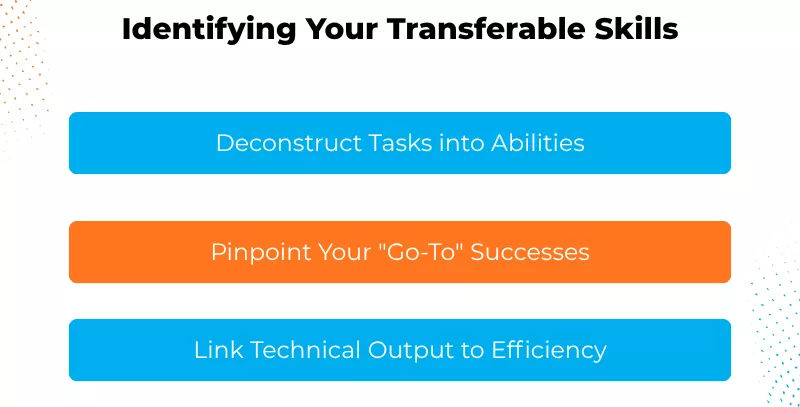
Identifying your strengths requires you to look at your daily accomplishments rather than just your job title. The one formula is: (Job-Specific Task) + (Action Taken) = (Transferable Ability). So here’s how you can identify your potential skills:
1. Deconstruct Each Responsibility
Break down every past responsibility to find the underlying talent. Do not just look at your industry; focus on the actual work you did. If you coordinated busy staff rotas in a restaurant, for instance, you have skills that are useful in a project management job.
2. Reflect on Past Successes
To answer the question, “What transferable skills do I have?”, you must reflect on the praise you have received. Consider your core competency in every role.
For example, being the “go-to” person for computer problems demonstrates a technical ability that could be applied to an IT support or office manager position.
3. Analyse Your Workplace Output
Transferable skills are important to show how you can boost a company’s productivity. Look at where your technical knowledge crosses over into general efficiency in your workplace. For example, designing a faster filing system in a clinic is a process-improvement skill. It can easily transfer to a business analyst role.
If you need help, professional career services can help you choose your transferable skills through a one-on-one consultation.
Which UK Industries Value Transferable Skills the Most?
There is a significant skills gap in many UK industries. Nearly 76% of employers have trouble recruiting qualified staff. As a result, these industries now value transferable skills, such as communication skills and flexibility. Here are the top 5 industries:
| Industry | Key Preferred Skills |
| Technology & AI | Critical thinking, adaptability, and digital literacy |
| Healthcare & Social Care | Empathy, active listening, and conflict resolution |
| Construction & Engineering | Project management, budgeting, and health and safety |
| Professional Services | Commercial awareness, negotiation, and public speaking |
| Logistics & Operations | Strategic planning, multitasking, and problem-solving |
| Education & Training | Leadership skills, mentoring, and patience |
| Hospitality & Retail | Verbal communication, resilience, and customer service |
Mistakes to Avoid While Choosing Transferable Skills for Your CV
While choosing your strengths, avoid these common traps to ensure your application remains competitive.
- Avoid listing too many general skills that lack a direct connection to the new role.
- The biggest mistake an applicant makes is claiming a skill without providing evidence.
- Presenting skills that are irrelevant to the target sector creates a barrier to your progress.
- Don’t forget to mention the keywords that are present in the job description.
- Not quantifying your skills makes them less convincing to the hiring manager.
- Avoid writing too many things in the skills section; keep it brief and clear.
By steering clear of these errors, you’ll put forward a solid and coherent case to justify your career change.
Ready For The Next Step?
Transferable skills are your most powerful asset in the UK job market. Understanding your specific strengths can help fill the skills gap. You can then use your CV to demonstrate competency in a wide range of sectors. Emphasise how your skills address your new employer’s challenges. Whether you are switching careers or moving up, these all-purpose skills mean you are always marketable.
Frequently Asked Questions About Transferable Skills
Are soft skills and transferable skills the same thing?
Transferable skills and soft skills are not the same, but they can overlap. Soft skills are personal traits, such as empathy and teamwork. They define how you work and interact with others.
Transferable skills are those you can take with you to different jobs. Such skills include both soft and technical skills. So, soft skills are a form of transferable skills.
Can I get a job in a new field with only transferable skills?
Yes, you can obtain a new job with just transferable skills. You need to showcase adaptable skills such as leadership, communication, and project management.
The key to success is translating your skills into the new industry’s language. Focus on your actual accomplishments rather than just listing your daily tasks. Finally, you must prove that you can learn new systems quickly.
How do I demonstrate transferable skills in a job interview?
Provide measurable examples using the STAR (Situation, Task, Action, Result) method. Demonstrate how your transferable skills and experience address problems for the new job. Use the language of the job description; avoid old industry buzzwords. Highlight skills such as leadership, communication, and problem-solving to demonstrate your adaptability.
Should I list transferable skills separately on my UK CV?
Yes, listing transferable skills is highly recommended for a UK CV. The most effective approach is to include a dedicated “Core Skills” or “Professional Profile” section. Also, incorporate these skills through examples in your work experience. This approach demonstrates your worth to a potential employer and makes your CV more readable.
Is a skills-based CV better for a career change in the UK?
A skills-based or functional CV is often best for a UK career change. It highlights relevant transferable skills instead of a linear, unrelated work history. In 2026, 81% of UK employers have started prioritising skills-based hiring over traditional credentials.
Can transferable skills replace qualifications in the UK job market?
Transferable skills are increasingly replacing traditional qualifications in the UK. Technical roles still need credentials, but employers now prioritise competence and capability. Studies show 94% of skills-based hires outperform those chosen only for their qualifications.
How do I gain transferable skills?
Gain transferable skills—such as communication, leadership, and problem-solving—by leveraging current roles, doing internships or part-time jobs, volunteering, taking online courses, and leading projects. Actively document these skills through the PAR Method (Project + Action = Result) and tailor your resume to showcase how they apply to new industries.
How useful was this post?
Click on a star to rate it!
Average rating / 5. Vote count:
No votes so far! Be the first to rate this post.
We are sorry that this post was not useful for you!
Let us improve this post!
Tell us how we can improve this post?

