
Are you still sending a generic CV and hoping for a miracle to get an interview call? In this highly competitive UK job market, where bots do the selection, reaching recruiters’ decks requires a CV more than a dull list of previous jobs.
To stand out, your CV must act as a high-impact marketing brochure that strategically presents your essential skills, aligning with the job description.
In this article, we will discuss the best skills for CV that are highly sought after by employers. Plus, we will offer tips on how to choose your top skills for your CV to be unmissable!
Key Takeaways
- An effective CV must serve as a focused marketing instrument, and it must clearly match your competencies to the job description to be able to shine in a competitive market.
- Putting the correct skills on the list enhances visibility, as your CV will sail through ATS filters and attract the attention of a recruiter in a few seconds.
- In 2026, employers are seeking a balanced blend of hard (technical) and soft (interpersonal) skills to determine both ability and cultural fit.
- Relevance and credibility are achieved by carefully choosing and customising the skills in accordance with job requirements, industry trends, and quantifiable impact.
- By strategically demonstrating skills, i.e., in a well-organised manner with actual results, you make your CV look like a value proposition instead of a list of skills.
Why Is It Important to List Skills on Your CV?
Listing your abilities isn’t just about padding; it’s about strategic visibility. Here is why they matter:
- Beating the Bots: The use of relevant skills can make you beat ATS software and score higher in automated searches.
- Instant Impact: Highlighting the right skills catches an employer’s eye during their initial six-second scan.
- Specific Targeting: When you tailor your CV, you bridge the gap between your experience and the specific job description.
- Proving Value: Using measurable data helps you convey your professional impact rather than just listing vague daily duties.
- Clear Visuals: Choosing good skills for CV allows you to showcase your range and versatility at a glance.
The information you put on your CV must prove you are the solution to an employer’s problem. In case you are having a hard time refining these, professional CV writing Services can work it out to refine your profile and increase the chances of success.
Types of Skills Employers Look For in 2026
The top skills employers want to see in action are the dynamic blend of technical proficiency and human-centric emotional intelligence. The first step in applying for a job is to identify the type of skills for CV. To impress hiring managers, you must categorise your abilities in hard and soft skills to show a 360-degree professional profile.
What Are Soft Skills for CV?
Soft skills in CV are your personality traits and emotional intelligence in a professional workplace. These interpersonal skills show how you collaborate and build rapport with colleagues. For example, these skills include:
| Types of Soft Skills | Examples |
| Problem-solving & Analytical skills for CV |
|
| Leadership skills for CV |
|
| Strong communication skills for CV |
|

Put these examples straight into a CV
Copy your favourite line into the editor and have a finished, ATS-friendly CV today. Free to build — download from £3.99.
What Are Hard Skills for CV?
Hard skills are skills that can be measured, and they are technical skills acquired in school or through voluntary experience. These are the work-specific tools that you operate daily.
For example, knowing advanced coding is one of the IT skills for CV and is highly sought after in the digital economy. Other examples of essential hard or technical skills for CV include:
- Data analysis: Proving managerial input by making precise predictions and insights.
- Cloud Computing: Find your way around AWS or Azure to store secure corporate information.
- UX Design: Creation of user-friendly web and mobile applications.
- Foreign Languages: Interaction with global market clients.
- Financial Forecasting: Managing budgets and technical accounting software.
Hard Skills vs Soft Skills for CV: Combining Both for a Balanced Profile
The combination of technical skills and interpersonal advantages is the formula that makes the most winning CVs in the competitive market. To ensure your skills on CV provides a comprehensive view of your professional value, you must show how these two different skill sets complement one another.
| Feature | Hard Skills Focus | Soft Skills Focus | Combined Strategy |
| Market Value | Displays the minimum level of knowledge required to perform the job. | Shows that you will grow and fit in the workplace. | These together help you stand out as a “complete” candidate. |
| Problem Resolution | Applies particular software or techniques to resolve a problem. | Manages stakeholders through collaboration and empathy. | Shows you can solve technical problems while maintaining team harmony. |
| Career Longevity | Makes you pertinent to certain job needs. | Turns you into a high-potential future leader. | Enhances perception of a competent and promotable employee. |
| Validation | Authenticated by credentials, examination, or portfolios. | Validated at the time of the interview based on tone and social cues. | Builds instant credibility and trust with hiring panels. |
A balanced profile shows that your hard skills will take you inside the door of an organisation, but your soft skills will enable you to shine once you are inside. Cultivating these Transferable Skills is essential for professional growth. In 2026, employers are seeking this balance to guarantee that new employees are able to contribute instantly to both the technical work and the workplace culture.
How to Choose Top Skills to Include on Your CV?
Curation is the secret to an unmissable profile. Rather than listing all the skills you have, you have to place your CV skills into a prism of the vacancy. This is how you pick the most influential qualities to get your next job.
Reverse Engineer the Job Description
Begin by auditing the vacancy advertisement. Look for verbs and nouns that repeat. Find nouns and verbs that are repeated. When the terms stakeholder management or regulatory compliance are used several times, these are the most essential skills to list on a CV.
Using these keywords in your CV to explain skills proves you have understood the role’s core priorities.
Research Market-Specific Trends
You must ask yourself: What skills do UK employers look for in 2026? The answer often lies in digital fluency and sustainability.
For example, a marketing applicant must now focus on AI content prompting in addition to the conventional brand strategy. Such future-proof skills are targeted to a niche, which proves that you are a progressive candidate.
Map Phrases for ATS Precision
To pass automated Application Tracking System screenings, you need to be precise about what skills to put on a CV. Don’t just write “good at computers” if the advert asks for “proficiency in SaaS platforms.”
It is best to use the exact wording that the job advert uses to make your profile rise to the top. If the employer wants “conflict resolution,” don’t swap it for “calming people down.”
Filter by Evidence and Impact
A skill can only count when you can demonstrate it. Choose abilities where you can attach a “mini-win.”
As an example, when you add project coordination, make sure that in your experience section, you mention a single project that was completed on time.
Only include skills that you can discuss confidently during a technical or second round interview questions to maintain total professional credibility.
How to Present Skills on Your CV (With Examples)
The way in which you present your skills is equally vital as the skills themselves because the way they are presented and the context in which they are presented determine how readily a hiring manager can confirm that you are knowledgeable.
To effectively showcase your strengths, you should weave them into both a dedicated sidebar for quick scanning and within your work experience to provide necessary context.
CV Skills for Digital Project Manager
When documenting CV key skills for project management, focus on the methodology and the tools used to drive efficiency. Instead of simply naming a software, use the work experience section for explaining how you’ve utilised it to achieve a specific business outcome.
- Agile, Scrum Orchestration: Conducted the sprints of a team of 12 led by two bi-weekly sprints; the product release cycle became 15 % faster.
- Budgetary Oversight: Handled a portfolio of 250k and kept all project streams within 10% of the budget by means of strict resource allocation.
- Stakeholder Matrix Mapping: Utilised Miro and Jira to align cross-functional teams, reducing communication bottlenecks by 30%.
CV Skills for Customer Success Specialist
In this role, you need to be able to demonstrate both empathy and a data-driven approach to retention. Your top CV skills should highlight your ability to turn a satisfied customer into a long-term brand advocate.
One of the best ways to show this is in a bullet point, Key Achievements:
Successfully cut churn rate 12% in six months through a new proactive feedback loop and client-onboarding journeys by personalisation of high-value accounts.
CV Skills for a Data Analyst
For technical roles, the professional skills section should be categorised by language or tool. Clearly state the skills needed to handle the specific data architecture mentioned in the job description to ensure ATS compatibility.
- Languages: Python (Pandas, NumPy), SQL, R.
- Visualisation: Tableau, Power BI, and Google Data Studio.
- Statistical Analysis: A/B testing, regression analysis, and predictive modelling to support executive decision-making.
AI Content Strategist
As one of the emerging roles for 2026, your list of skills for CV must reflect your ability to bridge human creativity with machine efficiency. To highlight the best skills for CV in marketing, show that you can prompt and polish AI-generated content rather than just hitting ‘generate.’
Focus on:
- Generative AI Prompt Engineering: Crafting high-conversion copy across five platforms.
- SEO Semantic Auditing: Improving organic reach by 40% through deep-keyword integration.
- Multi-Channel Strategy: Aligning tone of voice across LinkedIn, TikTok, and Instagram.
CV Skills for Registered Nurse or Healthcare Lead
In the healthcare sector, the skills you need are often a mix of clinical precision and crisis management.
Mentioning problem solving within a high-pressure clinical environment provides a layer of credibility that a simple list cannot achieve.
You can even draw from experiences outside of work, such as volunteering with St John Ambulance, to show a consistent commitment to patient care and resilience.
CV Skills for Human Resources (HR) Business Partner
To make your profile stand out from the crowd, align your expertise with the modern workplace’s focus on culture and compliance. Detail the skills required for the job by focusing on conflict mediation and strategic growth.
- Conflict Resolution: Resolved 20+ workplace conflicts, including a 95% internal conflict resolution rate without tribunal cases.
- Talent Acquisition: Re-modelled the interviewing process to focus on inclusivity training, which has led to a 25 % diversity in the workforce.
- Employee Relations: Implemented mental health wellness programs that boosted staff retention by 18% annually.
CV Skills for Sustainability and ESG Consultant
UK firms are increasingly prioritising environmental impact, so placing the right key skills for your CV here is vital for future-proofing your career. Employers also look for candidates who can translate complex regulations into actionable corporate policy.
- Net Zero Strategy: Prepared carbon reduction roadmaps of three SME clients, achieving 2025 goals a year earlier.
- Regulatory Full Compliance: Making sure that all the legal requirements are met in UK-specific ESG reporting.
- Supply Chain Auditing: High-risk environmental factors identified and addressed in global supply chains.
Put these examples straight into a CV
Copy your favourite line into the editor and have a finished, ATS-friendly CV today. Free to build — download from £3.99.
How Do I Write a Skills-based CV in the UK for Different Levels?
First, your UK CV Format must have a dedicated skill section. Next, to ensure your CV reaches the right recruiter, you must adapt your skills presentation to match your current career trajectory. Here’s how to do it:
Why should I have a separate skills section on my CV?
A dedicated skills section serves as a strategic summary of your professional toolkit. Placed prominently, it allows hiring managers to verify your technical and interpersonal eligibility instantly. This section is not just a list; it is a curated space that mirrors the requirements of the job role, making your profile more “scannable” for both humans and AI bots.
Now let’s see how to tailor your Skill section according to the specific experience level:
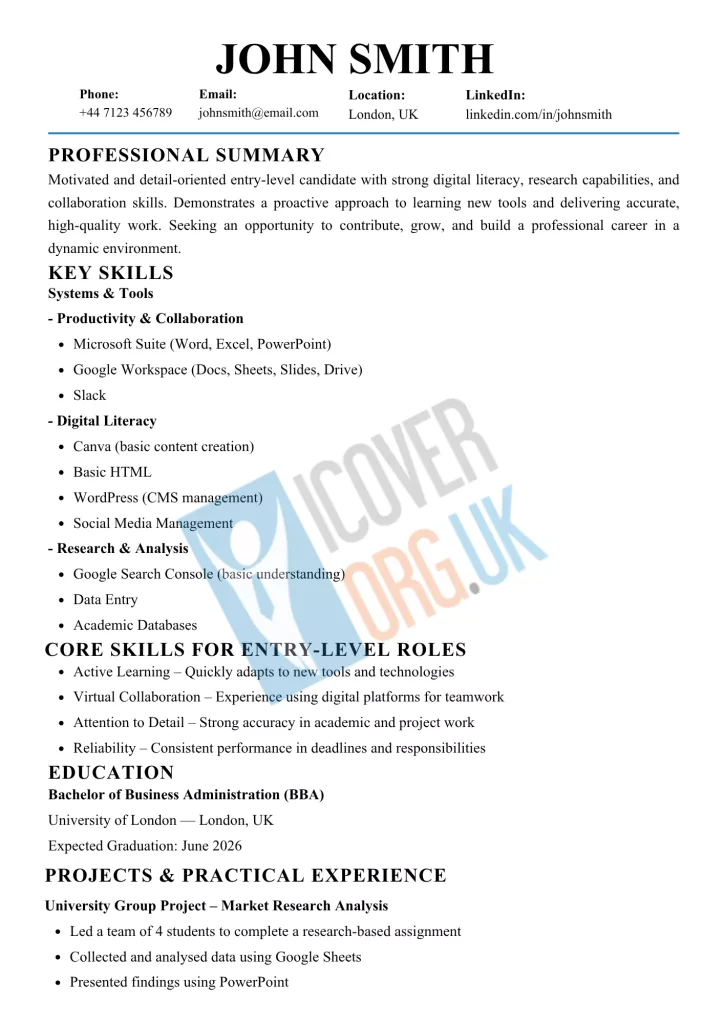
1. Launching a Career: Entry-Level Strategies
Junior candidates often struggle with a lack of history. At this stage, your list of skills for CV should mirror the hunger for growth and basic workplace competency an employer is looking for in the current market.
What Skills Should I Put on My CV with No Experience?
Instead of searching for direct industry matches, focus on the “baseline essentials” required for any corporate job role. Here are some non-experience skills for CV examples:
- Active Learning: Showing the speed at which you absorb new digital tools or methodologies.
- Virtual Collaboration: Familiarity with Zoom, Slack, and cloud-based document sharing.
- Attention to Detail: Evidence of accuracy in academic data or personal projects.
- Reliability: Demonstrating consistency through attendance records or volunteering.
How Do You Prove Your Skills on a CV without Work Experience?
Since you lack professional proof, shift the spotlight to verifiable outcomes from alternative environments. Check out some CV skills examples UK for freshers:
- Academic Leadership: If you managed a group project, you have already practised delegating and time-sensitive delivery.
- Micro-Credentials: List certificates from platforms like Coursera or LinkedIn Learning to show self-taught initiative.
- Sports & Hobbies: Mentioning team sports proves you understand shared goals and high-stakes cooperation.
Skills-based CV Template for Entry-Level Roles
2. Expanding Professional Mobility: Mid-Level Transitions
As a professional with 3-7 years of experience, you are expected to operate with autonomy. This is the stage to showcase the transferable skills you’ve refined that go beyond your specific industry jargon to drive actual productivity.
What Are Transferable Skills and How Do I List Them on a CV?
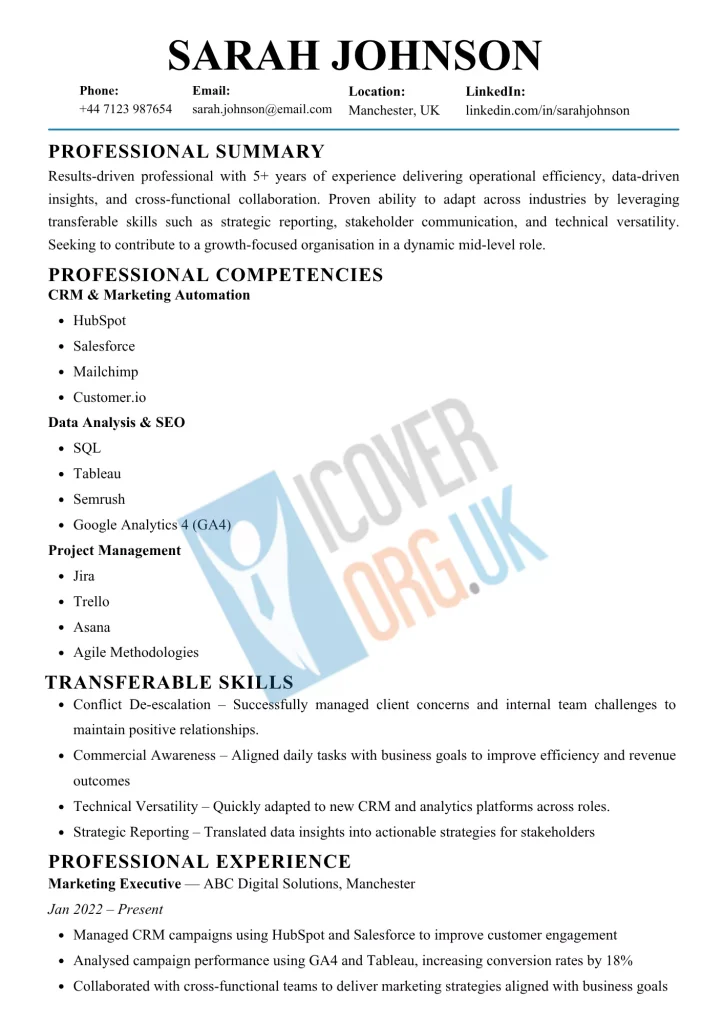
Transferable skills are universal strengths that allow you to pivot into different sectors with minimal retraining. These should be framed as core assets that build relationships and maintain operational flow. Some transferable CV skills examples are:
- Conflict De-escalation: Critical people skills used to navigate sensitive client or internal disputes.
- Commercial Awareness: Understanding how individual tasks impact the wider business bottom line.
- Technical Versatility: Group your specific tools (CRM, CMS) as proof that you can learn new tech stacks quickly.
- Strategic Reporting: Proving you can translate data into clear, actionable steps for stakeholders.
When listing them, create a “Professional Competencies” header. Use the skills you’ve acquired in previous sectors to explain how they solve problems in a new job role, ensuring your versatility is clear to the hiring manager.
Skills-based CV Example for Mid-Level Roles
3. Driving Growth and Policy: Executive and Management Level
High-level hires are the architects of a company’s future, requiring a focus on vision and influence rather than daily execution.
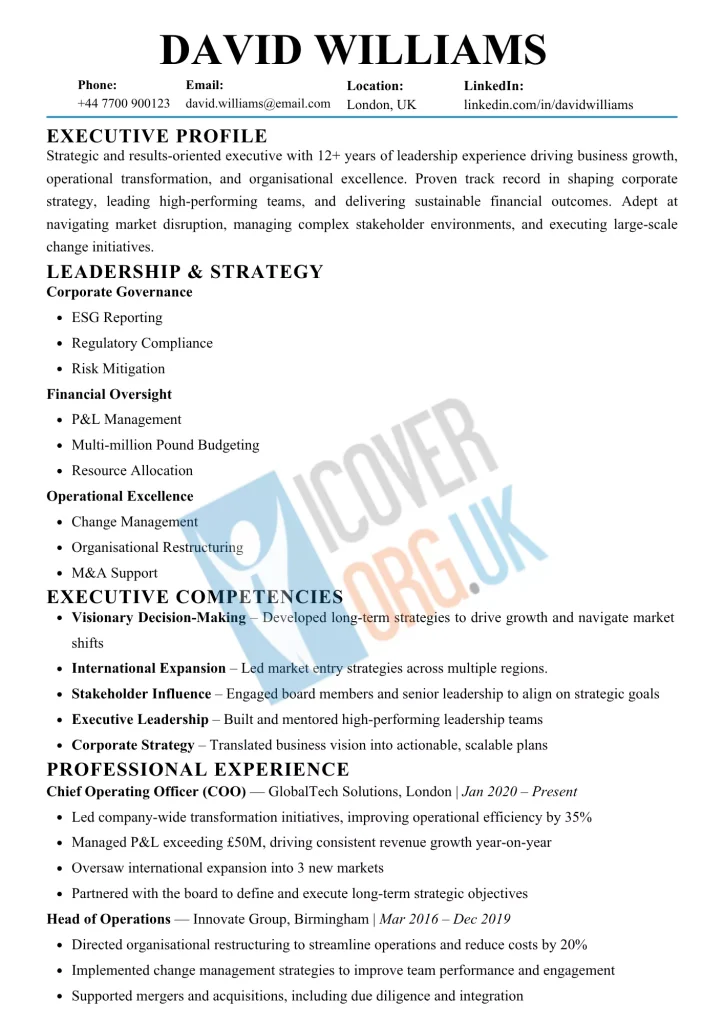
When creating a list of skills for CV at this level, avoid listing basic software. Instead, focus on the impact of your leadership. Including additional skills for CV, such as board-level advisory roles or executive coaching certifications, will further distinguish you as a top-tier candidate.
Here are some tips with skills for CV examples:
- Visionary Decision-Making: Proving you can think outside the box to navigate market disruptions.
- Resource Allocation: Mentioning P&L responsibility to show financial maturity.
- Additional skills for CV: Include Change Management, Corporate Governance, and International Expansion strategy.
Sample Outline for Executive Skill section
To ensure your skills are articulated with maximum impact and tailored perfectly to your industry, consider investing in professional CV editing services to help you secure that next big interview.
Common Mistakes to Avoid When Listing Skills on Your CV
Even the most experienced candidates can undermine their profile by making simple errors. To ensure your CV to get the attention it deserves, avoid these common CV mistakes:
- Lying or Exaggerating: Never claim mastery of a tool you haven’t used; technical interviews will quickly expose a dishonest skills CV.
- Skill Stuffing: Including too many irrelevant abilities dilutes your core message. Curate your skills to your CV by focusing only on what the employer specifically requested.
- Listing Obsolete Tech: Including outdated software like Windows 7 or “Internet Browsing” suggests your professional development has stalled.
- Vague Definitions: Avoid generic terms like “Good Communicator.” Without context or a “mini-win” to back it up, the skill carries no weight.
- Poor Formatting: Skills hidden in dense paragraphs are often missed. Use clean bullet points or a categorised table for instant readability.
Conclusion
Your skills are the engine of your CV, driving your profile past automated filters and directly into a recruiter’s hands. By categorising your abilities and backing them with evidence, you transform a standard document into a compelling value proposition. Whether you are a fresh graduate or a seasoned executive, a targeted approach ensures your expertise resonates with the specific needs of the 2026 UK job market.
Frequently Asked Questions
What technical skills are most in demand in the UK job market?
Data literacy, AI prompt engineering, cybersecurity, and cloud platform management (AWS/Azure) currently lead demand across most sectors.
How do you describe communication skills on a CV?
Instead of using the word “communication,” use active verbs like “negotiated,” “facilitated,” “presented,” or “authored” followed by a specific achievement or outcome.
Can you include skills you are still learning on your CV?
Yes. List them with a qualifier like “In Progress” or “Currently Pursuing,” especially if the skill is a mandatory requirement for the job role.
How many skills should you list on a CV?
Aim for a balanced list of 8 to 12 skills. This provides enough variety to pass ATS filters without overwhelming the human reader.
What skills do UK employers look for in 2026?
Employers prioritise AI fluency, sustainability awareness (ESG), digital collaboration, and high emotional intelligence (EQ) to manage hybrid work environments.
How useful was this post?
Click on a star to rate it!
Average rating / 5. Vote count:
No votes so far! Be the first to rate this post.
We are sorry that this post was not useful for you!
Let us improve this post!
Tell us how we can improve this post?

Want To See My Profile — Click Here Jonathan
- OKR vs KPI: What’s the Difference? (With UK Workplace Examples) - August 14, 2026
- 25+ Questions to Ask the Interviewer at the End of an Interview - August 8, 2026
- Video Interview Tips UK: How to Succeed in a Remote Job Interview - July 3, 2026
