
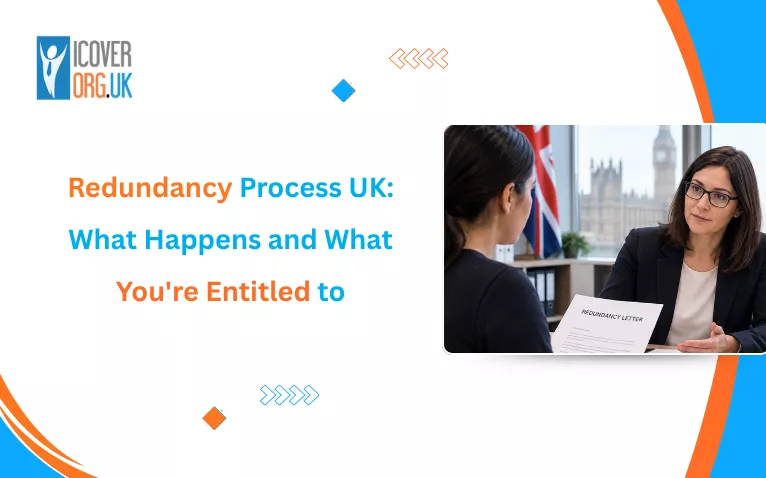
Redundancy process UK is challenging, be it for the company, HR, or the employee. As per the latest official ONS estimate available, approximately 106,000 people were made redundant or took voluntary redundancy in the three months from April to June 2026.
Evidently, the number of jobs being categorised as redundant is increasing. For employees working in the UK, this is a major career transition or setback. In this blog, we explain the UK redundancy process in detail, including the stages, the difference between voluntary and compulsory redundancy, what it means for employees, their legal rights, and how it affects the notice period.
Key Takeaways: What to Do after Being Made Redundant UK?
- Check your redundancy letter and final date and make sure you receive your final salary, notice pay, holiday pay, and redundancy pay.
- Ask your employer for a calculation if you are unsure about the amount. If your employer has an appeals process, you can use it. If not, you may still be able to raise a grievance or bring a tribunal claim.
- Apply for benefits such as Universal Credit or Jobseeker’s Allowance if eligible.
- Update your CV and start looking for a new job, and also ask whether you can get help with training or finding work.
- Keep copies of all letters, payslips, and redundancy documents.
- Contact Acas quickly if you believe your rights have been breached, because legal deadlines can be short.
What Is the Redundancy Process in the UK?
Redundancy refers to dismissing employees because the employer no longer needs the work to be done or an employee to do the job. It might be because of restructuring, closure, or technological advancements.
In the three months to June 2026, the ONS recorded a UK redundancy rate of 3.6 per 1,000 employees.
| Industry | What the latest data shows: redundancy process in Great Britain |
| Distribution, hotels and restaurants | Potential redundancies quadrupled in May 2026 compared with April and rose 190% year-on-year. |
| Public administration, education and health | Accounted for 26% of all potential redundancies in May 2026. |
| Banking and finance | Accounted for 24% of potential redundancies in May 2026; it represented 33% in April. |
| Transport and communication | Accounted for 29% of potential redundancies in June 2026—the largest share that month. |
How Does Redundancy Process Work UK?

The process for redundancy UK is not as straightforward as it may seem. It involves a great deal of considerations and alternatives. Contrary to common belief, the redundancy process cannot be used simply to address poor performance or misconduct.
Wondering, “What Is My Employer Legally Required to Do Before Making Me Redundant?” Let’s check out the process here:
1. Establish the Business Case
To begin with, employers should clearly identify the underlying business reason and consider alternatives such as recruitment freezes, reduced overtime, voluntary redundancy, changed hours, redeployment, or temporary lay-off where legally available.
2. Consult Employees
Employers must consult individually with each employee whose role is at risk. UK law allows employees to ask questions, challenge the proposal, suggest alternatives, and discuss selection criteria. Where 20 or more redundancies are proposed, the employer must also notify the Insolvency Service using form HR1 before consultation begins.
| Proposed redundancies | Minimum consultation period before the first dismissal |
| 20–99 | 30 days |
| 100 or more | 45 days |
What Happens During a Redundancy Consultation: UK Redundancy Consultation Process
A redundancy consultation is a formal process in which an employer explains the proposed business changes, discusses at-risk roles, and considers feedback before making final decisions.
There can be two types of consultations: individual consultation and collective consultation.
In individual redundancy consultation, employers or hiring managers will have one-on-one meetings, which are required for all redundancies, regardless of company size.
Collective consultation is required if an employer plans 20 or more redundancies at one establishment within 90 days. Here, the employer might consult with the union leader or elected employee representatives.
As a professional career consultation provider, we’d advise employees to stay calm, document everything, and put their position clearly.
3. Select Employees Fairly
One of the most essential tasks of an HR manager in this phase is to select employees for UK redundancy. Just as companies now focus on value-based recruitment, one must focus on using objective, evidence-based criteria that are:
- Skills, qualifications, and experience.
- Performance or capability, supported by records.
- Disciplinary or attendance records, applied carefully.
- Business-critical skills.
If an employee is selected for redundancy because of age, sex, disability, pregnancy, race or religion, or is discriminated against for trade-union activity, then the employee can exercise legal employment rights. We have discussed the legal rights later in the blog.
4. Consider Alternative Employment
There’s another essential step one must take: hiring managers and employers must first search for suitable alternative roles within the organisation for the employees at risk.
Suitability is judged on duties, pay, status, location, hours, and the employee’s circumstances. An employee can trial a suitable alternative role for four weeks without losing redundancy rights; a longer trial can be agreed in writing and explain a career gap on your CV.
5. Make the Decision and Give Notice
An HR professional or employer can only confirm redundancy in the UK after proper consultation and selection. The decision should be given in writing, including:
- The reason for redundancy.
- The selection score or rationale.
- The dismissal and leaving dates.
- Notice entitlement.
- Redundancy-pay calculation.
- Holiday pay and other sums due.
- Appeal arrangements.
Employees should begin their job search immediately, even if they are still working through their notice period. Now, since this is a delicate situation to deal with, many people choose to hire a professional CV writer UK.
What Counts as Genuine Redundancy?
Under UK law in section 139 of the Employment Rights Act 1996, a redundancy situation is genuine when the employer’s need for employees to do particular work has ended or reduced, and that is the main reason for the dismissal.
| What does qualify as genuine redundancy in the UK? | What does not qualify as genuine redundancy in the UK? |
| The business is closing completely. The employer is closing or moving the workplace where the employee works. The amount of work of a particular kind has reduced. Fewer employees are needed to perform the same type of work. The business is reorganising, and some roles are removed or substantially changed. The employer expects its need for that work to reduce in the future. | Remove an employee because of poor performance. Punish misconduct. Replace someone with another person doing essentially the same job. Dismiss someone because of a personal disagreement. Discriminate against an employee. Avoid following a capability, disciplinary, or other appropriate procedure. |
How Long Does Redundancy Process Take UK?
The timeline ranges from around two weeks to several months:
- Fewer than 20 proposed redundancies: Usually takes 2 to 3 weeks.
- 20 to 99 proposed redundancies: Takes a minimum of 30 days before any dismissals can take effect.
- 100 or more proposed redundancies: Takes a minimum of 45 days before the first dismissal happens.
Where fewer than 20 redundancies are proposed, there is no statutory minimum consultation period. Two to three weeks is typical practice, not a legal requirement.
Voluntary Redundancy vs Compulsory Redundancy: The Difference
| Point of difference | Voluntary redundancy | Compulsory redundancy | |
| Meaning | The employee agrees to leave after the employer invites applications for redundancy. | The employer selects an employee for redundancy because the role or number of roles is being reduced. | |
| Who starts the process? | Usually, the employer offers a voluntary redundancy scheme, and employees decide whether to apply. | The employer identifies roles at risk and begins a formal selection process. | |
| Is leaving optional? | Yes. An employee can normally decline the offer, although the employer may later consider compulsory redundancies if too few people volunteer. | No. The employee may challenge the decision, but cannot simply refuse the redundancy if the process is lawful. | |
| How are people chosen? | Employees put themselves forward, although the employer does not always have to accept every application. | The employer uses a fair selection pool and objective criteria, such as skills, experience, performance, or length of service. | |
| Consultation | The employer should explain the offer, payment, deadline, and terms. Further consultation may be needed if the employee accepts. | The employer must consult meaningfully before making the final decision. Consultation should allow the employee to ask questions and suggest alternatives. | |
| Redundancy payment | The employee usually receives statutory redundancy pay if eligible, plus any enhanced payment offered under the voluntary scheme. | The employee usually receives statutory redundancy pay if eligible, unless an exception applies. The employer may also offer enhanced redundancy terms above the statutory minimum. | |
| Can the employer refuse? | Yes. The employer may reject an application if it needs to retain that employee’s skills or if too many people apply. | The employer cannot choose randomly or unfairly. It must apply a reasonable, non-discriminatory process. | |
| Notice and holiday pay | The employee is still normally entitled to notice pay and payment for accrued, unused holiday. | The employee is normally entitled to notice pay and payment for accrued, unused holiday. | |
| Suitable alternative role | The employer may offer another role before the employee leaves. Accepting or refusing it can affect redundancy-pay rights in some circumstances. |
| |
| Appeal | There may be limited grounds to appeal if the employee freely accepted the offer, although concerns about pressure, discrimination, or incorrect payment may still be raised. | The employer should provide an appeal process if the employee believes the selection or procedure was unfair. | |
| Main advantage for the employee | It may provide better financial terms and more control over the decision to leave. | It may provide redundancy rights even when the employee does not want to leave. | |
| Main risk for the employee | The enhanced payment may be conditional, and accepting the offer may end the employment relationship permanently. | The employee has less control over the outcome and may face an unfair-dismissal dispute if the process is defective. |
Should I Accept Voluntary Redundancy or Wait for Compulsory Redundancy?
Well, technically speaking, accepting voluntary redundancy usually provides a better financial package and a smoother exit, whereas waiting for compulsory redundancy risks job survival or a lower statutory minimum payout.
How to Know if a Redundancy Is Fair or Unfair?
Signs of a Fair UK Redundancy Process
- Objective criteria
- Fair selection pool
- Meaningful consultation
- Genuine business reason
Signs of an Unfair Redundancy UK Process
- Rushed or missing process for redundancy UK
- Discriminatory redundancy selection criteria
- No consultation before the decision was made
- Targeted or retaliatory
Is My Redundancy Selection Process Fair, and What Can I Challenge?
If your redundancy process UK does not follow the signs here, there might be a chance it is an unfair redundancy process. In that case, you can challenge the following while finding a job fast:
A. Unfair Selection Criteria or Scoring
From the criteria being vague, subjective, or changed during the process to your scores looking inconsistent with your performance records, targets, or feedback, you can challenge everything during the consultation process. Furthermore, if the employer relied on outdated or disputed information or similar employees were scored differently without a clear reason, then you can challenge that too.
B. Unfair Selection Pool
If you are placed in a pool where the employees do not have similar roles and responsibilities, and obvious comparators were excluded to protect them. This means the pool is manipulated and you can challenge it.
C. Discrimination or automatically unfair reasons
If you are discriminated against on the grounds of race, sex, pregnancy, trade union, age, etc or suspect any foul play as such, then note specific comments, patterns, or timing that support your concern.
D. Lack of proper consultation
If you have been purposefully omitted from the meeting and the meeting seems more like an information exchange than a discussion, then you can challenge it on the grounds of improper consultation.
E. Failure to consider alternatives and procedural defects in notice, pay, or information
If you are not provided any alternatives or if your suggested valuable alternatives are outright rejected without proper explanations, then you can challenge the redundancy process in the UK. Furthermore, you need to check if your redundancy pay, notice pay, or holiday pay appears incorrect; if so, challenge it.
How Much Redundancy Pay Am I Entitled to UK?
Your statutory redundancy pay in the UK depends on your age, length of service (up to 20 years), and your average weekly pay. If you work part-time, your redundancy pay is based on your actual average weekly pay, not the FTE (Full-Time Equivalent) salary quoted for the role.
How Is Statutory Redundancy Pay Calculated in the UK: The Statutory Formula
- Under 22: Half a week’s pay for each full year
- Aged 22 to 40: 1 week’s pay for each full year
- Aged 41 or older: 1.5 weeks’ pay for each full year
Current Limits (2026/27 Tax Year)
- Maximum weekly pay used: £751 (even if you earn more)
- Maximum years of service counted: 20 years
- Maximum total statutory redundancy pay: £22,530
- Tax status: Statutory redundancy pay is tax-free. The £30,000 threshold applies to your total package, including any enhanced or ex gratia payment.
What Are My Rights If I Am Made Redundant UK?

- You have the right to fair selection, so your employer cannot simply pick you at random or for discriminatory reasons.
- Under your right to consultation, employers must consult with you individually before making a final decision. This allows you to discuss alternatives and risks, and to make an informed decision.
- You are legally entitled to a statutory minimum notice period, though your employment contract might offer more.
- If you have at least 2 years of continuous service with your employer, you are entitled to statutory redundancy pay.
- You also have the right to be considered for suitable alternative roles within the company, to a four-week trial period to see if it works out without losing your right to redundancy pay, and paid time off during your notice period to attend job interviews or training.
Do I Have to Work My Notice Period If Made Redundant?
Notice pay is separate from, and in addition to, your redundancy pay. Statutory redundancy notice period falls into three bands:
- 1 month to 2 years of service: 1 week’s notice
- 2 to 12 years of service: 1 week’s notice for every full year worked
- 12 years or more of service: 12 weeks’ notice
Your employer may ask you to work your notice or place you on Garden Leave (paid but not required to work). Alternatively, they can give you Pay in Lieu of Notice (PILON), where your contract ends immediately and you are paid a lump sum for the notice period instead.
Should I Ask for a Reference Letter during Redundancy?
Yes. You can ask your employer for a reference letter while you are going through redundancy, and it is usually best to do so before your last day.
Template for Requesting a Reference Letter

Frequently Asked Questions
Is redundancy pay taxed UK?
Statutory redundancy pay is tax-free. The £30,000 threshold applies to your total redundancy package — statutory plus any enhanced or ex gratia payment. Anything above £30,000 is taxed as income. Pay in lieu of notice (PILON) is always taxable in full.
Can you appeal a redundancy decision UK?
Yes, you can. The redundancy appeal process says that in case of unfair redundancy or if your employer has an internal appeals process, you can appeal it.
What is a redundancy settlement agreement?
A redundancy settlement agreement is a legally binding contract where an employer provides financial compensation in exchange for an employee agreeing to end their employment and waive the right to bring future legal claims.
Can my employer refuse to make me redundant?
Employers are not obliged to accept an application for voluntary redundancy. They can decline it if they need to retain your skills, or if more people apply than they need to release.
Can you be made redundant while on sick leave UK?
Yes, an employer or hiring manager can make you redundant while you are on sick leave. However, the selection must still be fair. If sickness absence related to a disability is used as a selection criterion without adjustment, the dismissal may be discriminatory.
Can you be made redundant without consultation UK?
Dismissing you without meaningful consultation will usually make the redundancy unfair, and you may be able to claim unfair dismissal if you have the required length of service.
Can I be made redundant while on maternity leave UK?
Yes, a female employee can be made redundant while on maternity leave in the UK. However, the redundancy process must be genuine, and your company must follow a fair process. A company cannot make you redundant for taking your maternity leave as the reason to let you go. Since 6 April 2024, employees who are pregnant or who have recently returned from maternity leave have priority over other at-risk colleagues for any suitable alternative vacancy. This protection runs from the point the employer is told of the pregnancy until 18 months after the child’s birth.
How do I explain a redundancy on my CV and in interviews?
Treat redundancy as a neutral, common business event. This is not a personal failure. On your CV, you usually don’t need to mention it at all. As for interviews, you can give a short, honest, non-defensive explanation and move quickly to what you’re looking for next.
What is the difference between redundancy and dismissal UK?
In the UK, redundancy happens when your specific job role is no longer needed by the business, whereas a general dismissal happens when your employer ends your employment due to issues related to you personally, such as poor performance or misconduct.
What should I do in the first week after being made redundant in the UK?
Treat the first week as a “stabilise and secure” phase. In this phase, you need to confirm what you’re owed from the HR, protect your rights, and set up your finances and job search so you don’t lose time or money.
How useful was this post?
Click on a star to rate it!
Average rating / 5. Vote count:
No votes so far! Be the first to rate this post.
We are sorry that this post was not useful for you!
Let us improve this post!
Tell us how we can improve this post?

Want To See My Profile — Click Here Peter
- Redundancy Process UK: What Happens and What You’re Entitled to - September 16, 2026
- Values Based Recruitment: What It Is and How to Prepare as a Candidate - August 19, 2026
- Compassionate Leave UK – Know Your Employment Rights - July 31, 2026
