
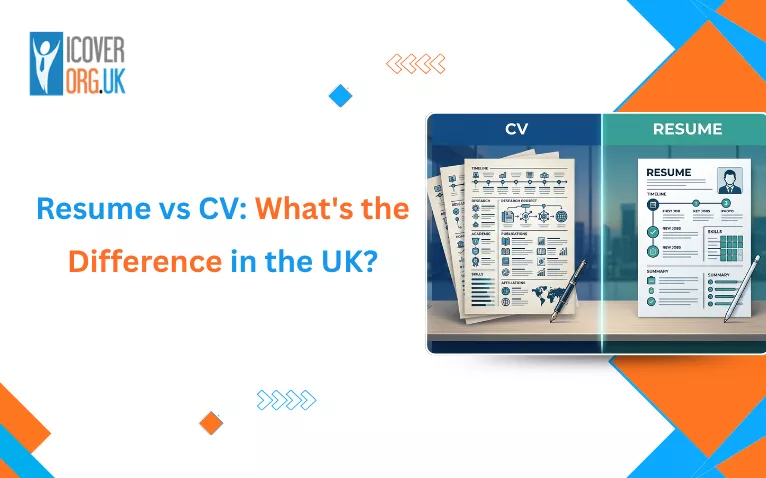
If you’ve ever wondered about the difference between a resume vs CV in the UK, you’re not alone. It’s easy to get confused, particularly when changing countries. In the UK, the term CV is used for almost all job applications. The word resume is rarely heard. But in the US, the same document is known as a resume, while CV means something completely different.
In the UK, 99% of job postings specify a “CV,” while in the US, “resume” is the standard term for non-academic roles, appearing in 95% of job descriptions. Knowing when and how to use each term might help you land your dream job.
Key Takeaways on the Difference Between a Resume and a CV
- In the UK, CV is the term. “Resume” is rarely used.
- In the US, the CV is called a resume. “CV” is only used for academic jobs.
- A UK CV is usually one or two pages long and is job-specific.
- Photos are not included in a UK CV unless requested.
- In the UK, always submit a CV even if the employer is American.
What Do "CV" and "Resume" Actually Mean?
CV is an abbreviation for curriculum vitae, the Latin term for “the course of one’s life”. It’s a document that outlines your academic and work experience, skills, and accomplishments.
A resume is derived from the French word résumé, which means “to summarise”. It refers to a short and targeted document summarising your relevant experience for a job. Both words are used in the UK. But only one is widely used.
Is a CV the Same as a Resume in the UK?
Yes. A CV is a resume in the UK. The term “resume” is simply not common here. If a UK employer asks for your CV, they are asking for your resume.
Why the UK Uses “CV” Instead of “Resume”
The UK uses the Latin word curriculum vitae to describe a document used for job applications. It is the preferred term in the workplace and academia. “Resume” is perceived as an American word and is not used in the UK. This confusion can be avoided by hiring CV writing services.
Is “Resume” Ever Used in the UK?
Rarely. Sometimes those who have come back from America or are applying at international companies will use it. However, it is always better to refer to the document as a CV when applying for work within the UK.
CV vs Resume: Key Differences at a Glance
The difference between CV and resume depends largely on which country you’re applying to. Here’s a quick comparison:

The CV of the UK and the resume of the USA serve similar purposes. The only CV and resume difference UK lies in the names used to refer to each other and small differences in formats.
How Resume vs CV Differ Around the World?
The CV vs resume debate looks very different depending on where you are. Here’s how the terminology breaks down globally.
UK, Ireland, and Europe: CV Is the Standard
In the UK, Ireland, most European countries, and New Zealand, “CV” is the correct terminology. This means a brief document that is customised to suit a specific purpose, usually the UK CV length 2 pages long. The structure of a UK is fairly straightforward: contact information, personal statement, experience, education, skills, and additional sections, where applicable.
USA and Canada: Resume for Jobs, CV for Academia
A resume is what US and Canadian citizens use in most cases when applying for jobs. It is normally one page long for young people who are just starting their careers. In those countries, the term “CV” is applied to academic, research, and medical jobs. A US CV is a much more elaborate document that has no maximum length restriction; it includes publications, grants, teaching experience, and presentations at conferences.
This is where the resume vs CV UK confusion often starts. What Americans call a CV, UK applicants would call an academic CV. What Americans call a resume, UK applicants would simply call a CV. The professional career services will make sure they manage your application well.
Australia, India, and South Africa: Used Interchangeably
In Australia, South Africa, and India, both are used interchangeably and have the same meaning. In these countries, there is nothing different about a CV from a resume. However, “CV” can be used more frequently in white-collar jobs, whereas “resume” may be more prevalent in blue-collar work advertisements.
What Is an Academic CV and How Is It Different?
An academic CV is a different document altogether. It is not a two-page summary. It is a full and ongoing record of a person’s academic career, and it can run to many pages.
Sections Unique to an Academic CV
A standard job application CV would not include any of the following. An academic CV typically does:

When to Use an Academic CV in the UK?
The academic CV must be used while applying for a job in a university or a research institute, or in any case where the academic work of the candidate matters. The heading of the CV must be written as “Curriculum Vitae” in both cases, irrespective of whether you are applying to the UK or the US.
In case you are not sure which type of CV editing service would suit a certain job, refer to the job description provided by the employer.
Does the UK Use Resumes or CVs for Graduate Jobs?
CV is the standard requirement when applying to graduate-level jobs in the United Kingdom. For example, even if a position is in a US-based corporation with UK operations, the hiring manager from the UK side will require a CV.
UK graduate CV should not exceed one page in length and should highlight information related to educational background, placements or internships, skills gained, and extra-curricular involvement that reflects leadership qualities.
When job hunting, some websites might use the term “resume,” especially if a multinational organization is listed in more than one country. However, in the case of UK positions, this term should be interpreted as a CV.
UK CV Format: What Should It Include?
The UK CV format follows a fairly consistent structure. Here’s what to include:
- Contact details- name, phone number, email, LinkedIn URL
- Personal statement– a short paragraph summarising who you are and what you offer
- Work experience- in reverse chronological order (most recent first)
- Education- degrees, A-levels, GCSEs if relevant
- Skills- both technical and soft skills
- Optional sections- hobbies, volunteer work, certifications, languages
Should a UK CV Have an Objective or Personal Statement?
Yes. Your UK style CV must include a personal statement, which comes close to the beginning of your CV and summarises your professional experience and career aspirations. It is advisable that you keep this section concise and limited to three to five lines.
A US resume often uses a “resume summary” or “resume objective” in a similar position. The content is roughly the same, though the wording differs slightly.
Do UK CVs Include a Photo?
No. In the UK, adding an image to your CV is not mandatory. Employers will most likely prefer not to have your photograph in the CV, as it may lead to unintentional discrimination.
This is one of the more notable UK CV photo rules to be aware of if you’re coming from a country where photos are common, such as Germany or Spain, where a professional headshot is often expected.
Is a UK CV One Page or Two?
It depends on your experience.
- As a general guide: Entry level (students and graduates): CV with no experience should be one page.
- Mid-career: Two pages is average.
- Experienced candidates: two pages, unless for an academic or technical position.
In the UK, CVs of three pages or more will be ignored. Keep it concise. Every word should count.
Are American Resumes Accepted in the UK?
Technically, yes. But in reality, a US resume may hinder you if it doesn’t align with UK standards. An American resume UK looks very different from what UK employers are familiar with. A one-page resume with American bullet points and an objective may be questioned.
What UK employers expect vs what a US resume looks like. There are a couple of stylistic differences between CV UK vs US:
- US resumes tend to be one page.
- UK CVs allow two. US resumes rarely have a personal statement.
- UK CVs always have a personal statement.
- US resumes may include an “objective” statement. UK CVs do have a personal profile.
- US resumes may have an address. UK CVs just include a postcode.
- UK CVs list education first in many variations. US resumes vary by industry.
How to Convert an American Resume for UK Job Applications?
When applying for a UK job with an American resume, make these changes to CV for jobs in America from UK:

Can I Use My UK CV to Apply for US Jobs?
Yes, but you may need to make changes. When you send a UK CV to a US employer, it may look different, especially if the CV is two pages long or has a personal statement format that US recruiters might not expect.
Differences in length, format, and style to watch out for
The key changes to make when applying for US jobs from the UK are:
- Reduce the length to one page if you have less than ten years’ experience
- Substitute a resume summary for a personal statement
- Use American English spelling
- Don’t mention A-levels or GCSEs and use their US equivalents if you can. Rename it a “resume” in the filename and any accompanying email.
Should You Convert Your UK CV Into a US Resume?
Yes, if you’re applying for a role based in the US or with a US hiring team. Most American recruiters will expect a resume format. Following European CV format without adjustments may not disqualify you, but a tailored resume format will make a stronger first impression.
When Should You Use a CV or a Resume?
A simple rule: use the convention of the country you’re applying in. Here’s a quick breakdown:

CV or Resume UK
In the UK, use a CV. If a job advert asks for a resume, treat it as a CV. The content and format expected are the same.
Applying for UK jobs as an international candidate:
If you’re applying for UK jobs from abroad, make sure your document follows the CV format UK. Keep it to two pages, include a personal statement, and avoid adding a photo. A resume for a UK job application should look and feel like a standard UK CV, not a US-format document.
Quick Tips to Keep in Mind

Conclusion
The CV vs resume difference in the UK is mostly a matter of terminology. In the UK, a CV is the standard document for job applications. The word “resume” is rarely used, and when it appears on job adverts, it means exactly the same thing.
The real difference between a CV and a resume comes into play when you cross borders. US employers expect a resume. UK employers expect a CV. Academic roles in any country expect an academic CV, which is a significantly more detailed document.
Know your market, match the format, and tailor your content every time. That is the simplest way to stay on the right side of the CV vs resume difference, wherever you’re applying.
Frequently Asked Questions
Is a CV the same as a resume in the UK?
Yes. CV and resume mean the same thing in the UK. “CV” is the most common term. “Resume” is the American word and is not commonly used in the UK.
Do UK employers want a CV or a resume?
UK employers want a CV. Even if the job description asks for a “resume”, a UK CV is required, which is normally one or two pages, with a personal statement and chronological employment history.
How long should a UK CV be compared to a resume?
One to two-page CVs are standard in the UK. A US resume is one page, particularly for applicants with less than ten years of experience.
Do UK CVs include a photo?
No. It is not common practice to include a photo in a UK CV, and it is usually not recommended. Only use a photo if it’s requested.
Should I send a CV or a resume when applying for a UK job?
Always send a CV. Use the UK CV format: personal details, personal statement, employment, education, and skills. The maximum is two pages.
Can I use an American resume to apply for jobs in the UK?
Yes, but make changes. Include a personal statement, consider making it two pages long, spell words according to British English conventions, and remove anything that is not standard UK CV practice.
Does a UK CV need a personal statement or objective?
Yes. UK CVs have a personal statement. It should be 3-5 lines and placed at the top.
Is a CV more formal than a resume?
Not really, in the UK. They are both used for the same purpose and written in the same style. In the US, a CV (academic CV) is more detailed than a resume, and can look more official.
Do UK graduate jobs ask for a CV or a resume?
CVs are required for UK graduate jobs. Graduate CVs are normally one page long, and set out qualifications, experience and skills.
Should I convert my UK CV into a resume for US job applications?
Yes. Trim to one page, replace the personal statement with a resume summary, use American English spelling, and rename the document as a resume. Keeping two separate versions is the most practical approach.
How useful was this post?
Click on a star to rate it!
Average rating / 5. Vote count:
No votes so far! Be the first to rate this post.
We are sorry that this post was not useful for you!
Let us improve this post!
Tell us how we can improve this post?

Want To See My Profile — Click Here Jonathan
