Are you struggling to share your experience clearly in a competency-based interview? The STAR method will help you to convert your work history into an engaging interview response that will demonstrate your competencies, skills, achievements, and abilities.
It is especially relevant to behavioural and competency-based interview questions which are commonly used across the UK. Employers ask such questions to learn more about the candidate’s soft skills (e.g., teamwork, communication, problem-solving), leadership experiences, and behaviours in professional settings.
In this blog, we will discuss how to answer STAR method interview questions, what details to include in your responses, and what mistakes to avoid in your STAR interview answers. We will also provide examples of interview answers based on the STAR method. In addition, we will share advice on competency-based interview questions for graduates and cover the most common STAR interview questions for NHS and Civil Service interviews.
Key Takeaways: Essential Rules for STAR Method Interview Answers
- STAR stands for Situation, Task, Action, and Result.
- Use it to structure answers to competency-based and behavioural interview questions.
- Focus most on what you personally did and the outcome.
- Prepare a few flexible STAR method examples before your interview.
- Keep answers specific, relevant and natural rather than memorising a script.
- STAR can help with UK, NHS, and Civil Service interviews, depending on the role and question.
What Is the STAR Method in an Interview?
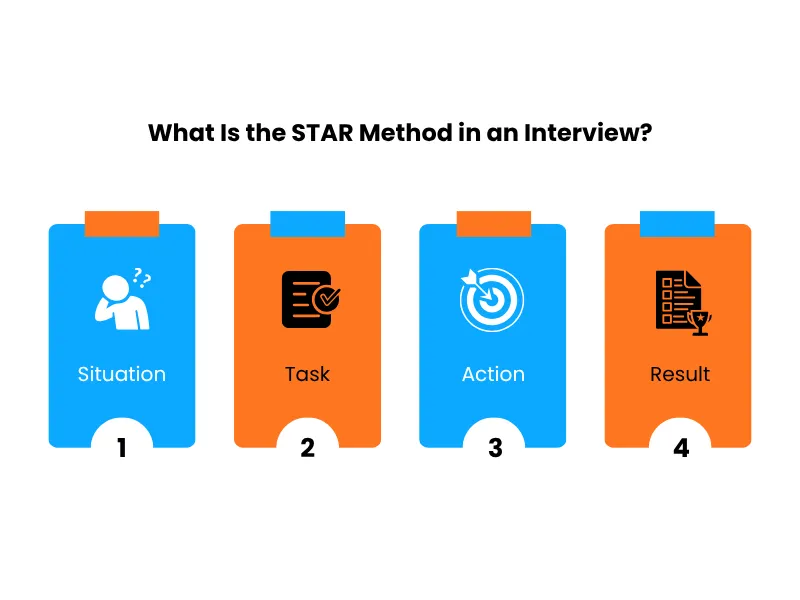
The STAR method is a way of answering competency-based interview questions and behavioural interview questions using an example from your experience.
Instead of giving a general statement like “I’m good at teamwork,” you explain a specific situation, what you were expected to do, the actions you took, and the outcome.
What does STAR stand for in an interview?
- Situation: Tell the interviewer what was going on so that they understand the circumstances in which you were operating. Give only the information relevant to the point you want to make.
- Task: What was your responsibility in this situation? What were you asked to do? What goal were you trying to reach, or what problem were you trying to solve?
- Action: What did you do about it? Demonstrate your skill here by explaining your actions, your decision-making process, and what skills you used. This is the bit that really demonstrates your ability to the interviewer.
- Result: What happened as a result of the action that you took? Did it have a positive impact? If so, what? Was there a measurable outcome? Did it save time or money, or did it generate positive feedback from customers or colleagues?
The STAR method shows rather than tells potential employers what you can offer. It is especially useful when a question starts with phrases such as “Tell me about a time…”, “Give me an example…”, or “Describe a situation where…”.
The STAR method helps you tell a story that lets the interviewer get to know you and helps them decide whether you are the best person for the job.
How Do I Use the STAR Method to Answer Questions in a UK Job Interview?
Start by identifying what the question is asking. A question about disagreements could test your communication skills or conflict management abilities, while a question about meeting a tight deadline could test your organisational or prioritisation skills.
Unlike strength-based interview questions, which focus on what energises you, behavioural questions test your past performance with concrete evidence.
Navigating Competency and Behavioural Questions in UK Behavioural Interviews
Once you identify the competency, learn how to answer competency questions using the STAR method:
1. Choose a Relevant Example
Choose a real-life example that is relevant to the question. Where did you get the example from? Your working life, an internship, university, or volunteering?
Don’t choose an example based on how impressive the outcome may be. Think about the evidence you will give for that example.
2. Set the Situation
Give the interviewer enough of a background so they can understand the setting, the problem, and the people involved if relevant.
Don’t give the interviewer too much information about what happened before the situation began.
3. Explain the Task
Clarify your part in the situation. What was your responsibility, and what made the task challenging?
Explaining your individual part in the task will give the interviewer an idea of your skills and decision-making by contrasting your approach with that of your team.
4. Describe Your Action
Describe what you did to solve the problem. Take the focus off the team and put it on your actions to solve the problem.
When answering behavioural interview questions, make sure to focus on what you did to show the interviewer how you would approach similar problems in the role. Instead of saying:
“We improved the process”
And go for:
“I analysed the process and found the points of friction. I suggested we invest in a new tracking system”
5. Give the Result
Describe the outcome of your actions. Try to quantify the result wherever possible, instead of generalised statements like “it all worked in the end”.
Possible results might be:
- A target being hit or exceeded
- A measurable improvement
- A deadline being met
- Positive feedback
- A problem being resolved
- A lesson that changed how you approached similar situations
A simple STAR formula
Question → Competency → Relevant example → Situation → Task → Action → Result
This approach keeps the answer focused while giving the interviewer enough evidence to assess your suitability for the role.
How Much Detail Should I Put into Each Part of a STAR Answer?
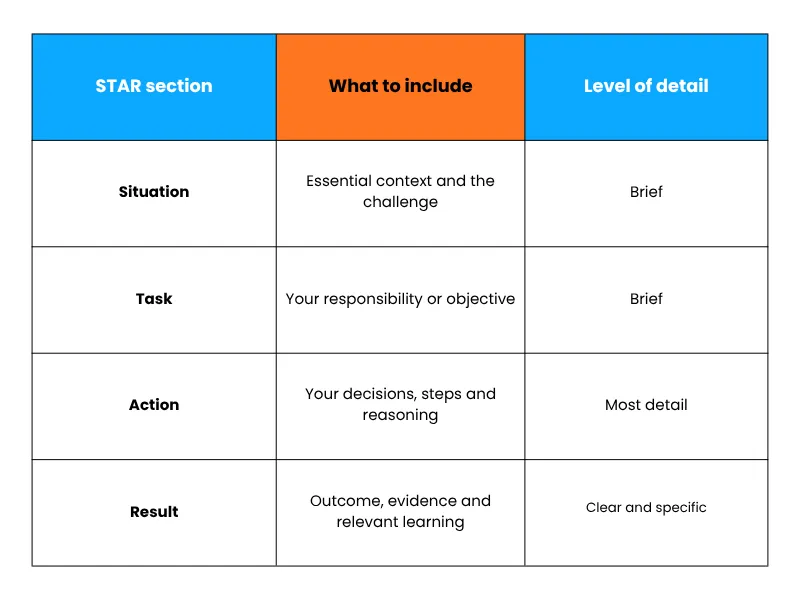
Not every part of a STAR answer needs equal attention. A common mistake is spending most of the response explaining the background and then rushing through what you actually did.
Situation: Keep the Context Short
Your interviewer is not interested in an elaborate expose on the organisation, project, or people involved. They need enough background information to put your story into context, but you need to get straight to the point about your own contribution.
Task: Make Your Responsibility Clear
Clarify what your personal role or responsibility was. Don’t assume that the interviewer knows what you were responsible for – tell them.
Action: Give the Strongest Evidence Here
You have reached the part of the interview where you demonstrate your skills by describing what you did and, where relevant, why.
Result: Show the Impact
Give the best possible evidence of the impact you made. Where relevant, give numbers – if numbers are inappropriate, give a successful outcome or positive feedback to illustrate what you achieved.
How Long Should a STAR Interview Answer Be?
There is no hard and fast rule about word counts. A well-structured answer will take about two minutes when spoken, but this will vary according to the question and example given.
Use timing as a guide, not a limit – one and a half minutes of relevant, concise response is better than three minutes of irrelevant, waffling background information.
STAR Method Examples for Common Competency-Based Interview Questions
When interviewers ask you to describe a time when you faced a specific challenge, the STAR format helps you stay concise and structured. These examples show how to structure answers using this method.
STAR Method Example Answer for Teamwork
Question: “Tell me about a time you worked effectively as part of a team.”
Situation: During a university project, team members disagreed on the presentation structure.
Task: I needed to help the team agree on an approach and meet the deadline.
Action: I combined useful ideas from both proposals, divided the work into sections, and created a shared schedule.
Result: We completed the project on time with a consistent presentation.
Skills demonstrated: Teamwork, communication, and organisation.
STAR Method Example for Problem-Solving
Question: “Tell me about a time you solved an unexpected problem.”
Situation: Customer enquiries were delayed because information was recorded in different places.
- Task: I needed to help streamline the process.
- Action: I identified duplicate entries and introduced a standardised tracking sheet.
- Result: Information became easier to find, and unnecessary duplication decreased.
- Skills demonstrated: Analysis, initiative, and problem-solving.
STAR Method Example for Leadership
Question: “Give me an example of when you demonstrated leadership.”
Situation: Several tasks remained unfinished before a university society event.
- Task: I needed to help the team complete essential arrangements.
- Action: I prioritised tasks, delegated responsibilities, and monitored progress.
- Result: We completed the arrangements on time, and the event proceeded as planned.
- Skills demonstrated: Leadership, delegation and prioritisation.
STAR Method Example for Working Under Pressure
Question: “Tell me about a time you had to work under pressure.”
Situation: Several urgent requests arrived while I was handling routine tasks.
- Task: I needed to manage the urgent work without missing other deadlines.
- Action: I prioritised tasks by urgency, communicated realistic timelines, and rescheduled lower-priority work.
- Result: I completed the urgent requests on time and met my remaining deadlines.
- Skills demonstrated: Time management, communication, and resilience.
Can You Give Me a Strong STAR Answer for "Tell Me About a Time You Dealt With a Difficult Colleague"?

Knowing how to effectively answer the conflict at work interview question helps you show emotional intelligence and professional maturity.
Question: “Tell me about a time you dealt with a difficult colleague.”
Situation: In a previous part-time role, I worked with a colleague who regularly provided information later than agreed, which meant I sometimes had to wait before completing my part of a shared task.
Task: I needed to address the issue without damaging our working relationship or letting the delays continue to affect the team’s work.
Action: Rather than raising the issue in front of the wider team, I spoke to my colleague privately. I explained how the delays were affecting the workflow and asked why they were having difficulty meeting the agreed times. I learned they were managing several competing tasks and weren’t sure which information was needed first. We agreed on a simpler handover process and set clearer deadlines for the information I needed.
Result: The handovers became more consistent, and the shared tasks were completed with fewer delays. The conversation also helped us establish a more effective working relationship.
Why this is a strong STAR answer:
- It focuses on behaviour, not personality. The candidate does not label the colleague as “difficult” or criticise them.
- It demonstrates personal action. The candidate explains exactly how they approached the issue.
- It shows judgement. Speaking privately and asking about the underlying problem demonstrates professionalism.
- It produces a practical result. The answer ends with an improvement rather than simply stating that the disagreement was resolved.
- It demonstrates transferable competencies. The example provides evidence of communication, teamwork, conflict management and problem-solving.
The strongest answer to this type of question is therefore not about proving that the other person was difficult. It is about showing how you handled a challenging working relationship constructively.
How Do I Use STAR for Questions About Failure, Mistakes, or Setbacks?
Use the STAR method to show how you responded to a mistake, not to hide the mistake itself. Choose a genuine example where you had some responsibility for the problem and could take action to improve the situation.
- Situation: Briefly explain what went wrong.
- Task: Clarify your responsibility in addressing it.
- Action: Explain how you identified the issue, corrected it, and communicated with anyone affected.
- Result: Describe the outcome and what you learned or changed afterwards.
For these questions, the Result can include a lesson or improvement rather than a perfect outcome. Avoid blaming colleagues, choosing a trivial mistake, or spending most of the answer defending yourself. The strongest answers show accountability, adaptability, problem-solving, and self-awareness.
I'm a Graduate with Little Work Experience. How Can I Still Use the STAR Method?

You can give strong STAR method interview answers without full-time work experience. Draw on university assignments, internships, volunteering, part-time jobs, or extracurricular activities.
Choose an example that matches the skill in the question. For example, a group project can show teamwork, while organising a student event can demonstrate leadership and planning.
So, if you are wondering how to use the STAR method with no work experience, focus on your own contribution and the outcome. Avoid claiming responsibility for work completed by others. Employers want to understand how you approach challenges, not just where you gained experience.
If you are preparing applications from scratch, our CV writing services can help your CV highlight these skills.
How Should I Prepare STAR Examples Before a Competency-Based Interview?
Prepare a bank of STAR method examples before your interview so you can respond confidently to different competency-based interview questions.
- Review the job advert: Identify the key skills and behaviours the employer expects.
- Select varied examples: Choose experiences that demonstrate teamwork, problem-solving, communication and adaptability.
- Record key details: Note the challenge, your responsibility, the actions you took and the outcome.
- Check relevance: Match each example to the competency it demonstrates.
- Practise adapting your examples: Use brief notes rather than memorising complete answers.
Prepare a few flexible examples, but make sure each answer directly addresses the question asked. A targeted cover letter can help connect your competencies to the job description, and our cover letter writing service can help you prepare one.
Do NHS and Civil Service Interviews Expect STAR Method Answers?
Yes, STAR is a useful approach for many NHS and Civil Service interviews in the UK. However, the questions and assessment criteria vary based on role, so you should check the relevant job advert and recruitment guidance.
When preparing your evidence, you can also cross-reference official details against Civil Service behaviours to ensure your workplace examples align with standard public sector guidelines.
STAR method civil service interview examples are:
STAR Method for NHS Interviews
NHS interviews may assess communication, teamwork, patient-centred care and alignment with NHS values. Use relevant examples from employment, placements, volunteering or education to show how you handled a situation and supported a positive outcome.
STAR Interview Technique for Civil Service Interviews
Civil Service interview questions may assess behaviours such as Working Together, Making Effective Decisions and Communicating and Influencing. Review the behaviours listed for the vacancy and prepare specific examples that demonstrate your contribution.
In both settings, focus on the skills or behaviours being assessed rather than relying on a generic answer. We understand that mastering interview frameworks is just one piece of the puzzle; comprehensive professional career services can support you at other stages of your job search.
Does the STAR Method Work for UK, US, and Australian Interviews?
Yes. You can use the STAR interview technique for competency-based and behavioural interviews in the UK, US, and Australia. While employers may use different terminology, the basic principle is similar: provide a relevant example, explain your contribution, and show the outcome.
The main difference is usually the competencies being assessed, not the STAR structure. For example, a UK employer may refer to competencies or behaviours, while a US employer may describe the process as a behavioural interview.
Before an interview, check the employer’s job description and interview guidance. Adapt your examples to the skills and assessment criteria for that specific role rather than using identical STAR answers across countries.
What's the Difference Between the STAR, STARR, and CAR Interview Techniques?
STAR, STARR, and CAR all help you organise examples for behavioural interview questions, but each framework emphasises something slightly different.
STAR vs STARR vs CAR at a glance
| Technique | Meaning | Key difference |
| STAR | Situation, Task, Action, Result | Explains the context, responsibility, actions, and outcome. |
| STARR Technique | Situation, Task, Action, Result, Reflection | Adds what you learned or what you would do differently. |
| CAR | Context (or Challenge), Action, Result | Combines the background and responsibility into a shorter structure. |
Use STAR for most competency-based interview questions. Choose STARR when learning and reflection are relevant, or CAR technique when a concise response suits the question. The best approach is the one that clearly demonstrates your skills and answers the interviewer’s question.
What Are the Most Common Mistakes People Make When Giving STAR Answers?
Even relevant STAR method examples can lose impact if the answer is unclear or unfocused.
Avoiding Over-Rehearsed STAR Responses and Other Common STAR Technique Mistakes
- Being vague: Describe a specific situation and the actions you personally took.
- Overusing “we”: Explain your contribution while acknowledging the team’s work.
- Blaming others: Show how you handled difficulties professionally.
- Making unsupported claims: Give a truthful result, using measurable evidence where available.
- Ignoring the question: Choose an example that directly demonstrates the competency being assessed.
- Sounding over-rehearsed: Practise your key points.
- Failing to reflect when relevant: If asked what you learned, explain how the experience influenced your approach.
Strong STAR method interview answers are specific, credible and focused on your contribution. Use the framework to make your evidence clear, not to force every experience into a rigid script.
STAR Method Template for Interview Preparation
A STAR method template helps you organise your examples into a clear structure before an interview. Use it to capture the key details of each experience without memorising your answers word for word.
STAR Method Template
| Section | What to include |
| Situation | Brief background explaining what was happening. |
| Task | Your responsibility or the challenge you needed to address. |
| Action | The specific steps you took and the decisions you made. |
| Result | The outcome of your actions and, where possible, measurable evidence of your impact. |
How to Effectively Use the STAR Technique in Prep Notes?
- Identify the competency: Note the skill your example demonstrates, such as teamwork, leadership, or problem-solving.
- Summarise the situation and task: Include only enough context to explain the challenge and your responsibility.
- Describe your actions: Record what you personally did and why you chose that approach.
- State the result: Explain what changed or what you achieved. Use figures only when they are accurate.
- Review your notes: Check that your example is relevant to the competency and that your individual contribution is clear.
Use brief notes rather than memorising a complete script. This makes it easier to adapt your STAR method interview answers to different questions.
Final Takeaway: Deliver Winning STAR Method Interview Answers
The STAR method provides a simple framework for structuring your answers to interview questions based on your experience. This approach works for graduate roles, where you’ll discuss academic projects, and for more senior positions, where you’ll give examples of your past work.
Practise developing a few flexible STAR examples and work on presenting them in a natural, conversational manner. Focus on adapting your response to the question, rather than learning a script by heart.
If you’d like more help, reach out to us and ask for feedback on your CV, interview answers, or general interview technique before your next interview.
Frequently Asked Questions
How many STAR examples should I prepare for an interview?
It is recommended to prepare a few flexible STAR examples that demonstrate different competencies (teamwork, problem-solving, leadership, communication, adaptability, etc.). You do not have to prepare an example for each question; one well-prepared example can often be adapted to more than one competency-based question, as long as you can genuinely relate it to the question asked.
Should I use “I” or “We” in a STAR interview answer?
You can use both, but ensure that most of your answer is focused on your contributions and decisions rather than the contributions and decisions of your colleagues. Use ‘I’ for your own actions, and use ‘we’ or colleagues’ roles when describing the team’s work.
Can one STAR example answer more than one interview question?
One STAR example can be used for multiple questions if the experience genuinely shows more than one competency. Adjust which details you emphasise to fit each question.
What should I do if the interviewer interrupts my STAR answer?
If the interviewer asks a clarifying question, take a breath, acknowledge their question, and answer it honestly. Interviewers often ask follow-up questions, so be ready to explain any part of your example in more detail. Because you know the full story behind your example, you can expand on any part when asked, without relying on a script.
Can I use a hypothetical example in a STAR interview answer?
Competency-based questions are designed to assess past performance, so using a hypothetical example is risky. If you have no relevant or impressive STAR example, it is better to be honest than to make one up. If you lack a direct example, use the closest genuine experience and explain what you would apply from it. While STAR focuses on past evidence, candidates may also face scenario-based interview questions that require them to apply past performance to a hypothetical future workplace challenge.
How useful was this post?
Click on a star to rate it!
Average rating / 5. Vote count:
No votes so far! Be the first to rate this post.
We are sorry that this post was not useful for you!
Let us improve this post!
Tell us how we can improve this post?

Want To See My Profile — Click Here Jonathan
- Creative CV Template: When a Designed CV Helps and When It Costs You the Interview - November 5, 2026
- STAR Method Interview Answers: Framework, Examples, and Common Mistakes - October 10, 2026
- What Is Your Greatest Achievement? — How To Choose and Structure Your Answer - October 7, 2026