
UK Job Hunting is nothing less than fighting an uphill battle. The unemployment rate reached 5.2% at the end of last year, which is a five-year high of 1.88 million individuals seeking employment.
In this tough, competitive field, how to find a job fast in UK is the most critical concern. Plus, a high economic inactivity rate of 20.8% and poor market activity have positioned multitudes of candidates in limbo. But don’t worry! This guide will give you a specific plan to land a job faster, no matter what situation you are in. So, keep reading!
Key Takeaways
- Before applying, identify your desired type of employment, industry, level of experience, work setting, and culture in the company.
- When you are inexperienced, internships are a way to acquire skills, build a network, and frequently result in full-time positions.
- Use websites such as Indeed, LinkedIn, Reed, and Monster to explore and filter open opportunities.
- Customise your CV and cover letter, quantify achievements, optimise for ATS, and proofread carefully.
- Network with recruiters, visit job fairs, find referrals, and monitor applications to enhance follow-ups and success rate.
How to Find a New Job Fast in England? A Guide for Job Changers
If you are already employed and looking for a job change or want to try a completely different role, here’s how to find a new job fast while working or after being redundant in the UK:
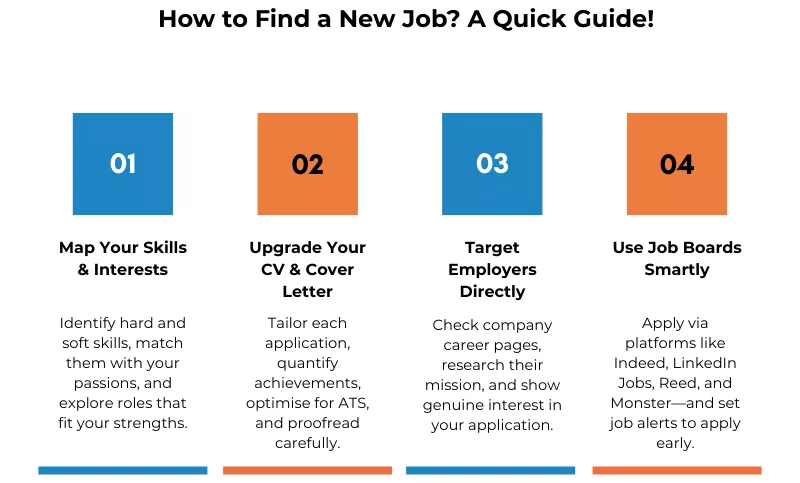
1. Map Your Strengths & Transferable Skills to Explore Career Options
First, map your strengths. Begin by identifying your talents to narrow down on appropriate jobs. It helps to divide these into “hard” and “soft” categories to see your full potential.
| Skill Type | Definition | Real-World Examples |
| Hard Skills | These are technical skills acquired through training. They offer measurable proof of your expertise. |
|
| Soft Skills | These focus on your character and interactions. They are valuable in every industry. |
|
Then, consider what you are really passionate about. Hobbies are often a pointer to a sustainable career. Your natural enthusiasm is a major asset to any employer. Consider these combinations:
- The Creative Organiser: Like planning social events? Are you a good communicator? Then consider getting jobs in hospitality management or PR.
- The Problem-Solver, Technical: Do you enjoy working with devices and have a logical mind? You can apply for a cybersecurity or a hardware repair job.
By pausing to examine these qualities, you are bound to end up with jobs that you will excel in.
2. Update Your CV & Cover Letter
Once you have mapped your strengths, it is time to create or revise your CV. This document tracks your history, while your cover letter tells your story. It is your best chance to show personality and prove you are the right fit. Use these tips to stand out:
- Tailor Every Application: Never use a generic template. Mention the company by name and show you understand their mission. Update your CV according to the expectations detailed in the job adverts.
- Remove Mistakes: Proofread your CV and cover letter, and check for existing errors and tone mismatch. Further refinement through grammatical mistakes, format issues, and section placement is always recommended. Also, try to address a career gap in the CV if it exists.
- Quantify Your Wins: Prove your worth with numbers. Mention what experience you gained in the last company. For example: “managed 20 people” or “cut costs by 5%.”
- Be Specific: Swap vague terms like “team player” for real examples. Write about a certain incident when you overcame an obstacle.
- Optimise for Tech: ATS (Application Tracking Software) is actively used by many UK firms to scan CVs. The way to pass these filters is to write an ATS Friendly CV by including some of the keywords used in the job description.
- Strong Closures: End with a confident, polite line. Thank the recruiter for their time and state your interest in an interview.
Professional CV writing services can provide expert advice for job seekers who are stuck. They make sure that your application is convincing and refined to the prevailing market.
3. Consider Your Special Needs
You should be aware of what you want before you apply to each vacancy. This will help avoid search burnout and will also raise your success rate. Here’s how to search for jobs that are perfect for you:
- Begin with your employment type. Are you more of a full-time or freelance person?
- Next, look at industry growth. Research sectors that align with your personal interests and future goals.
- You must also consider the level of experience. Are you looking for an entry-level role or a management path? For example, a graduate should aim for the positions of Juniors or Associates to gain a strong professional background.
- The work environment is equally important. Determine whether you work best in a team-oriented workplace or in a hybrid arrangement.
- Lastly, inquire about job culture and company values. Look at employee reviews of the target firms in portals such as Glassdoor.
A clear vision simply answers your doubt about “how to find a suitable job for me”. You can confidently apply for that job where you will truly excel.
4. Start Finding for Job Vacancies
In case you have a dream organisation, visit their official site to see job availability. This is the best way to find work. The majority of companies include a Careers page on which they post their recent vacancies.
Make sure to mention this research in your application to demonstrate your actual interest. It shows you value their specific mission over a generic role. This also shows you are a proactive candidate.
5. Apply Directly Through Job Boards
Job boards are a perfect option if you do not have a particular employer in mind. These digital marketplaces have thousands of vacancies in all industries and skill levels. They enable you to filter the results based on the location, salary, and remote work opportunities.
Top job sites in England to explore include:
- Indeed: This is an enormous database of the broadest range of local and national positions.
- LinkedIn Jobs: Best to network and to identify positions that fit your professional profile. Offers “Easy Apply” features for mobile users.
- Reed: Among the most popular ones, this is the best website to find a job when it comes to positions in the UK, in particular.
- Monster: Explore global opportunities and access helpful career planning tools.
To stay ahead, set up automated email alerts. Early applicants have a significant edge over other candidates.
6. Use Your Professional Network
Your professional network is a brilliant way to find a job. Start by talking to former colleagues and managers. They understand your skills well. You should also attend industry events in London or Manchester. Use LinkedIn to connect with recruiters in your field. Often, the best roles are not even advertised online. Referrals can help you bypass the initial screening. Offer to help others in exchange for advice.
How to Find a Job Fast UK with No Experience? Guide for First-timers
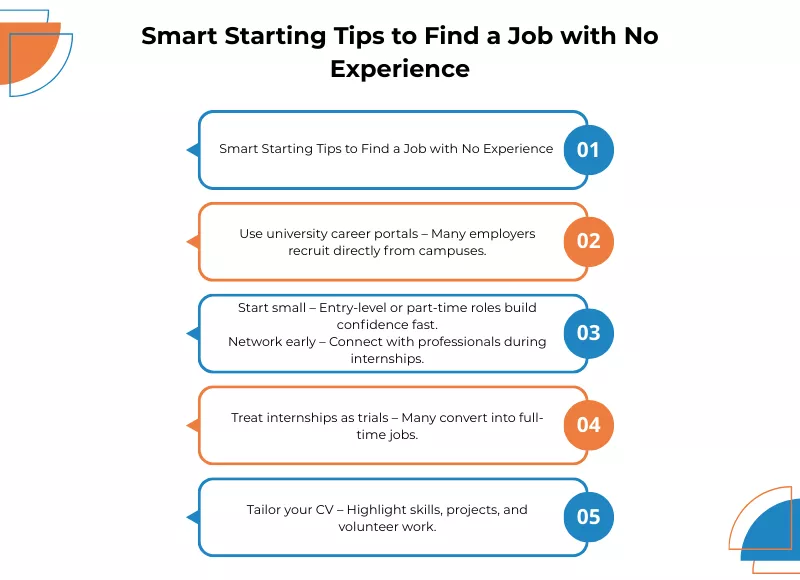
Have no experience? Don’t worry! Apply for internships. Internships allow you to build practical skills while filling gaps in your Graduate CV. Plus, you will get a rare chance to network with industry leaders.
In many cases, an excellent internship can be followed up by a full-time employment opportunity. This is the time to observe the company culture and understand day-to-day operations. Consider it a low-stress trial period during which you can demonstrate your professional value.
These roles allow you to get your confidence boosted prior to joining a high-stakes setting. Start small to build a foundation that employers will respect.
How to Find a Part Time Job Fast or Internships in the UK?
When you are a fresh graduate or just finishing college, you can consider finding part-time jobs or internships. One of the best ways is to look into the internal careers portal of your institution or the placement cells. Employers usually approach certain universities directly.
Apart from this, you can search for internships at these platforms:
| Where to find a job for non-experienced individuals? | Key Features and Specialisms |
| Internwise | Find paid internships and summer roles. It spans the London and the UK market at large. |
| RateMyPlacement | This site is dedicated to industrial placements. You can read student reviews for honest insights. |
| StudentJob UK | Find part-time flexible positions here. It also provides entry-level internships to students. |
| Milkround | This site has undergraduate programs. It is a top choice for structured career paths. |
| 10,000 Interns Foundation | This foundation creates equity in hiring. It helps Black and Disabled career seekers. |
| GetMyFirstJob | Begin your career through an apprenticeship. There are also numerous entry-level positions. |
| Otta | Explore roles at high-growth tech startups. Their descriptions are clear and free of jargon. |
Also, before applying for internships, make sure you know how to write a CV with No Experience or an unskilled CV.
How to Find Jobs that Fit Your Qualifications?
Wondering “how to find a good job for me?” First, make sure the job hunt is aligned with your qualifications. For example:
| If Your Qualification is | Then Go for these Suitable Job Roles |
| Computer Science | Software Developer, Data Analyst, IT Support |
| Marketing Degree | Digital Marketing Specialist, Social Media Manager, Brand Strategist |
| Accounting Background | Accountant, Financial Analyst, Audit Assistant |
Choosing roles that match your qualifications can improve your chances of getting hired and performing well in the position. It also helps you build relevant experience and grow faster in your chosen career path.
How to Find Jobs Online? Important Tips
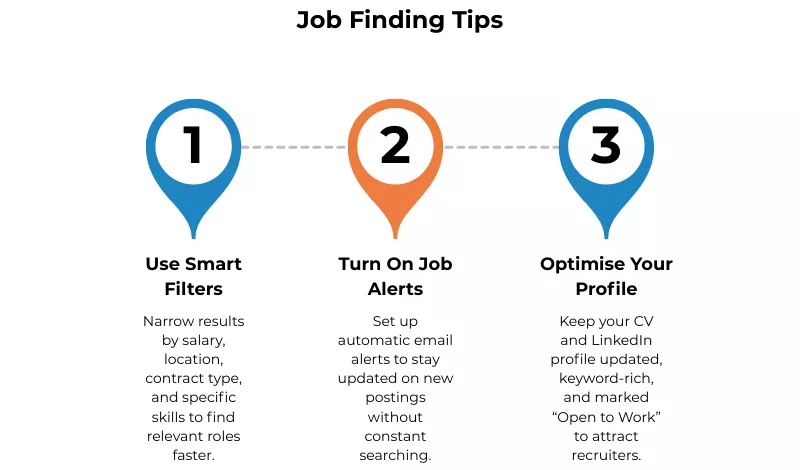
When submitting job applications using job boards, ensure that you are doing the following:
1. Search Jobs by Filter
The best way to find a job online is to narrow the search results with the use of filters. Target particular salary scales, localities, and types of contracts. This will save time and ensure that you remain focused on the pertinent roles. Try searching by technical skills instead of broad job titles to find niche opportunities.
2. Turn on Automatic Email Alerts
Do not visit job boards every hour. Rather, you can subscribe to automatic email notifications of your important search terms. This will simplify your search of a job while keeping you informed of new vacancies.
3. Keep Your Job Board Profile Fully Updated
Your online profile acts as a digital resume. For example, your LinkedIn profile is often the first thing a recruiter checks. In fact, some recruiters headhunt talent before they even post an ad. So, keep your LinkedIn open to work badge activated to send the signal.
Or, they will definitely check if your CV gets shortlisted for further review.
Therefore, ensure your latest skills and contact details are correct. It must be polished and keyword-rich to attract the right attention. A complete profile significantly improves your ranking in search results.
If your page lacks impact, a professional LinkedIn Profile Writing service can help. They ensure your headline and summary truly reflect your professional value.
How to Find a Job When Struggling?
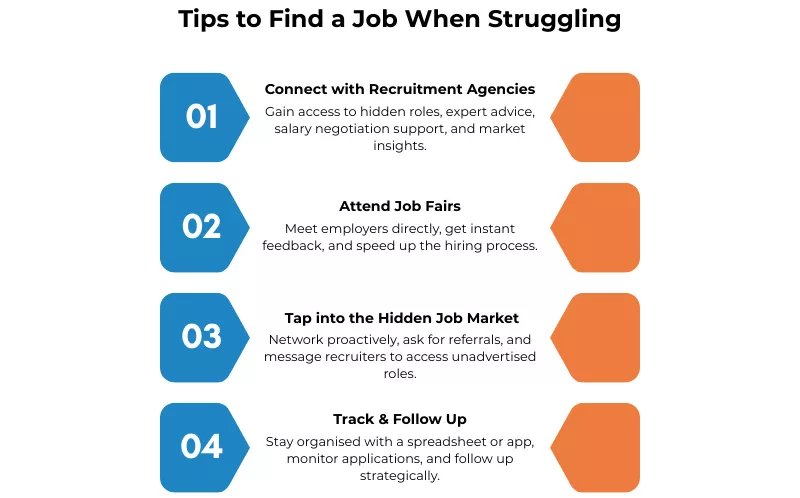
Wondering how to find a job fast after being fired? Getting a termination notice out of the blue or a layoff email may leave you in panic.
But life challenges can occur with no prior notice. The same level of stress is also faced by those who experience several months of joblessness even after submitting hundreds of applications. Others have to quit their present job and move elsewhere due to personal reasons.
In such challenging circumstances, people start thinking “what if i can’t find a job?”. This also brings about a pressing necessity to have financial stability. You naturally begin to wonder how to find a job fast to secure your future. In this case, these are what you need to do.
1. Connect with Recruitment Agencies and Word of Mouth
Recruitment agencies are the intermediaries between job applicants and the firms. They often manage “hidden” roles that never reach public boards. Working with a firm that offers professional career services gives you a major advantage in your search.
- Exclusive Vacancies: Early access to positions prior to advertising.
- Professional Advice: Professional career search advice and review of your CV and interview.
- Negotiation Assistance: Professional assistance in getting the optimal salary.
- Market Insights: Instantaneous information about the employment patterns in your industry.
To achieve the most positive outcome, it is better to select an agency specialising in your industry. These recruiters have direct connections to the hiring managers, and they can be your application advocates. This personal advocacy will make you stand out in a saturated market. It makes sure that your CV gets to the right person at the right time.
2. Work on Your Weaker Skills
Being terminated is a major challenge. Use this time to grow. Identify the specific skills that held you back. Take a fast online course to fill those gaps. Focus on technical tools or professional soft skills. This effort shows recruiters that you take action. Quick certifications will speed up your job search. Explain your development during your next interview. Honest growth makes you a strong candidate. You will find work soon.
3. Go to Job Fairs or Job Expos
Wondering “how can I find a job quickly”? Job fairs are fast-paced hiring gatherings wherein a large number of employers meet job seekers. Rather than emailing and waiting to receive a response, you talk to the recruiters directly to get immediate feedback.
These events help to speed up your search, as dozens of companies are gathered in a single room. It is possible to visit multiple options within an afternoon. This personal interaction usually results in quicker hiring processes.
4. Explore the Hidden Job Market
Another good way to search for jobs quickly is to explore the hidden job market. This includes roles filled through referrals and word-of-mouth. Such jobs are fast-tracked as they do not go through the public application process. You have to get into this market in case you have to get a position urgently. It bypasses the crowd and puts you directly in front of hiring managers.
In seeking such unadvertised opportunities, attention should be paid to the following approaches:
- Network Proactively: Ask your professional contacts for job search tips and tell them you are looking for immediate openings. You can also attend industry events and webinars to meet key decision-makers.
- Ask for Referrals: Inform your acquaintances that you are looking for work. Ask if they know of any openings that suit your character and abilities.
- Directly Message Recruiters: Independent HRs often manage unadvertised vacancies for high-growth firms. They often have an urgent need to fill these positions ahead of schedule. How to find a job recruiter? You can easily reach out to them directly through LinkedIn or other social media like Facebook.
Note: When you reach out to these experts, your application materials must be persuasive. Using professional CV & cover letter writing services ensures your pitch is polished for these unique, high-stakes opportunities.
5. Keep a Track for Better Follow-Ups
Staying organised during your job search reduces stress and helps you follow up with recruiters effectively. To do this, first choose a tracking method that fits your personal workflow:
- Spreadsheets: Use Excel or Google Sheets for a simple, data-heavy list.
- Visual Tools: Try Trello or Notion to move applications through various stages.
- Dedicated Apps: Use specialised job trackers for mobile updates on the go.
Next, be sure to record these essential details for every application:
- Company and Role: This prevents you from applying to the same firm twice.
- Date Applied: Use this to time your follow-up emails perfectly.
- Application Status: Track whether a role is submitted, under review, or closed.
- Job Description Text: Always save a copy, as online listings often expire before the interview.
- Contact Information: Keep hiring manager names and emails for direct networking and thank-you notes.
An organised log allows you to evaluate your progress objectively. This data-driven approach keeps your search focused and productive.
Tips for Standing Out in an Interview
Standing out in an interview is the best way to get hired fast. This applies to career changers and new graduates alike. Follow these simple tips to impress any recruiter:
- Research the Firm: Learn about their latest projects and core values.
- Highlight Soft Skills: Focus on your ability to learn quickly and solve problems.
- Prepare Your Pitch: Explain why you are the best fit for the role.
- Stay Positive: Focus on your future goals instead of past career struggles.
- Ask Questions: Inquire about team objectives to show your real interest.
A confident attitude always makes a lasting impression. Remember to send a follow-up email after the meeting ends. These small steps prove you are a professional candidate.
Wrapping Up
The concern for “how to find a job uk” is legitimate as the current market is competitive. But this is not impossible. Use the job search advice mentioned in this blog to stay ahead of the competition. Focus on your strengths and keep every application tailored. Whether you use recruitment agencies or the hidden market, consistency is vital. Stay organised, remain proactive, and track your progress daily. With a professional approach, you will secure your next role soon. Start your search today!
Frequently Asked Questions
What’s the best site for finding a job?
Indeed remains one of the best job search sites in uk. Its massive database makes it a top choice for any search. For professional or specialised roles, consider platforms like Reed and LinkedIn. CV-Library is also a strong contender for broad career searches. Using a mix of these sites ensures you never miss a new opening.
How to find a job abroad?
Finding work abroad requires careful research. You must tailor your CV to meet local standards for each country. Use international boards and LinkedIn to find global roles. Securing a visa sponsorship is the best way of getting a job abroad. Target companies with global offices that support relocation. Use resources like EURES for opportunities in Europe. Working holiday visas are also a good option for many.
What months are the hardest to find a job?
The most challenging months for uk job hunting are typically November, December, July, and August. Hiring activity tends to slow down during these periods due to the holiday season, summer breaks, and companies finalising their annual budgets.
Which jobs are in shortage in the UK?
As of early 2026, the UK is still experiencing significant labour shortages across key sectors — particularly in healthcare (e.g., nurses and care workers), engineering, IT and tech-related roles, and various skilled trades, with a very large number of job openings still going unfilled.
How to find a job in a bank in the UK?
Getting a job in a UK bank takes focusing on building relevant skills, networking, and applying via official career portals or specialist agencies. Entry routes include graduate programs, apprenticeships, or entry-level roles (e.g., contact centers). The process involves online applications, aptitude tests, interviews, and strict background checks (credit, criminal, identity).
How useful was this post?
Click on a star to rate it!
Average rating / 5. Vote count:
No votes so far! Be the first to rate this post.
We are sorry that this post was not useful for you!
Let us improve this post!
Tell us how we can improve this post?

Want To See My Profile — Click Here Elise
- Skills-Based Hiring in the UK: How to Get Hired Without a Degree (2026 Guide) - March 28, 2026
- How to Find a Job Fast in UK? A Search Guide and Finding Tips - March 14, 2026
- Listing Hobbies and Interests for CV in 2026 | What to Include and Avoid? - December 6, 2025
